
The Agentic Integration Platform
Declare your Agent Capability
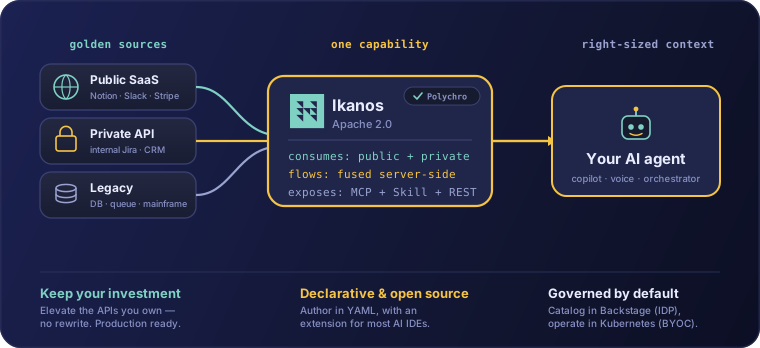
Agents need custom MCP shaped to their job, not API mirrors or glue code nobody reviews. Give security a YAML spec to approve before attaching credentials.
Our top use case
Context Engineering
Whether to shape an agent's context is settled. What's still open is whether a human approved the shape. Imperative approaches decide at runtime — in an optimizer, a retrieval index, a generated program — and leave no artifact behind. A declaration decides once, in a file: the tools the agent sees, the fields that come back, and the credential authorizing exactly those.
Everyone else shrinks the context. We make most of it unnecessary.
Decided once, in a file
The tools, the fields, and the upstream operations behind them — fixed at authoring time, not improvised per turn.
Approved before it runs
You can audit what happened with any approach. Only a declaration lets you approve what could happen, before the credential is attached.
Written by an agent, read by a human
The agent may well have drafted the spec. What matters is that a human saw it in between.
What changes with a capability spec

Velocity
Before: Developers do archaeology. Specs drift from reality, and the agent's context degrades as tool lists grow.
After: Three round-trips collapse into one call. One capability is authored once and serves MCP, Skills, and REST from the same spec.

Approval
Before: Nobody can say what an agent is able to reach before the credential is attached. Shadow gateways and shadow MCP widen the surface, and identity across agent chains is unclear.
After: The whole capability is in a file security can read first — operations reachable, fields returned, credential scope. Approved before it runs, not audited after.

Cost
Before: Teams rebuild what already exists because reuse is invisible, and every turn re-sends a tool catalog nobody curated.
After: A task-shaped capability never had a catalog to re-send. Caching removes upstream calls, not just tokens.
Compose one capability from internal and external APIs.
A doc-review agent needs three tools from three systems. Partners publish source capabilities; your teams compose them into applied capabilities shaped to the task.
Keep your runtime. Replace the unreviewed glue code with a spec. When the MCP transport revises, it's an engine bump — the capability spec is unchanged, whoever published it.
Subscribe to the Naftiko Manifest
What we ship, what we're deciding next, and where Design, Service, and Ecosystem Partners can shape it — while Naftiko is still in beta.