
The Agentic Integration Platform
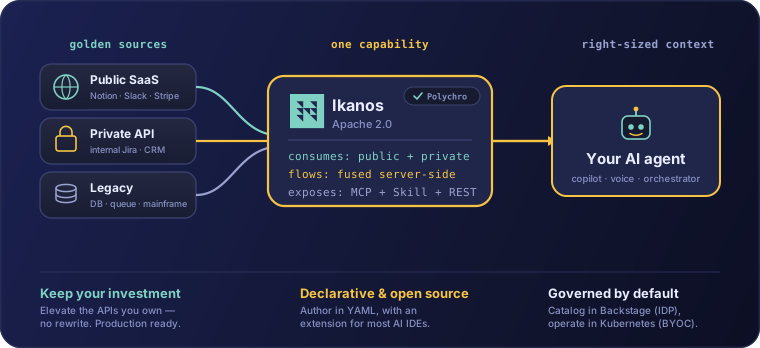
Your agent's context becomes a capability spec — versioned, linted, and reviewable — served as MCP and Skills from APIs you already own. One declarative spec, two Apache 2.0 engines (Ikanos + Polychro), and the enterprise components that carry them onto the surfaces your teams already use.
Land in the Shipyard
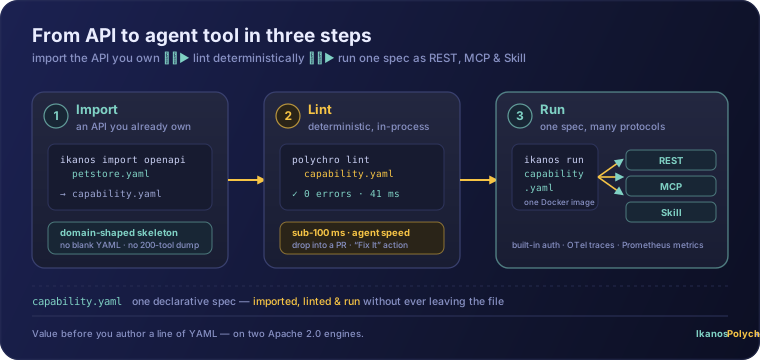
From API to agent context in three steps
This is the core loop the Platform is built around — a complete, production-ready path on the two Apache 2.0 engines, Ikanos and Polychro. One declarative capability.yaml is imported, linted, and served without ever leaving the file. Value before you author a line of YAML.
1
Import
ikanos import openapi petstore.yaml
Turn an API you already own into a skeleton capability. Aggregate several upstream calls into one domain-shaped capability — not a 200-tool endpoint dump. No blank YAML file.
2
Lint
polychro lint capability.yaml
Validate deterministically with Polychro, in-process, sub-100 ms — at the speed an agent generates it. Drop it in a PR with the "Fix It" GitHub Action.
3
Serve
ikanos serve capability.yaml
Serve it with Ikanos as MCP, Skill, and REST from the same spec (plus a Control port for ops). One Docker image, built-in auth, OTel traces + Prometheus metrics.
Two engines, three components, one spec
The Agentic Integration Platform is tied together by Spec-Driven Integration (SDI) — a single declarative YAML spec, authored once, that turns an API into the context an agent can trust. SaaS partners publish source capabilities over their APIs; your teams compose them into applied capabilities shaped to the task. Two open-source engines do the work. Three enterprise components carry the same reviewed spec, with its governance intact, onto the surfaces your teams already use.
The open-source engines

Ikanos
Capability Engine
The OSS capability engine. Serves a Naftiko spec as a multi-protocol server — MCP, Skill, and REST from the same definition. Apache 2.0.

Polychro
Specs Linting
The OSS deterministic AI-era linter for Ikanos YAML capabilities and related YAML, JSON, and Markdown specs. The new Spectral for SDI. Apache 2.0.
The enterprise components
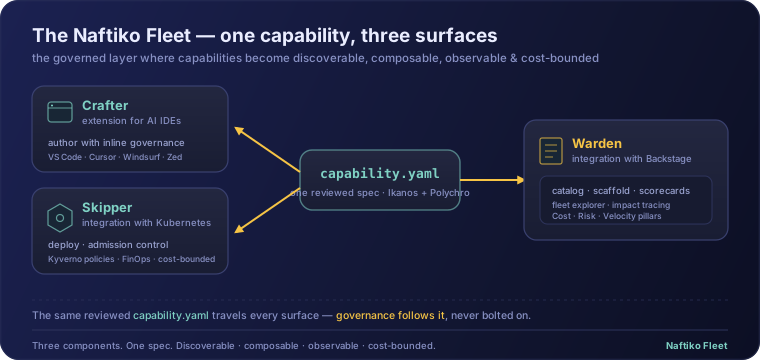

VS Code Extension
Schema-driven completion for capability YAML, live Polychro diagnostics as you type, and custom rulesets alongside the built-in rules.

Backstage Integration
Scaffold a capability from a Backstage template, register it and its provided API in the catalog, and keep that API in sync from Git.

Kubernetes Integration
A Capability CRD reconciled into a running workload, with spec drift detection, stop/restart, GitOps deployment, and Prometheus observability.
Four properties they give every capability

Discoverable
Humans and agents can find what exists before rebuilding. Intent and semantic discovery, not just filters and keywords. Reduce human-router dependency for ownership, changes, and onboarding.

Policy-driven
Security, compliance, and ownership are enforceable. Blocking and advisory rules at validation, CI gates, and Kubernetes admission. Governance as enablement, not a gate.

Composable
Capabilities assemble into MCP servers, copilots, and agent workflows. Right-sized units with clearer contracts. Domain-driven abstraction layers through capability composition.

Observable + cost-bounded
Telemetry, attribution, and guardrails are built-in. Cost-center labeling, FinOps tagging, Kubecost integration. Budget-aware execution with thresholds and alerts.
One capability, many protocols
A single Naftiko spec is exposed simultaneously across MCP, Skill, and REST — and soon A2A — from one Ikanos deployment. The agent-facing surfaces come first, because the spec is the context.
MCP
Tools, resources, and prompts for AI copilots and agents via streamable HTTP or stdio.
Agent Skills
Downloadable skill folders with SKILL.md prompt integration for developer agents.
REST
Clean REST endpoints with per-operation path, method, and parameter mapping.
A2A
Roadmap
Google's Agent-to-Agent protocol for cross-agent tool discovery and execution. On the roadmap — not yet shipped.



Subscribe to the Naftiko Manifest
What we ship, what we're deciding next, and where Design, Service, and Ecosystem Partners can shape it — while Naftiko is still in beta.