
Enterprise integration has spent the last decade accreting boilerplate, drift, and duplication around APIs that were never designed for the AI era. The 2025–2026 wave of MCPs, copilots, and agents has only sharpened the problem: the surface area that humans and machines now consume is bigger, fragmented across vendors, and impossible to govern from any one console. Naftiko’s answer is a single specification — declared once in YAML, validated continuously, executed deterministically — and an open-source Fleet of components that share that specification end to end. This week, Naftiko opens Shipyard as the public front door for that Fleet, and locks in the canonical names for the components behind it.
What Is Shipyard
Naftiko Shipyard is the documentation hub for the entire Naftiko Fleet — and the first place a new reader, a design-partner engineer, or an enterprise architect lands when they want to understand what Naftiko actually does. Shipyard lands visitors on the Spec-Driven Integration (SDI) thesis, walks them through the six components of the Fleet, and routes them into the right tutorial track depending on the pain that brought them in.
Behind Shipyard sits a clean three-part monorepo:
- shipyard-front — the landing experience (React/Vite).
- shipyard-docs — the canonical documentation tree under
docs/ikanos,docs/polychro,docs/crafter,docs/warden,docs/skipper,docs/concepts,docs/tutorials, anddocs/fleet. - deployment — the Cloudflare-backed deployment layer.
Two milestones are scoped to land before Beta 1 at end of June: a hosted Playground where visitors run a capability against a live Ikanos engine without installing anything, and an AI-assisted Ask Navi search across the whole docs corpus.
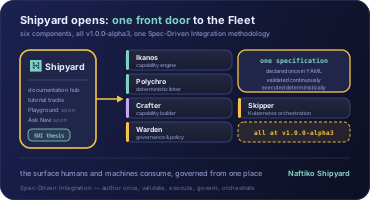
Six Components, All at v1.0.0-alpha3
The Fleet stopped using working titles this week. The canonical product family is now:
| Component | Purpose |
|---|---|
| Shipyard | Documentation hub — and soon a hosted Playground and AI-assisted Ask Navi search |
| Ikanos | The OSS capability engine — runs a Naftiko spec as a multi-protocol server |
| Polychro | The OSS deterministic AI-era linter for YAML, JSON, and Markdown specs |
| Crafter | The capability builder for VS Code and most AI IDEs — visual + spec-driven authoring |
| Warden | Capability governance and policy enforcement for Backstage |
| Skipper | Fleet-wide orchestration for Kubernetes, across teams, regions, and compliance domains |
The renames are not cosmetic. Each one sharpens the question the product answers and gives the open-source community the right name to reach for when it talks about each piece. Every component is at v1.0.0-alpha3.
Spec-Driven Integration — The Methodology Underneath
The methodology that ties Ikanos to Polychro to Crafter to Warden to Skipper is Spec-Driven Integration (SDI). SDI treats every integration as a declarative specification first: authored once, validated by a deterministic linter, executed by a deterministic engine, governed by deterministic policy, and orchestrated across the Fleet. Shipyard teaches SDI as the first concept a new reader encounters, and the entire documentation tree is organized around it.
Three Layered Editions
Three editions are now published on Shipyard:
- Community — Free forever for personal and internal business use; ships every component; Ikanos and Polychro fully Apache 2.0.
- Standard (planned) — Team-grade premium features for Shipyard, Crafter, Warden, and Skipper, under the Naftiko Commercial License.
- Enterprise (planned) — Governance and scale features for regulated environments.
The editions are layered, not exclusive — anything authored in Community runs unchanged in Standard or Enterprise. Capability YAML, rulesets, and policies are forward-compatible across editions. Ikanos and Polychro are committed to staying 100% Apache 2.0 in every edition.
Four Tutorial Tracks Mapped to Four Buyer Pains
Shipyard organizes its tutorials around the four pains the Fleet exists to solve:
- Track 1 — Context Engineering (published) — Design for MCP, then wire the APIs.
- Track 2 — API Reusability (next) — Turn old API investment into new experiences.
- Track 3 — Agent Orchestration (scoped) — Deterministic flows over non-deterministic models.
- Track 4 — Platform Operations (scoped) — Running the Fleet across teams and regions.
Each track answers one of the four pains: API sprawl, AI agents drifting, hallucinating, or breaking contracts, context fragmentation for AI tasks, and integration boilerplate. The tutorial-track-to-pain mapping is the cleanest pedagogical frame Naftiko has shipped to date.
What Comes Next
- Alpha 4 (mid-June 2026) — MCP trust propagation, API-gateway integration (CORS for developer portals, OpenTelemetry context propagation, mTLS client certificates, HTTP cache-control directives), and the first A2A server adapter with native Langchain4j integration.
- Beta 1 (end of June 2026) — Stable MVP target: interactive MCP Apps, server-side code-mode for MCP, client-SDK generation across TypeScript / Python / Java / Go, authorization via Open Policy Agent. The Shipyard Playground and Ask Navi search ride this same train.
- General Availability (September 2026) — Production-ready v1.0 across the Fleet.
The full plan is public: the Ikanos / Framework Roadmap and Fleet Roadmap are both updated weekly and cross-linked from Shipyard.
Who It Is For
The Naftiko Fleet — and Shipyard as its front door — is built for AI, API, integration, and platform leaders who already know that AI integration without governance does not scale and does not survive. SDI is designed for organizations with heavy investment in APIs, SaaS, and AI, where data is a strategic asset accessed across multiple protocols and where standardization and governance are operational imperatives.
Get Started
- Land in the Shipyard: shipyard.naftiko.io — and github.com/naftiko/shipyard
- Run Ikanos: github.com/naftiko/ikanos (Apache 2.0)
- Lint with Polychro: github.com/naftiko/polychro (Apache 2.0)
- Author in Crafter: Naftiko VS Code extension — see Shipyard for install
- Govern with Warden: Naftiko Backstage plugin — see Shipyard for install
- Orchestrate with Skipper: Naftiko Kubernetes operator — see Shipyard for install
- Visit the Naftiko Org: github.com/naftiko
About Naftiko
Naftiko reinvents API integration for the AI era. Its governed, spec-driven platform transforms the fragmented landscape of SaaS APIs, microservices, and AI tools into a unified capability Fleet — discoverable by humans and machines, governed by policy, and observable by design. Founded on the values of openness, sustainability, and responsible use, Naftiko is building the connective tissue between enterprise API investments and the AI-powered future. Naftiko operates from Paris and New York City.
| Media Contact: press@naftiko.io | naftiko.io |