
Context engineering decides whether an agent works. Which tools a model sees, how they are described, what comes back, and which systems sit behind them determine accuracy and cost on every turn. Today that work is imperative — server code and glue nobody can fully enumerate — even though the systems supplying the context are ones enterprises already run. Over 10,000 MCP servers are reported in production; reaching a system is no longer the hard part. Knowing what one exposes and what its credential can reach still is.
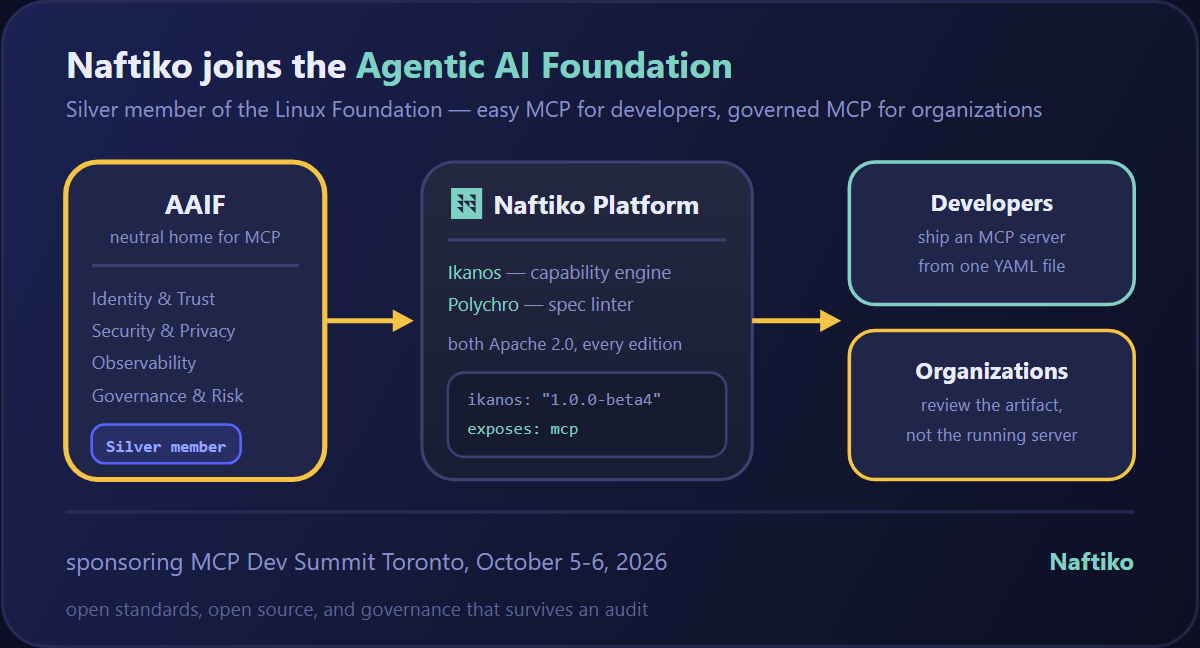
Today Naftiko is joining the Agentic AI Foundation (AAIF) as a Silver member — and, through it, the Linux Foundation — to advance a practical idea: context engineering should be declarative. The agent-facing surface is written down as an artifact, not assembled at runtime by code. The unit that makes that possible is the capability, a business-shaped operation that says what it does rather than how. As Naftiko traced across three disciplines, business architecture named it in 2006. Agents did not invent these boundaries; they inherited them.
What Naftiko Brings
Naftiko’s contribution is a practical one: context declared as an artifact, not assembled in code.
You cannot enumerate, by reading general-purpose server code, every upstream operation a credential will authorize — or the exact tool surface a model will be shown. Computed URLs and dynamic dispatch defeat static analysis, so reviewers certify one observed run instead of the thing that runs. Declared context inverts that: which tools an agent sees, how each is described, what fields come back, and what the credential may reach become lines in a file a reviewer can diff, a linter can enforce, and a pull request can gate.
For developers, publishing an MCP server should not require writing and maintaining a server. With Ikanos, a capability is declared once in YAML over the APIs a team already owns, then served as MCP tools, resources, and prompts — alongside REST and Agent Skills — from one deployment. Payloads are shaped in the same file, so a vendor’s sixty-field object never lands in a context window untouched.
For organizations, that same file is the review surface. Polychro, Naftiko’s deterministic linter, validates it in CI and runs as an MCP server itself. Its linting extends to Markdown, with profiles shipping today for AGENTS.md — the file OpenAI donated to the AAIF — plus SKILL.md, *.instructions.md, and *.prompt.md. Those files are context too: a malformed AGENTS.md does not fail loudly, it silently changes how an agent behaves.
Naftiko will engage across the Identity & Trust, Security & Privacy, Observability & Traceability, and Governance, Risk & Regulatory Alignment working groups.
Sponsoring MCP Dev Summit Toronto
Naftiko will sponsor MCP Dev Summit Toronto on October 5-6, 2026, part of the AAIF’s global developer series. Naftiko’s team will be on site to talk through capability specifications, protocol migration, and credential scoping.
Quote from Naftiko
“MCP solved the connection problem so thoroughly that it exposed the next one. Any developer can stand up an MCP server over an existing API in an afternoon — and no reviewer can tell you, by reading it, what that server will do with the credential you gave it, or what the model will actually be shown.
Context engineering is the difference between an agent that works and one that burns tokens guessing, and it is still done imperatively, in code, one integration at a time. It should be declarative: the tools, the descriptions, the response shapes and the credential scope written down in a file you can read before you run it. That is why Ikanos and Polychro are Apache 2.0 in every edition and will stay that way — governance you have to buy is not governance, it is a feature gate.”
— Jerome Louvel, CEO & Co-Founder, Naftiko
Availability
Ikanos v1.0.0-beta5 (“Bark”) shipped today, continuing support for the 2026-07-28 MCP specification with no breaking schema change. The release hardens the supply chain — every published binary and Docker image is now automatically scanned before it ships, with SHA256 checksums and an SBOM on each artifact — and lands the project’s first fix from an external contributor.
- Learn about the AAIF: aaif.io
- Attend MCP Dev Summit Toronto: October 5-6, 2026
- Run Ikanos: github.com/naftiko/ikanos (Apache 2.0)
- Lint with Polychro: github.com/naftiko/polychro (Apache 2.0)
- Read the docs: shipyard.naftiko.io
About Naftiko
Naftiko is the Agentic Integration Platform for declarative context engineering. Rather than hand-writing MCP servers and integration glue, teams declare a capability once — a versioned, linted, reviewable spec over the data and APIs they already own — and serve it as MCP tools, Agent Skills, and REST from a single deployment. Its two engines, the Ikanos runtime and the Polychro linter, are Apache 2.0 in every edition. Founded on the values of openness, sustainability, and responsible use, Naftiko is building the connective tissue between enterprise API investments and the AI-powered future. Naftiko operates from Philadelphia and Paris.
| Media Contact: press@naftiko.io | naftiko.io |