
API Reusability
Turn reuse into a measurable, repeatable practice -- by making capabilities discoverable.
Explore with us
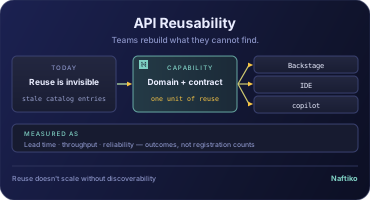
API reuse is not just discipline -- it is visibility and incentives. Teams rebuild what already exists because reuse is invisible. Manual catalog registration goes stale. Reuse metrics are activity-based, not outcome-based, so the number goes up while the duplication does too.
Naftiko defines reuse by domain, capability, and contract. Measure and communicate reuse in leadership language -- lead time, throughput, reliability -- and surface discovery where developers make decisions: the IDE and the copilot workflow, not a catalog nobody opens. What follows are the four shapes that reuse takes in practice, from wrapping a single API to designing from your existing estate outward.
Elevate an existing API
Model the legacy or existing API once in your capability spec with explicit methods, paths, parameters, and body formats. Add a stable capability namespace and expose curated resource paths and tools that are easier to consume than vendor-native endpoints -- without touching the upstream service.
Schema-based validation keeps the elevated contract consistent and machine-checkable. HTTP methods can be remapped to expose proper semantics -- a read-only POST query becomes a cacheable GET -- and XML, Avro and CSV payloads convert to JSON on the way out. The API you already run stays where it is; what changes is what consumers see.
Rightsize a set of microservices
Aggregate multiple microservice endpoints under one exposed namespace and a small set of business-oriented resources and tools. Standardize authentication, header behaviour and parameter handling at capability level instead of duplicating that logic in every client.
Orchestration and output shaping hide the service fragmentation and return consistent contracts, with sequenced steps and YAML or Protobuf payload conversion where the wire formats differ. Clients stop needing a mental map of the service topology; they call one capability with a business-shaped contract.
Rightsize a monolith API
Select only the monolith operations you actually need and remap them to narrower exposed resources and tools. Output filtering and mapping publish smaller, purpose-built payloads for each consumer scenario, so a client integrating one workflow is not handed the whole surface area of the platform.
Where full transformation is unnecessary, forward selected routes with a target namespace and keep the passthrough path. Each extracted capability becomes a focused, discoverable unit -- and no rewrite of the monolith is required to get there.
API-first design
Begin with consumed API declarations -- base URI, authentication, resources, operations -- then incrementally add exposed API and MCP adapters as the demand becomes clear. Reuse existing security and configuration through external references with file and runtime resolution, plus injected variables, so credentials and endpoints are not re-declared per capability.
Format-aware parsing and mapping across JSON, YAML, XML, CSV, Avro and Protobuf normalizes diverse backends into one contract shape. The API investment you have already made becomes the foundation for new AI and application experiences, without a rip-and-replace.
Reuse is an outcome, not an activity
All four shapes produce the same artifact: a capability declared in YAML, held in version control, discoverable in the catalog, and consumable over REST, MCP and Agent Skills from a single definition. That artifact is what makes reuse measurable -- you can count the capabilities, see who consumes them, and tie the number to lead time rather than to registration activity.
The APIs you already own do not need to be replaced to be reused. They need to be declared once, in a form other teams -- and agents -- can find.
Start small, scale smart
Reuse doesn't scale without discoverability.
Chart your next course
Context Engineering