
I have been pulling the Naftiko Signals data this week looking at what enterprises are actually investing in right now — what shows up in their job postings, their press releases, the technology footprint we score across their public surfaces. The picture that came back from the dataset is honest in a way that most analyst slides are not.
The top of the investment chart, sorted by company adoption across the 253 enterprises in the Signals dataset, is not “AI plus a bunch of modern things.” It is AI and EDI, side by side, at the very top.
- Artificial Intelligence — 253 of 253 companies
- Active Directory — 253 of 253 companies
- Data — 252 of 253 companies
- Deep Learning — 252 of 253 companies
- Electronic Data Interchange — 252 of 253 companies
- Machine Learning — 251 of 253 companies
Read that list slowly. Active Directory was first commercially shipped in 1999. EDI as a B2B exchange standard goes back to the 1970s and 1980s — X12, EDIFACT, the kind of fixed-position messaging that still moves trillions of dollars in healthcare claims, automotive supply chains, retail, freight, banking. Right next to those, and ahead of half of them by company count, sits the most modern category we have a name for — AI, ML, and DL.
This is not a transition chart. This is a steady-state reality.
The myth the keynote decks are selling
The story most enterprises are being sold in 2026 is some version of “AI is the new platform, retire the legacy stack, modernize.” Pick a vendor and you can find that exact phrase in a deck somewhere this quarter.
The data does not support it. Not at the macro level, and not at any single enterprise that I have looked at line by line. The investments are not replacing each other. They are layering on top of each other. The same company that is shipping an MCP server for an internal copilot this quarter is also paying somebody to maintain the X12 850 purchase order parser for their largest distributor, because that distributor is not changing how it sends purchase orders, and if the parser breaks, the orders stop, and the orders are the business.
That same company is also signing a contract for an LLM provider, instrumenting an agent stack, and being asked by their board what their AI strategy is. They will not say no to either set of work. They cannot. So they say yes to both, and the integration team — usually two people, sometimes one — gets to figure out how to keep both running.
That is the actual shape of enterprise integration in 2026. Not “AI versus EDI.” AI and EDI. The “and” is doing all the work.
Why this lands at the integration layer, specifically
Every legacy-versus-modern conversation eventually arrives at the same chokepoint, which is the integration layer.
EDI is integration. The whole point of an X12 837 healthcare claim or an EDIFACT INVOIC invoice is that one system speaks to another system in a format both sides agreed to a long time ago. AI is also integration. The whole point of an MCP tool or an agent skill is that one system — the model — speaks to another system in a format both sides have agreed to recently. Same problem, different decade, very different vocabulary.
The integration team in the middle is being asked to do both. To declare the upstream EDI feed honestly — fixed positions, segment terminators, control envelopes, partner-specific quirks. And to declare a clean, model-facing tool surface that the agent can actually use without choking on the raw EDI structure. The team that succeeds at this is the team that stops treating the two ends as separate problems and starts treating them as two halves of the same artifact.
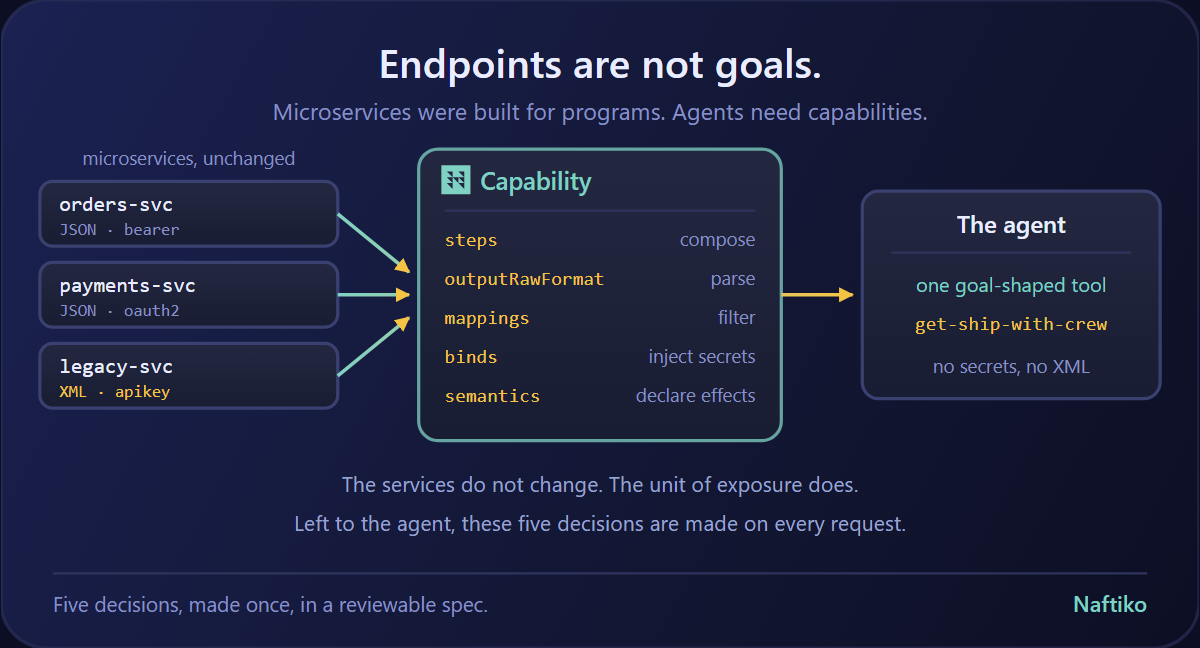
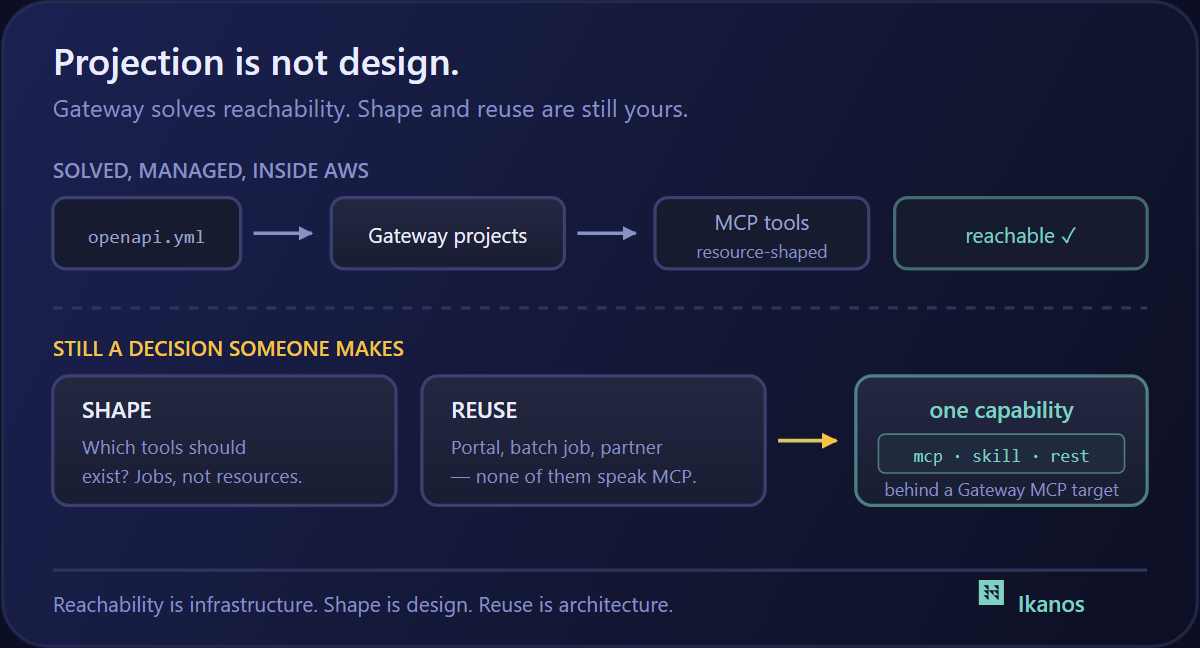
Which is exactly what a capability is for.
What the capability shape looks like for AI + EDI
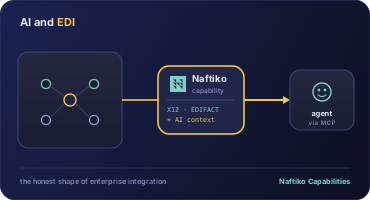
The Naftiko Capability spec was designed for this exact pair. Honest declarations of what the upstream actually looks like in consumes, including the legacy formats. Clean, model-facing tool surfaces in exposes. JSONPath-and-format-aware mappings between them, doing the translation that used to be a separate translation service.
For an EDI-to-AI capability, that means:
- A
consumesblock that declares the EDI feed as it actually is — the raw payload format (CSV, fixed-width, X12, EDIFACT-shaped envelopes), the partner-specific transport (SFTP, AS2, value-added network, plain HTTP), the auth, the polling cadence. Nothing sanitized. The legacy world stays in the legacy half of the file. - An
exposesblock that declares an MCP tool the agent will actually use — typed inputs, typed outputs, hint-annotated, a single clean noun in the model’s ubiquitous language.submitPurchaseOrder,getInvoiceStatus,lookupShipmentEvent. None of the X12 segment names leak through. - The mappings between them —
$.GS.ST.BEG.PurchaseOrderNumberlands aspurchaseOrderIdon the way out; the agent never sees a segment identifier. Format-aware parsing on the consumes side normalizes the EDI structure into JSON the engine can map cleanly.
That is one YAML file. It is reviewable in Git, scoped to one bounded context, and the auth, format, partner-quirk knowledge stays scoped to the consumes half. The agent surface is clean, and the legacy partner does not have to change anything to send the order.
This is the operational answer to “AI and EDI, both at full intensity.” You do not pick. You declare both, in one file, and let the engine do the work that nobody is volunteering to do imperatively.
Three lenses on the same chart
Technology. The top of the investment chart is not telling you to modernize. It is telling you to integrate. The same company is paying for new model APIs and old EDI partner connections in the same fiscal year. The technical answer is a substrate that can absorb both — declarative on the consumes side, declarative on the exposes side, format-aware in the middle. Capabilities are that substrate.
Business. The myth that legacy integration is “low priority because it is being phased out” is doing real damage. EDI is not being phased out. It is being invested in, by 252 of the 253 enterprises in the Signals dataset, at the same time as AI. If your platform team is treating the EDI work as backlog and the AI work as flagship, your roadmap is reflecting a story the business is not telling.
Politics. This is the part I keep coming back to. The “rip and replace” pitch is rarely a technology argument. It is a power play dressed up as modernization, and it usually rewards the team doing the rewriting at the expense of the team that has been quietly keeping the EDI partners happy for fifteen years. The honest data refuses that framing. It says both teams are load-bearing. It says the AI team needs the EDI team’s domain knowledge to ship anything that works against real partners. And it says the integration layer is where those teams finally have to meet, in the same artifact, owning the same contract.
Closing the loop
If you want the underlying numbers, they are in Naftiko Signals — the dataset is public, the per-company landing pages show the area, service, tool, and standards footprint we score, and the top-of-chart pattern holds whether you slice by industry, by company size, or by region. The “AI and EDI at the top” finding is not an artifact of one industry. It is the steady state.
The engine and the fleet are at naftiko/framework and naftiko/fleet. Everything else lives at naftiko.io.
The top of the chart is honest. The roadmap should be too.