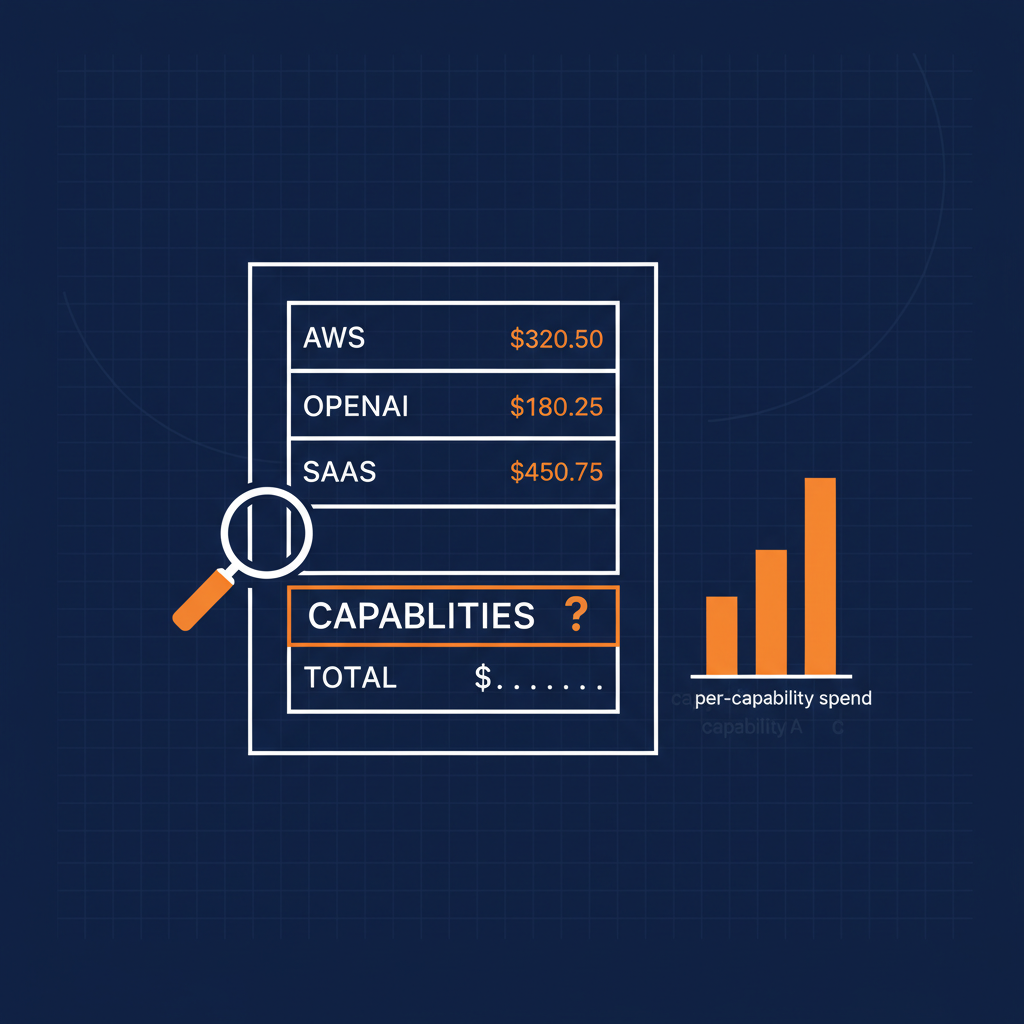
Your CFO knows your cloud bill. They know your model-provider spend. They certainly know your enterprise SaaS subscriptions.
They almost certainly do not know your per-capability AI spend.
The reason is structural. AI spend gets categorized by vendor, by infrastructure, by API gateway, by SaaS subscription. The dimension that actually matters for cost optimization — the capability the spend was used for — is not in any of those buckets. The capability is what the agent called. The capability is what the model paid tokens to reason about. The capability is the thing your developers reuse, or duplicate, or ignore.
If you cannot attribute spend to capabilities, you cannot govern spend on AI integration. You can only govern spend on infrastructure.
That is not a CFO problem. That is a technology problem with a CFO-shaped consequence.
What a capability-level FinOps view looks like
A Naftiko capability ships with a /metrics endpoint that exposes operational telemetry — request count, latency, error rate, resilience-pattern state. Add cost metadata to the same surface and you get the FinOps view that does not exist anywhere else:
- Per-call spend — token cost, upstream API cost, infrastructure cost rolled up per capability invocation
- Per-operation attribution — when one capability fans out to three upstream APIs, the spend is attributed to the right capability, not absorbed into the upstream
- Per-team rollup — when ten teams reuse one capability, the spend rollup tells you whether the reuse is paying off in shared cost or doubling it
- Per-agent attribution — when an agent makes the call, the identity binding ties the spend to the agent’s owner, not just to the calling service
This is not a future-state pitch. The Naftiko Framework already exposes the telemetry primitives. The Naftiko Fleet already aggregates metrics across capabilities. The remaining work is treating cost as one more dimension of those metrics — and that work fits the same shape the framework already supports.
Why activity metrics are not the answer
Most enterprises that have started measuring AI spend are measuring activity. Number of agent calls. Tokens consumed. Cost per million tokens.
Activity metrics tell you what happened. They do not tell you whether what happened was worth it. The CFO does not care that you ran ten million agent calls last month. The CFO cares whether ten million calls drove the lead-time, throughput, or revenue outcome that justifies them.
Capability-level cost telemetry connects spend to outcome because the capability is the unit of business value. A “process loan application” capability has a spend curve and a business curve, and the ratio is the only number that matters. A “list approved MCP servers” capability has a different ratio. A “compose customer context” capability has a third.
When the CFO asks “is our AI spend producing returns?” the only honest answer comes from the capability layer. The bill from your model provider tells you what was spent. The capability telemetry tells you on what.
Three dimensions for executives
Cost (the visible pillar): capability-level spend gives you the attribution you cannot get from a vendor invoice. You stop arguing about whether AI is “worth it” in the abstract and start arguing about which specific capabilities are worth their cost. Some are; some are not; the data tells you.
Risk (the invisible pillar): spend that you cannot attribute is spend you cannot govern. Anomaly detection on capability spend catches a runaway agent before the cloud bill catches it. Anomaly detection on the cloud bill catches it after the fact, at the wrong granularity, with no accountability path.
Velocity (the compounding pillar): the cheapest capability is the one your team did not have to build because somebody already built it. Per-capability spend rollups make reuse measurable in dollars. Reuse becomes a budget conversation, not a culture conversation — and budget conversations end faster.
The two-concern crosswalk
Two themes keep showing up in early conversations with enterprise design partners — in different shapes, from very different industries, but with the same underlying structure.
One concern is supply-chain risk in MCP servers. The connection to FinOps is direct: an MCP server you have not vetted is an MCP server you cannot bound the cost of, because you cannot attribute its calls.
The other concern is agent identity. The connection to FinOps is also direct: an agent without a bound identity is an agent without a budget owner, and an unbudgeted agent is a runaway-cost incident waiting to happen.
The two concerns sound different. They are the same concern with different vocabularies. Capability-level cost telemetry is the substrate that resolves both.
What to do with this
If your finance organization is still measuring AI spend by vendor, you are operating with a granularity that will not survive the next budget cycle. Move the measurement to the capability layer. Start with the dozen capabilities your developers actually reuse — the rollup will tell you which ones are pulling their weight and which ones are quiet money sinks.
The Naftiko Framework gives you the metrics primitives. The Naftiko Fleet gives you the cross-capability rollup. Your FinOps team gives you the dimensions to slice on. The combination is a CFO-grade picture of where AI investment actually lands.
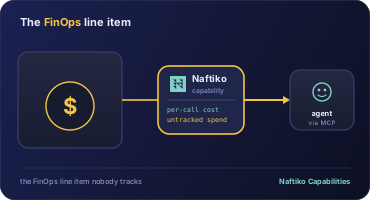
Capabilities are the line item nobody is tracking. The first organization to track them well wins a budget conversation that everybody else is losing.