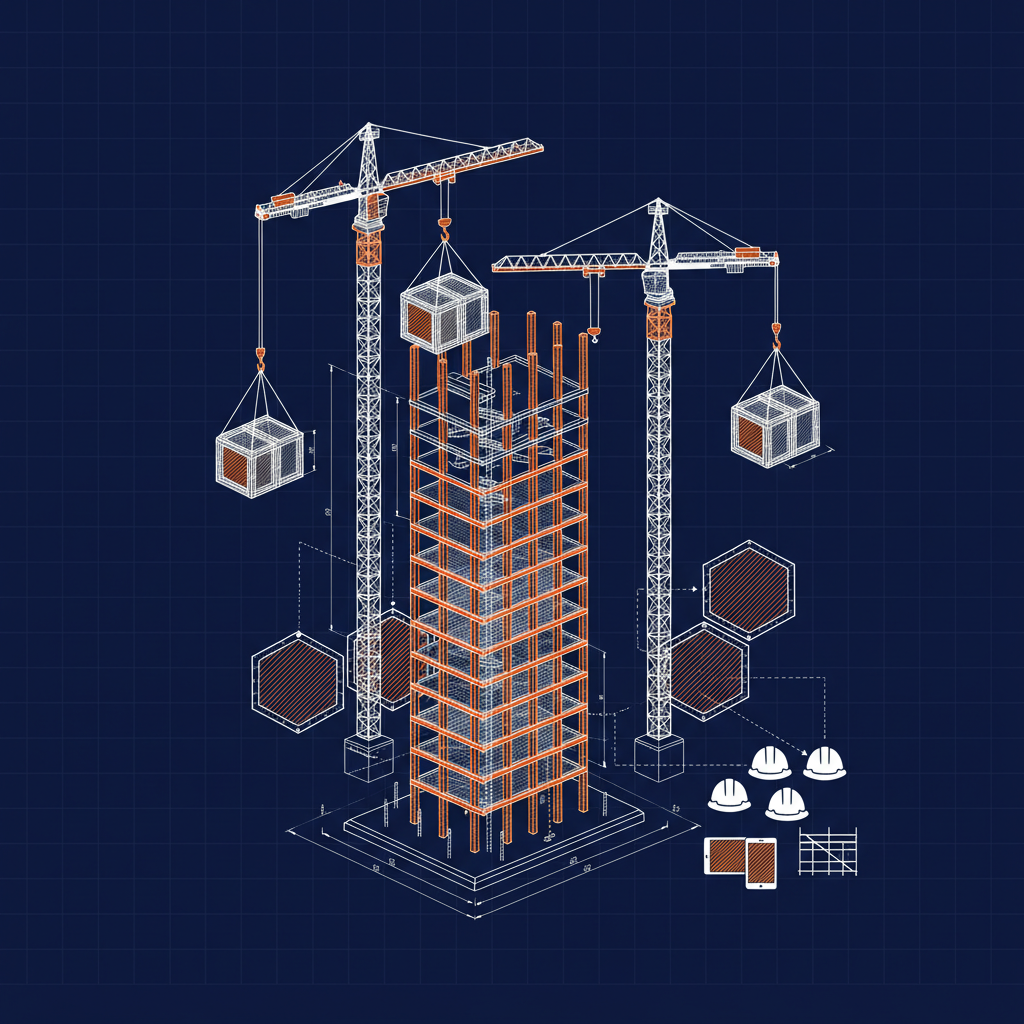
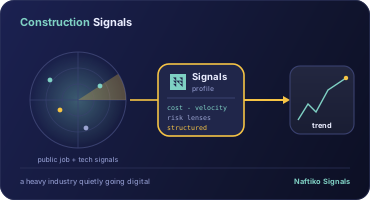
Construction is the industry I keep coming back to when people ask me which sector surprises me most through Naftiko Signals. The cultural shorthand says it’s hard hats, paper plans, and clipboards — a heavy industry running on diesel and tradition. The public footprint says something different. When I look at the 50 construction firms we track through Signals — heavy industrial builders like Bechtel, Fluor, and Peter Kiewit; engineering houses like AECOM, Jacobs, and KBR; commercial and residential builders like Lennar, Pulte, and Toll Brothers; plus the platform companies like Autodesk and Trimble — what shows up in the job posts, press releases, and engineering signals is not a sector hiding from technology. It is a sector quietly rebuilding around it.
The aggregate picture
The industry aggregates to a total signal score of 2,587 across 41 categories, with the heaviest concentrations sitting where you’d expect a digital-first business to invest: Services (398), Data (222), Cloud (165), Operations (132), and Automation (118). Security shows up at 106 and Artificial Intelligence at 98 — meaningful numbers for an industry that, in the public imagination, is supposed to be running spreadsheets off a job-site trailer. The data depth is the part that always stops me. A score of 222 across construction firms is the signature of an industry that has been quietly assembling project, materials, and field telemetry data for years — long before anyone in the sector started saying “AI.”
Autodesk leads, the engineers follow
A few company-level signals are worth naming. Autodesk is the runaway leader inside the industry view, posting 161 in AI, 159 in Cloud, 180 in Data, and 97 in Automation — which makes sense, because Autodesk is the platform layer the rest of construction runs on. AECOM leads the engineering peer group in Data (93), Automation (53), Operations (58), and Governance (31), with Bechtel asserting a tight counter-edge in Security (47), Model Registry (14), and Event-Driven architecture (15). KBR and Lennar show up consistently in the top three across foundational layers — quietly, without the marketing volume, which is exactly the pattern I trust.
Walk through the detections and the picture sharpens. BIM authoring and 3D modeling show up across the field, with Unity surfacing in multiple toolchains as a sign of 3D and visualization investment. Project-management and field-tech surfaces are dense — ServiceNow, Salesforce, HubSpot, and Microsoft 365 carry the workflow weight, while mobile field apps for inspection, RFI capture, and safety reporting show up in the press footprint. The data platforms underneath are not toys: PostgreSQL, Elasticsearch, Apache Spark, Apache Airflow, and Pandas anchor the analytics stack. AI in safety and scheduling is visible in detections around anomaly detection, alerting, operational safety, and process safety. And sustainability is a real signal, not a slogan — carbon accounting, low-carbon materials, and sustainability practice all surface across the area inventory.
The pipes are in, the water isn’t on
Here is the surprise. Most outside observers, if asked where construction is investing, would guess robotics or maybe drones. The Signals view says the real concentration is in operational data infrastructure — cloud, data pipelines, observability, and operations tooling — with services and integrations layered on top. The sector has spent its money on the substrate that makes AI possible, not yet on the AI itself. Domain Specialization across the entire industry sits at just 2. SaaS productivity sits at 8. That is the gap. The civil engineers, schedulers, and procurement teams writing the next generation of project workflows are sitting on top of a serious data estate that has not yet been translated into domain-adapted models or AI-native productivity tooling. The pipes are in. The water hasn’t been turned on.
What’s next
So what’s next at the industry level? Two capability recommendations I’d push for any construction firm reading their own Signals page. First, domain-specialized retrieval over project data — RFIs, change orders, submittals, daily reports, BIM model metadata — exposed as a small set of well-specified APIs that AI agents can actually traverse. Second, an event-driven safety and scheduling layer that turns the existing observability stack into a real-time feedback loop between the field and the model. Both are within reach of the infrastructure already detected.
The full industry view, every score, every detection, and every company in the cohort lives at industries.naftiko.io/signals/construction/dGx82BHGpv/. Construction is not behind. It’s quietly ahead of its own reputation, and the public signal proves it.