
I keep running into the same conversation. A team wants to put an agent in front of “the data,” and somebody finally has to admit that a meaningful slice of “the data” lives in CSV files. A payroll export from ADP. A vendor price list a partner emails on the first of the month. A nightly inventory drop the warehouse system writes to an SFTP bucket that somebody put behind nginx so it could be curled.
None of those are JSON. None of them are MCP. All of them are real, in production, and quietly load-bearing. And every consumer — the BI tool, the agent prototype, the script some director wrote in 2019 — is parsing them differently.
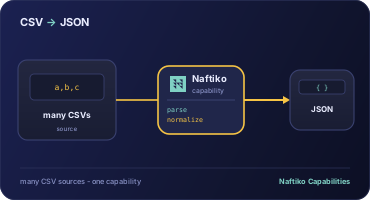
This post is about the Naftiko capability pattern for that exact mess. Convert CSV to JSON from multiple sources, in one capability, with no upstream rewrite.
The CSV-as-API problem
The honest shape of CSV in the enterprise is not “spreadsheet.” It is “the cheapest contract two systems could agree on.” That contract has known problems.
- No types. Every column is a string until somebody coerces it.
- No schema discovery. Column order in row 1 is the only thing standing between you and chaos.
- No versioning. Adding a column at the end is fine. Adding one in the middle breaks everyone.
- No discoverability. The consumer learns about the file from a Confluence page that was last edited three years ago.
The reflex is to “modernize” — stand up a new service, rewrite the producer, get the data into a real API. That is a multi-quarter project before anyone touches an agent. The capability-first answer is the opposite: declare what is already there, exactly as it is, and put a JSON-shaped contract on top.
One capability, three CSV drops
The Naftiko spec already has the primitive that makes this work — outputRawFormat: "csv" on a consumed operation. The framework decodes the response body, treats row 1 as headers, and gives every downstream outputParameters mapping a JSON-shaped view rooted at $.
That single field is the difference between “we need a CSV ingestion service” and “we need a YAML file.”
Here is the shape of a single capability that consumes three different CSV drops — payroll headcount, vendor pricing, warehouse inventory — and exposes all three as JSON via REST and MCP.
naftiko: "1.0.0-alpha1"

info:
  title: Operational Snapshots From CSV
  description: "Three legacy CSV drops normalized into one governed JSON capability"

capability:
  consumes:
    - namespace: payroll
      type: http
      baseUri: "https://exports.payroll.internal"
      authentication:
        type: bearer
        token: "{{PAYROLL_EXPORT_TOKEN}}"
      resources:
        - name: headcount
          path: "/exports/headcount.csv"
          operations:
            - name: get-headcount
              method: GET
              outputRawFormat: csv

    - namespace: vendor
      type: http
      baseUri: "https://files.vendor-portal.com"
      authentication:
        type: apiKey
        in: header
        name: X-Vendor-Key
        value: "{{VENDOR_PORTAL_KEY}}"
      resources:
        - name: pricing
          path: "/monthly/pricing.csv"
          operations:
            - name: get-pricing
              method: GET
              outputRawFormat: csv

    - namespace: warehouse
      type: http
      baseUri: "https://drops.warehouse.internal"
      authentication:
        type: basic
        username: "{{WAREHOUSE_USER}}"
        password: "{{WAREHOUSE_PASS}}"
      resources:
        - name: inventory
          path: "/nightly/inventory.csv"
          operations:
            - name: get-inventory
              method: GET
              outputRawFormat: csv

  exposes:
    - type: rest
      namespace: snapshots

      resources:
        - path: /headcount
          name: headcount
          operations:
            - method: GET
              call: payroll.get-headcount
              outputParameters:
                - type: array
                  mapping: "$"
                  items:
                    type: object
                    properties:
                      employeeId:
                        type: string
                        mapping: "$.employee_id"
                      department:
                        type: string
                        mapping: "$.department"
                      costCenter:
                        type: string
                        mapping: "$.cost_center"
                      employmentType:
                        type: string
                        mapping: "$.employment_type"

        - path: /pricing
          name: pricing
          operations:
            - method: GET
              call: vendor.get-pricing
              outputParameters:
                - type: array
                  mapping: "$"
                  items:
                    type: object
                    properties:
                      sku:
                        type: string
                        mapping: "$.sku"
                      vendor:
                        type: string
                        mapping: "$.vendor"
                      unitPrice:
                        type: number
                        mapping: "$.unit_price"
                      effectiveDate:
                        type: string
                        mapping: "$.effective_date"

        - path: /inventory
          name: inventory
          operations:
            - method: GET
              call: warehouse.get-inventory
              outputParameters:
                - type: array
                  mapping: "$"
                  items:
                    type: object
                    properties:
                      sku:
                        type: string
                        mapping: "$.sku"
                      warehouseId:
                        type: string
                        mapping: "$.warehouse_id"
                      onHand:
                        type: integer
                        mapping: "$.on_hand"
                      reorderPoint:
                        type: integer
                        mapping: "$.reorder_point"

    - type: mcp
      namespace: snapshots
      tools:
        - name: list-headcount
          description: "Current headcount snapshot from the payroll CSV export"
          call: payroll.get-headcount
          outputParameters:
            - type: array
              mapping: "$"
              items:
                type: object
                properties:
                  employeeId:
                    type: string
                    mapping: "$.employee_id"
                  department:
                    type: string
                    mapping: "$.department"

        - name: list-pricing
          description: "Latest vendor pricing snapshot from the monthly CSV"
          call: vendor.get-pricing
          outputParameters:
            - type: array
              mapping: "$"
              items:
                type: object
                properties:
                  sku:
                    type: string
                    mapping: "$.sku"
                  unitPrice:
                    type: number
                    mapping: "$.unit_price"

        - name: list-inventory
          description: "Nightly warehouse inventory snapshot"
          call: warehouse.get-inventory
          outputParameters:
            - type: array
              mapping: "$"
              items:
                type: object
                properties:
                  sku:
                    type: string
                    mapping: "$.sku"
                  onHand:
                    type: integer
                    mapping: "$.on_hand"
Three sources. One capability. Six exposed surfaces — three REST resources for traditional clients, three MCP tools for agents. Zero upstream rewrites.
What the framework is doing for you
The piece that earns its keep is small but specific. When you set outputRawFormat: csv on a consumed operation, the engine:
- Fetches the CSV exactly as the upstream system serves it — bytes on the wire, no transformation.
- Decodes the CSV using the first row as headers.
- Hands you a JSON-shaped view at the root
$— an array of row-objects keyed by header name. - Lets your
outputParametersuse ordinary JSONPath ($.sku,$.unit_price) to map to your contract.
Same primitive works for tsv, psv, yaml, xml, avro, protobuf, html, and markdown. The capability spec does not care that the upstream is a CSV drop. It cares that you declared the contract you want to expose.
The CSV is not your API. The capability is your API.
Three dimensions
Technology. The hidden cost of CSV-as-an-API is not parsing. Every language has a CSV parser. The cost is that every consumer reimplements the type coercion, the column-name handling, the missing-row defaults, and the “what happens when the vendor adds a column” logic in its own way. Centralizing that into a capability spec makes the contract a file, not a tribal practice. When the vendor adds a new column, you change one mapping in Git — not five different downstream consumers.
Business. CSV drops tend to be where the real money lives — payroll exports, pricing files, inventory feeds, regulatory filings. They are the integrations leadership cannot afford to break. Declaring them as capabilities means they keep working exactly as they do today, while the team finally has a JSON-shaped contract to point at when somebody asks “can the agent see headcount?” The answer becomes “yes, here is the MCP tool” instead of “let me schedule a call with the payroll team.”
Politics. This is the quiet win. The owner of the payroll CSV does not have to change a thing. The owner of the warehouse drop does not have to change a thing. The vendor portal stays the way the vendor wrote it. The capability lives next to the consumers, not the producers. Nobody’s roadmap moves. Nobody’s on-call rotation expands. The CSV producers keep doing what they have always done, and the AI conversation moves forward anyway.
Where this fits
This is the same shape as Use Case 4 — Elevate Google Sheets API and Use Case 3 — Elevate existing APIs. The Sheets case takes a positional JSON array and gives it column names. The CSV case takes an actual CSV file and does the same thing. Multi-source is just the same pattern with more consumes blocks and more namespaces.
If your enterprise has more CSV drops than it has modern APIs — and most do — this is the shortest path from “we have data” to “we have an API our agents can use.”
- Wiki: Guide — Use Cases
- Spec: Specification — Schema (
outputRawFormat) - GitHub: github.com/naftiko/framework
- Fleet Community Edition: github.com/naftiko/fleet
The CSVs are not going anywhere. Stop pretending they will. Wrap them.