Most enterprise AI rollouts fail in one of two ways.
The first failure mode treats the entire stack as non-deterministic. The team gives an agent a long tool list, lets it call whatever it wants, prompts it to figure things out, and watches it hallucinate against an unbounded surface. Same input, different output, every run. The audit trail is a transcript. The cost is unpredictable. Compliance flags it within a quarter.
The second failure mode tries to make the entire stack deterministic. The team writes elaborate prompt templates, pins model versions, freezes tool schemas, refuses to let the LLM “decide” anything. The system becomes a brittle if-then chain that breaks on any input it was not explicitly designed for. The thing the LLM was supposed to bring — flexible reasoning over messy enterprise data — was the first thing they engineered out.
Both failures come from the same misunderstanding: that AI integration has one characteristic — deterministic or non-deterministic — and that the team has to pick one.
It does not have one characteristic. It has two layers. And the balance between those layers is what separates a safe production AI rollout from chaos.
Determinism is the substrate
Every reliable enterprise system in production today is deterministic at the bottom of the stack. The database returns the same row for the same query. The auth service returns the same identity claims for the same token. The payment processor returns the same charge result for the same idempotency key. None of those layers reason. They execute.
Determinism is what makes those layers auditable, reproducible, billable, and safe. Same input, same output, same governance applied, same metrics emitted. When something breaks, the failure is in a known place. When the auditor asks “what did this system do on March 12 at 3:42 PM?”, there is an answer.
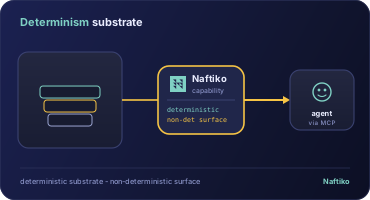
A capability — in the Naftiko Framework sense — is the same kind of object. The capability YAML declares what it consumes, what it exposes, what governance applies. The runtime executes the spec. Same upstream input, same output projection, same identity binding, same telemetry. The capability layer is the deterministic substrate the rest of the AI stack stands on.
Non-determinism is the surface
The model is non-deterministic by design. That is the point. The LLM is doing the thing none of the deterministic layers can do — reasoning over fuzzy input, summarizing long context, planning multi-step actions, holding a conversation. If the LLM were deterministic, you would not need an LLM. You would need a switch statement.
Non-determinism is what makes agents useful. Same prompt, different output, but a better output for the user’s actual intent. The team that tries to make the model deterministic has misunderstood what it is for.
The trick is that the non-deterministic layer should only be doing the things that need non-determinism. Reasoning. Planning. Summarization. Language. Anything that could have been a deterministic call — fetching data, applying governance, recording an audit entry, attributing a cost to an identity — should not be left to the model.
That is the rule. Deterministic where you can be. Non-deterministic where you have to be.
How the Naftiko Framework owns the seam
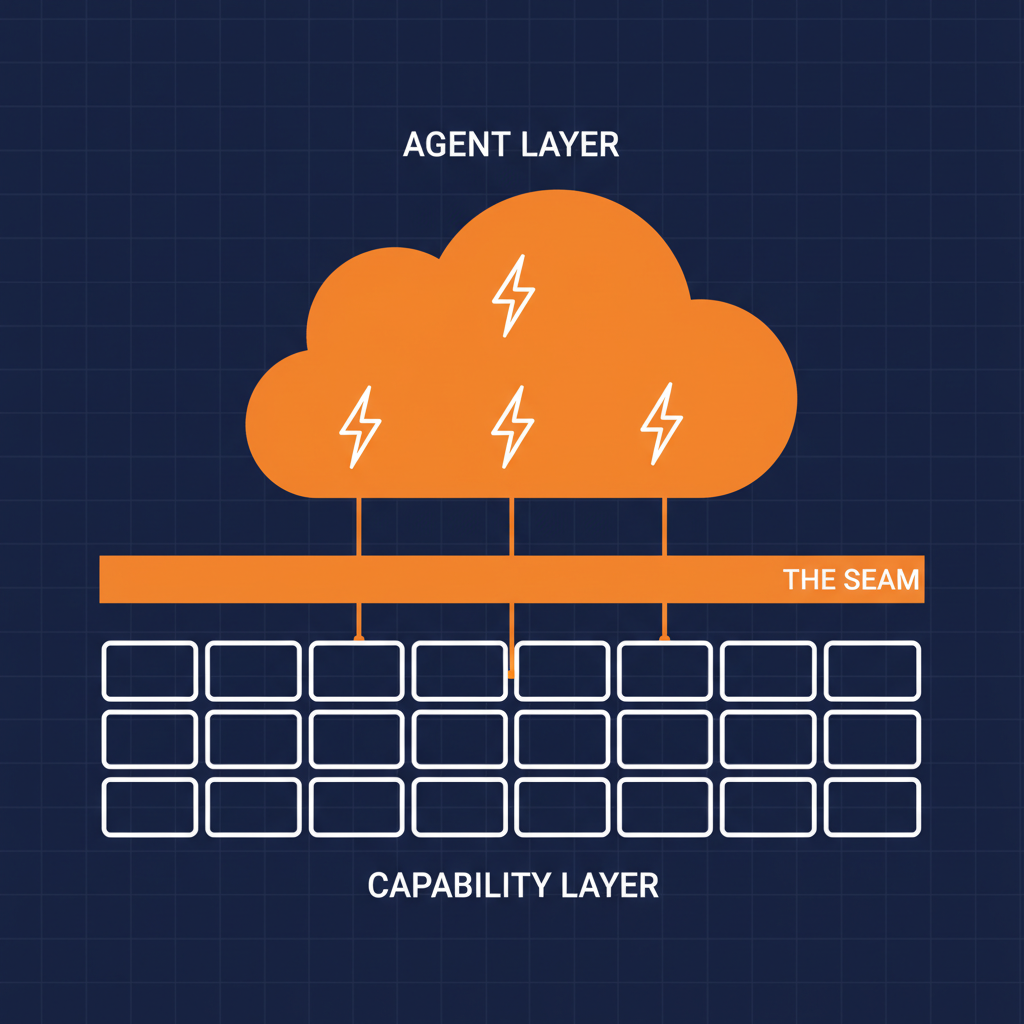
The Naftiko Framework is the runtime that sits at the seam between the two layers.
A capability is the deterministic unit. The framework executes it the same way every time, captures the metrics the same way, applies the governance the same way, binds the identity the same way. Whether the caller is a REST client, an MCP-attached LLM, or an Agent Skill, the capability layer behaves identically.
The non-deterministic layer above can call those capabilities freely, knowing that the call itself is reproducible. The agent decides which capabilities to call and how to compose their outputs into a response — that is the non-deterministic decision. But the call mechanics, the data shape, the governance, and the audit trail are all in the deterministic layer.
This is what makes the runtime defensible to a security team. The agent’s reasoning is non-deterministic — that is fine, because the things the agent can actually do are constrained to a deterministic capability set the security team approved. The blast radius of a non-deterministic decision is bounded by the deterministic substrate.
How the Naftiko Framework Wiki documents the discipline
The framework wiki is where this discipline is written down. The Spec-Driven Integration page argues that capability specs are the only honest contract between the deterministic layer and everything above it. The Rightsize AI Context page argues that the deterministic layer should reshape data into typed outputs the LLM can reason over, not raw upstream payloads.
These are not opinions. They are the operating principles that keep the seam between determinism and non-determinism stable. Without them, the seam drifts — and once it drifts, the deterministic substrate stops being deterministic, because the inputs flowing into it are no longer constrained.
How the Naftiko Fleet manages the boundary at scale
A single capability is one boundary. A fleet of capabilities is many boundaries — and managing them at enterprise scale is the Naftiko Fleet’s job.
The Fleet catalog is where the deterministic layer becomes legible to the rest of the organization. The Backstage capability page surfaces topology, ownership, governance status, and live telemetry for every capability in the fleet. Cross-engine observability dashboards aggregate the deterministic metrics across the whole estate. Fabric-wide dependency tracing shows blast radius when an upstream goes down — which is to say, when a deterministic guarantee is suddenly broken.
The non-deterministic layer above does not need to know any of this. It just calls the capability. The Fleet is what makes the capability worth calling — by ensuring the deterministic guarantees behind it are visible, auditable, and operationally sound.
How the Naftiko Fleet wiki documents the operational story
The Naftiko Fleet documentation captures how a capability moves from a developer’s IDE through scaffold, deploy, monitor, and retire — keeping the deterministic guarantees intact at every step. Backstage Templates for Naftiko, the VS Code extension, the CRD-and-operator pattern, the Tech Radar plugin coming in the Third Alpha — each of them is a piece of the boundary management story.
The point of writing it down is the same as the point of the framework wiki: the discipline does not survive without a written reference team members can hand to a new hire, a security reviewer, or a buyer.
Three dimensions
Technology: the deterministic substrate is the only place auditing, governance, and reproducibility can live. The non-deterministic surface is the only place flexible reasoning can live. The runtime that owns the seam is what makes the architecture defensible.
Business: unbounded non-determinism is unbounded cost. Bounded by deterministic capabilities, AI cost becomes attributable to specific operations the business cares about. The CFO can finally answer “what is this AI spend actually doing for us?” because the answer lives in the capability layer.
Politics: the security team is asking the right question when they say “what can the agent actually do?” The wrong answer is a long list of model permissions. The right answer is a curated, governed capability catalog. The deterministic substrate is what lets the security team say yes.
What to take away
If your enterprise AI integration is failing, look at the seam between determinism and non-determinism in your stack.
If everything is non-deterministic, you have an agent calling unbounded tools against an unbounded surface — and the audit, governance, and cost stories are all losing battles.
If everything is deterministic, you have a brittle automation pretending to be AI — and the use cases that need real reasoning are slipping out of scope.
The fix is not picking a side. The fix is structural separation. Determinism is the substrate. Non-determinism is the surface. The Naftiko Framework runs the substrate. The Naftiko Fleet manages it at scale. The framework wiki documents the discipline. The fleet documents the operations.
Together, they own the seam — which is the only place the balance can actually live.