
Last week I participated embedded event at a larger builders conference in Philadelphia. The event itself was three hours. The room held about thirty people. The mix was startups, enterprise CIOs, and a handful of investors. By the time it ended, three of the most consequential conversations I have had since founding Naftiko had started in that room — including a design-partner conversation with a buyer at a Fortune 50 bank.
The week before that, I published twenty-one blog posts, ran a daily LinkedIn cadence, shipped a video conversation, and sent a newsletter. The total reach across those channels was in the low six figures of impressions.
Three hours of conversation in a small room produced more pipeline movement than the week of broadcast did. Not by a little.
That is not a story about events being better than content. It is a story about the playbook the agent-era enterprise buyer responds to, and how it has quietly stopped looking anything like the playbook every startup blog has been telling us to run for twenty years.
The old instruction was right for a different era
For roughly the last two decades, the dominant instruction at the top of every startup go-to-market playbook has been some version of if it does not scale, do not do it. SEO scales. Paid acquisition scales. Content marketing scales. Webinars scale. Email nurtures scale. The whole machine was tuned to produce more of the people who self-identify as your buyer, push them into a funnel, and let volume do the math.
That instruction was correct for a long time. It was correct because the buyers it targeted — software developers, individual product leaders, mid-market operators — actually responded to the channels the machine produced. A developer Googles their problem at 11 PM, lands on a blog post, signs up for a trial, and is a customer six weeks later. SEO worked because the buyer’s behavior fit the channel.
It is not correct for the agent-era enterprise buyer, because the buyer’s behavior has changed. The C-level CIO at a regulated enterprise is not searching for their problem on Google at 11 PM. They are not signing up for trials. They are not reading the seventh blog post in the “best of” listicle you bought your way to the top of. They are talking — to peers, to advisors, to vendors who got a real introduction, in rooms that hold ten or twenty or thirty people.
The “scale or don’t bother” instruction tells you not to bother with those rooms. Wrong instruction. Wrong era.
What an advisor of mine said that landed
A peer who has run enterprise events for fifteen years gave me the framing I am going to use for the rest of the year.
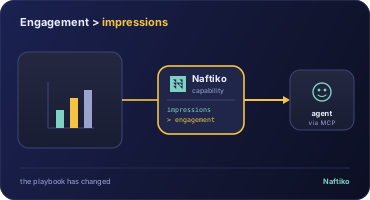
Impressions or engagement — which one are you trying to win?
She said it casually, but it is the question. Impressions are the metric the old playbook was designed for. Engagement is the metric the new buyer responds to. If you spend a quarter optimizing impressions in a market that is trying to engage, you will run out of money before you find the engagement.
Engagement is what gets a CIO to spend an hour with you on a Tuesday. It is what gets a deputy CTO to forward your demo to her boss with the words we should actually look at this. It is what gets a head of platform to put you on the calendar of the seven-person internal AI committee that decides which vendors get to talk next quarter. None of that comes from a banner ad. All of it comes from the eleven-person dinner you ran in Philadelphia last Thursday.
The boutique-niche model and why it scares startup founders
I am going to name the part that is uncomfortable. Engagement at this depth does not scale. It cannot. Ten people in a room is ten people. Twenty is twenty. A founder who runs ten of those a quarter spends thirty hours actively producing rooms — not counting prep — and reaches two hundred people. The mainstream startup playbook says that is a rounding error, what are you doing.
Two hundred high-engagement enterprise buyers is not a rounding error. It is a quarter of plan. If — and this is the part where the playbook update happens — you have priced your product for the buyer you are actually engaging.
The mistake startups make is keeping the price point of the old playbook (mid-market self-serve, three-figures-per-month, volume-driven) and the channels of the old playbook (impressions, SEO, content broadcast) and then wondering why the agent-era enterprise buyer is not finding them. The fix is not to do more impressions. The fix is to charge what the engagement-era buyer pays — five-figure to seven-figure annual contracts — and structure the GTM around producing the rooms those contracts come from.
When the math works at $250K-per-customer instead of $250-per-month, two hundred engaged buyers per quarter is not a rounding error. It is a Series A worth of revenue.
What I am running going forward
Three explicit changes to how I am spending my time as a founder. I am writing them down here so you can hold me to them.
More rooms, fewer broadcasts. Not zero broadcasts. The blog and the video conversations and the newsletter are still the public surface of the company, and I am going to keep producing them — because they are what makes the rooms possible in the first place. The Substack issue from last week is the reason a CIO in Boston knew who I was when we sat down in Philadelphia. But the rooms are the output. The content is the input. I had those two reversed for most of last year.
Hallway-grade interviewing. This week I am at APIDays NYC. I am not going to give a keynote and call that the engagement. I am going to spend two days in the hallways having short, real conversations with the operators who show up — and write up what they said in the next API Evangelist post and the Monday newsletter. That is the engagement loop. Conversations first, content second, distribution third. Not the other way around. (Thanks for that framing, by the way.)
Boutique events with collaborators. I have peers running their own small-format event series — Bonnie’s enterprise lab in Philadelphia, a friend’s API economy breakfasts, the women-in-APIs cohort that has been quietly producing some of the best executive engagement in the industry for two years. I am going to co-produce three more of these over the next quarter instead of pitching for a paid keynote slot at a thousand-person conference. The math is better. The pipeline math is much better.
The thing the playbooks will not tell you
There is a version of this post that says the old playbook is dead, the new playbook is small events. That version is wrong. The old playbook is not dead. The mistake is picking the wrong playbook for the buyer in front of you.
If you are selling a developer tool, the old playbook — SEO, content, self-serve trial, volume — is probably still the right one. The developer is still that buyer. The behavior still fits the channel.
If you are selling into the agent-era enterprise — to the CIOs and CTOs and Chief AI Officers and platform leads who are trying to figure out which vendors to bet on for the next decade — the old playbook is going to keep producing the wrong inputs forever. The buyer is not searching. The buyer is talking. Show up where the talking is happening, and engineer the math so that twenty conversations a quarter is a viable business.
Engagement over impressions. Conversations over content distribution. Small rooms over big rooms. Charge what the engagement-era buyer pays.
That is the playbook for the next two years. The old one will keep working — for the customers it was written for. The new one is for everybody else. Pick the one that fits the buyer in front of you.