Every enterprise integration starts with an intent: connect this system to that system, shape the data this way, expose it on that surface, authenticate with these credentials. That intent gets encoded somewhere — in application code, in middleware configuration, in a wiki page that somebody updates quarterly, in the head of the engineer who built it three years ago.
The problem is not the intent. The problem is the distance between the intent and what actually runs in production. That distance is where drift lives. It is where governance breaks down. It is where AI agents fail because the integration they are trying to reason about does not match the documentation they were given.
Spec-Driven Integration is a methodology that eliminates that distance.
The Integration Problem
Modern enterprise integration is characterized by three compounding challenges:
API sprawl. Systems expose endpoints that are inconsistently shaped, poorly documented, and duplicated across teams and contexts. A single enterprise might have dozens of internal services, hundreds of third-party SaaS subscriptions, and a growing number of AI model endpoints — each with its own conventions, authentication, and data shapes.
Context fragmentation. AI-driven workflows depend on access to the right data, in the right shape, at the right time. But integration layers are often too coarse or too opaque to provide this reliably. An AI agent that needs three fields from one API and two fields from another gets the full response from both, with all the noise and none of the governance.
Drift between intent and behavior. Integration logic is encoded in code, configuration, and institutional knowledge rather than in durable, inspectable artifacts. As systems evolve, intent diverges from behavior invisibly. The integration that was designed to do one thing now does something slightly different, and nobody knows until something breaks.
Spec-Driven Integration addresses all three by making the specification the primary integration artifact — not a byproduct.
Core Principles
SDI is built on six principles that define how integrations should be designed, operated, and governed:
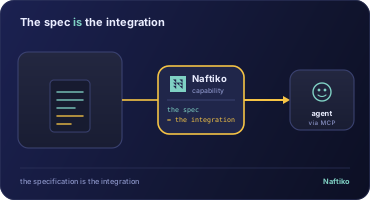
Specifications as the lingua franca. The integration specification is the single source of truth. It defines what is consumed from upstream systems, how inputs and outputs are shaped and composed, and what is re-exposed downstream. Maintaining an integration means evolving its specification. Everything else is derived.
Executable specifications. A specification is only valuable if it is precise, complete, and unambiguous enough to produce working integrations directly. SDI rejects the idea that specifications are documentation written after the fact. When a specification cannot be executed as-is, the gap is a signal of incompleteness — not an invitation for interpretation.
Continuous refinement. Integration consistency is not validated at a single gate. Specifications are continuously analyzed for ambiguity, internal contradiction, and gaps — ideally with AI assistance — throughout their lifecycle.
Research-driven context. Specifications are informed by research, not intuition. Decisions about how to shape upstream consumption, how to model domain concepts, and how to expose integration surfaces should be grounded in technical context, operational constraints, and organizational requirements.
Bidirectional feedback. Production behavior feeds back into specification evolution. Metrics, incidents, and real-world usage patterns are inputs for refining specifications — not just signals for operational teams.
Branching for exploration. A single specification can give rise to multiple integration variants, each optimized for a different target: performance, cost, consumer type, or context granularity.
The SDI Workflow
In practice, SDI defines a four-step cycle:
- Specify — Author a capability specification that captures the integration intent in a declarative YAML file.
- Validate — Analyze the spec for completeness, consistency, and ambiguity before execution.
- Execute — Run the engine against the specification. No code generation. No compilation. The engine reads the spec at runtime and handles all integration concerns.
- Refine — Evolve the specification based on production feedback, consumer requirements, or AI-assisted analysis.
This cycle keeps the specification as the primary artifact throughout — ensuring that what is deployed always reflects documented intent.
Why SDI Matters for AI
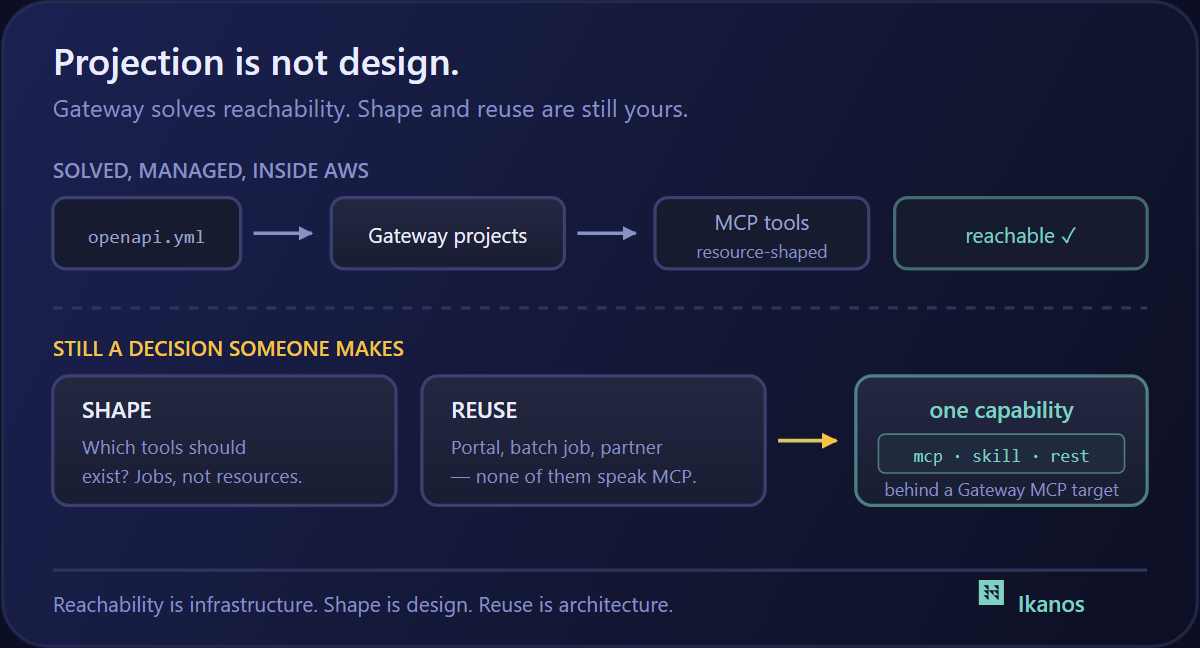
SDI is particularly well-suited to AI-driven architectures. Context engineering — shaping, filtering, and composing data for AI model consumption — is fundamentally an integration problem. Agent orchestration surfaces, such as MCP servers and tool-based APIs, require exactly the kind of right-sized, semantically coherent integration boundaries that SDI is designed to produce.
When specifications are the primary artifact, AI agents can reason about integrations, propose refinements, and validate consistency — treating the specification as a structured, inspectable contract rather than opaque runtime behavior. An AI agent can read a capability spec, understand what it does, and call it reliably. It cannot do the same with undocumented glue code.
The Naftiko Implementation
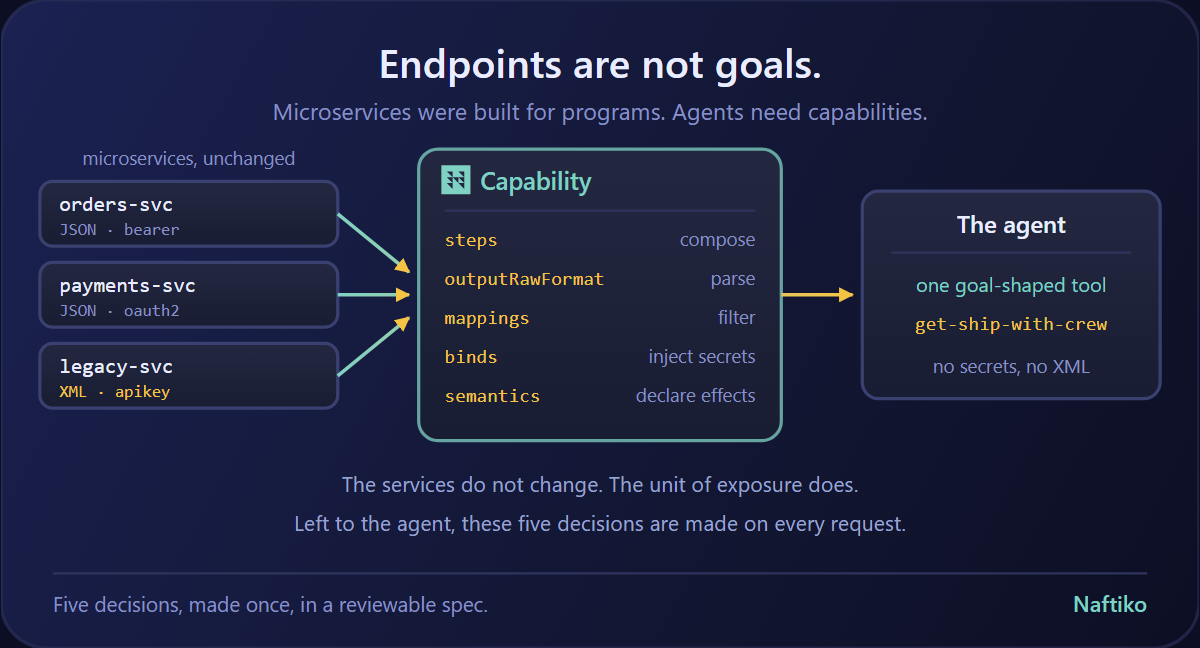
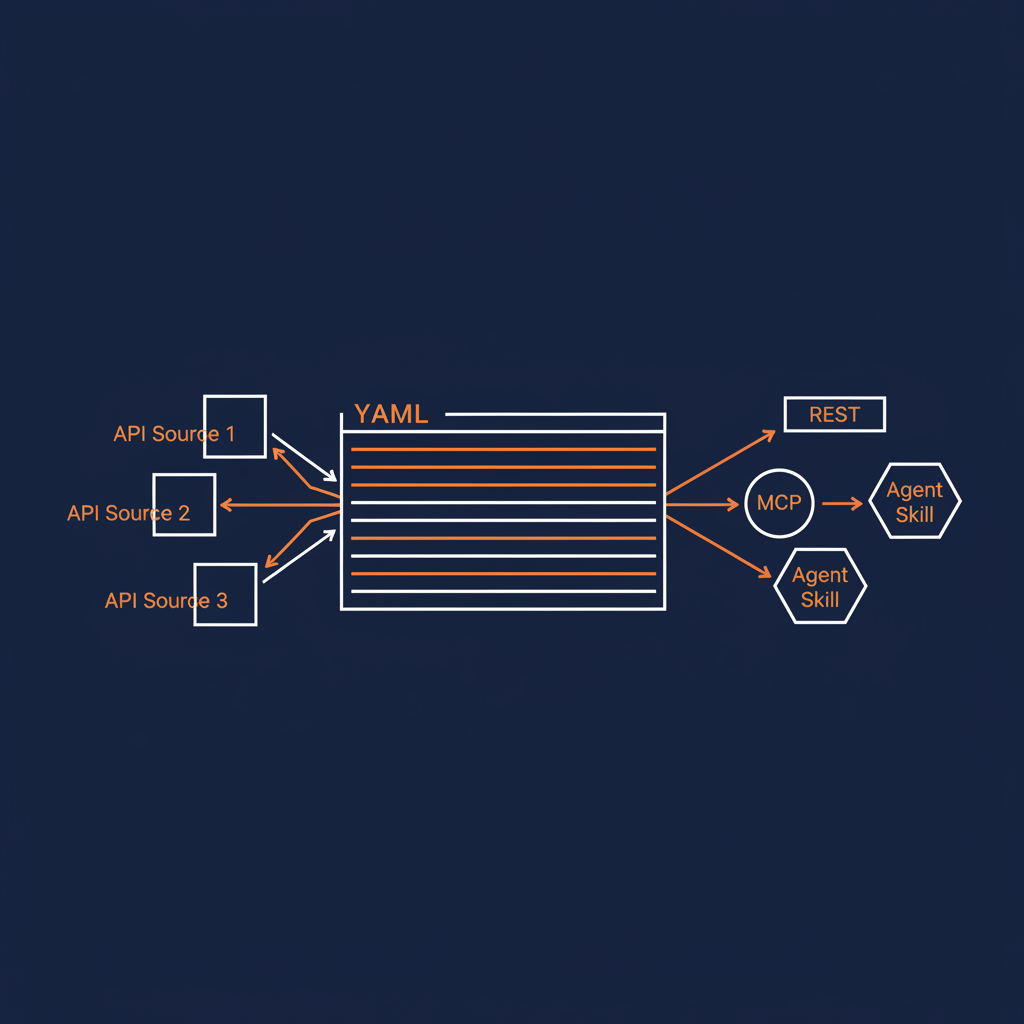
The Naftiko Framework is the open-source implementation of Spec-Driven Integration. A Naftiko capability file is the SDI artifact: a YAML specification that declares what an integration consumes and what it exposes. The Naftiko engine is the SDI runtime: it reads the spec, runs it in a container, and serves live integrations over REST, MCP, or Agent Skills.
No code generation. No build pipeline. No drift between spec and implementation, because they are the same artifact.
The methodology is tool-agnostic — SDI can be applied with any sufficiently expressive specification format and any runtime capable of executing it. The Naftiko Framework is one implementation. The principles apply everywhere.
| Read the full SDI methodology | Explore the Naftiko Fleet |