
I keep coming back to telecommunications because, for me, this is where the API story actually starts. Long before we had OpenAPI, JSON Schema, or the developer portals we argue about today, the carriers were running the original programmable infrastructure — SS7, OSS/BSS, billing mediation, provisioning systems quietly exchanging structured messages across the planet. So when I run Naftiko Signals against the telco carriers and look at what is showing up in their public hiring and press footprint, I am not watching an industry discover APIs. I am watching the original API players publicly rebuild themselves as cloud-native, AI-instrumented software companies — and you can read the rebuild in the signal.
The aggregate picture
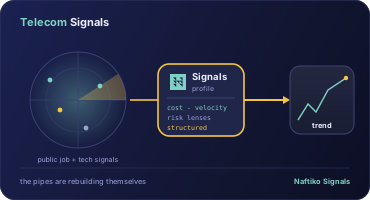
Naftiko Signals weighs the Telecommunications industry at a total signal score of 6620 across roughly 1,959 areas, 333 services, 225 tools, and 221 standards detected in jobs and press across the cohort. The top categories by aggregate investment depth are exactly the ones you would expect a network operator to lean into when it is trying to become a platform: Services (968), Cloud (477), Data (472), Operations (334), and Security (325), with Artificial Intelligence (288), Automation (287), and Observability (225) sitting right behind. That is the public outline of a carrier industry that has stopped pretending the core network is separate from the software org.
Who carries the weight
The company-level shape is more interesting than the totals. Qualcomm leads almost every dimension — AI (94), Cloud (132), Data (121), Containers (37), CNCF (32) — which is the analytical headline of this industry: the AI investment is concentrated in the chip and equipment layer, not in the service-delivery layer. AT&T is the carrier that actually shows up in the public footprint as a software operator, leading Security at 85 and Observability at 49 — the two dimensions you cannot fake when you are running national-scale infrastructure. Comcast sits in a competitive second tier on Cloud (105) and Data (104) and quietly leads Databases (32) and Regulatory Posture (13), which tells you something about Xfinity and Peacock living next door to FCC compliance. T-Mobile trails materially across the board — Cloud at 34, AI at 21, Automation at 19 — which is a leading indicator worth naming.
A CNCF-native rebuild
The specific detections are where you can see the rebuild. The cohort’s tool signal is dominated by Terraform (770), Buildpacks (713), SPIRE (550), OpenTelemetry (491), Open Policy Agent (426), Kubernetes Operators (422), Kubernetes (336), and Vitess (333) — that is a CNCF-native stack, not a legacy NEBS-rack stack, and it maps directly onto the cloud-native network function deployments that 5G core and edge require. Apache Kafka and Kafka Connect show up across the carriers as the telemetry and event bus for network operations AI. The standards layer detects CNCF, GraphQL, and OpenAPI — not yet the GSMA CAMARA / Open Gateway specs you would hope to see, but the foundation a network-as-a-service API program would need to sit on top of. And the Developer Experience leader is AT&T (24) — not Qualcomm — which lines up with the carrier developer-portal investment that has been quietly grinding away since the AT&T Developer Alliance days.
The gap between the chip and the service
What the public footprint actually reveals, when you stand back, is a telco industry trying to become a software company without yet having a software company’s customization muscle. The carriers own the largest behavioral and network-telemetry datasets on the planet, but the Data Pipelines scores are tiny (Qualcomm 11, Comcast 9, AT&T 8) and Domain Specialization is essentially zero across the cohort. The pipes are getting rebuilt in Kubernetes and Terraform and Kafka. The AI on top of those pipes is, for now, mostly somebody else’s foundation model running on Qualcomm silicon. That is the gap.
What’s Next at the industry level is two capabilities I would build if I were writing the next chapter for this sector. First, an industry-wide network-telemetry-to-fine-tune capability — a shared pattern for turning carrier-owned operational data into domain-specialized models, with the consent, provenance, and versioning plumbing the Privacy & Data Rights scores say is missing. Second, a CAMARA / Open Gateway exposure capability — a reference pattern that turns the CNCF-and-Kafka rebuild into a programmable network-as-a-service surface area that developers can actually consume, instead of leaving carriers as wholesale capacity to the hyperscalers.
The full industry breakdown lives at https://industries.naftiko.io/signals/telecommunications/Wl1NWO5mcB/.