If you read the trade press, every enterprise on earth is doing exactly one thing right now: AI. Every keynote, every analyst note, every LinkedIn post says the same thing. AI-first. Agent-native. Foundation-model-powered.
So we went and looked at what enterprises are actually spending money on. Not what their CMOs are saying. What their engineering orgs are hiring for, contributing to, and buying. The answer is more interesting than the hype cycle gives it credit for.
How we measured
Naftiko Signals profiles 253 enterprise companies by reading the engineering signals that cost real money: job postings, open source contributions, SaaS portfolios, standards participation, and tooling choices. Marketing is cheap. Headcount is not. A company that has been hiring for a capability for eighteen months is telling you something a press release cannot.
We bucket those signals into 44 areas of technology spanning the full stack — AI, cloud, data, APIs, integrations, security, governance, observability, platform engineering, and the rest. Then we count: out of 253 enterprises, how many show meaningful investment in each area?
The top of the list
| Rank | Area | Companies | % |
|---|---|---|---|
| 1 | Artificial Intelligence | 253 | 86% |
| 2 | Active Directory | 253 | 86% |
| 3 | Electronic Data Interchange | 252 | 86% |
| 4 | Deep Learning | 252 | 86% |
| 5 | Data | 252 | 86% |
| 6 | Machine Learning | 251 | 85% |
| 7 | Operations | 249 | 85% |
Read that list again. AI is tied for first — with Active Directory. And one rank below both of them, holding 86% of the enterprise market, is EDI. The protocol your grandfather used to send purchase orders.
This is the story the hype cycle refuses to tell.
What it actually means
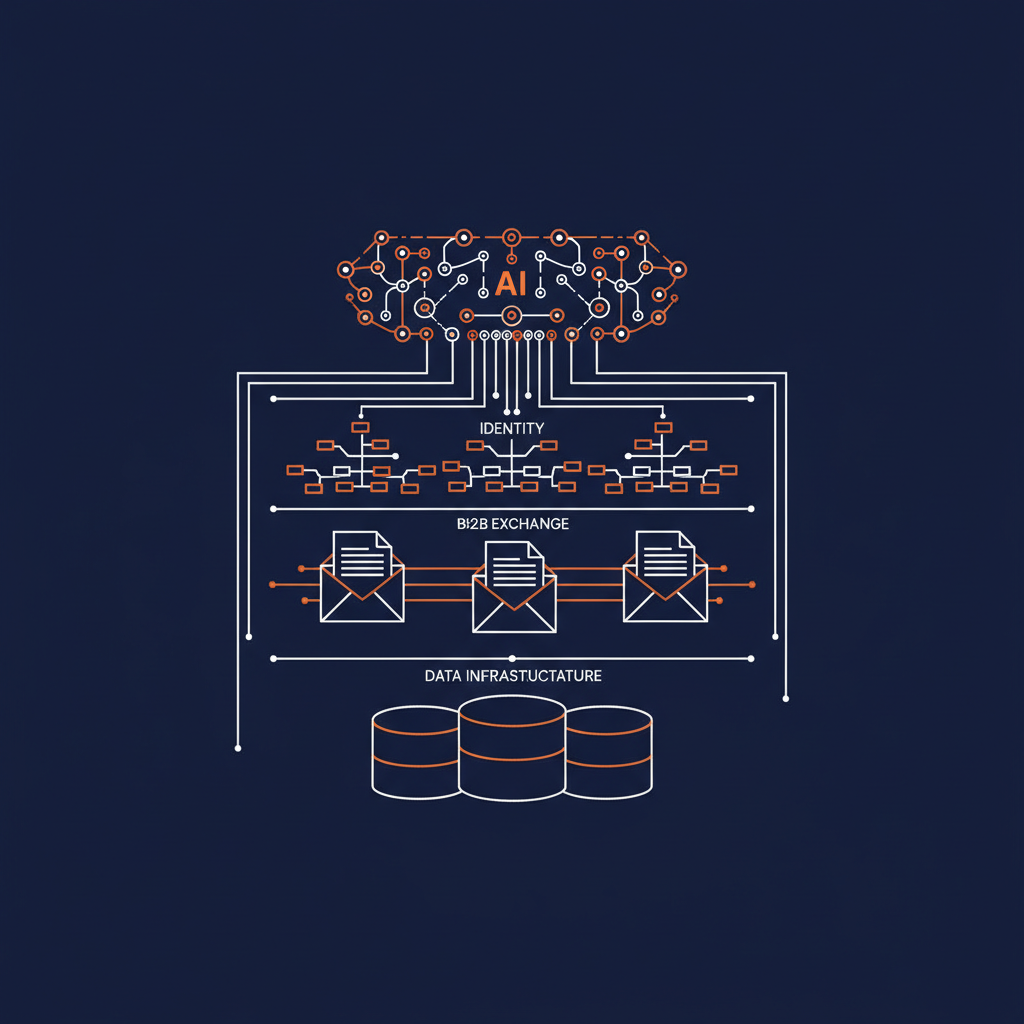
1. AI is real, but it is not alone at the top. Yes, 86% of enterprises are investing in AI, ML, and Deep Learning. That part of the narrative is true. What is missing from the narrative is that the same enterprises are investing — at the exact same intensity — in identity infrastructure, B2B document exchange, and operational tooling. The boring stuff did not go away. It got more important, because every AI initiative eventually has to authenticate against Active Directory and exchange data with a partner over EDI.
2. The unglamorous layers are load-bearing. Active Directory at #2 and EDI at #3 are not legacy footnotes. They are the substrate every shiny initiative runs on top of. When 86% of large enterprises are still actively investing in EDI in 2026, that is not technical debt — it is the operating reality of how business actually moves between organizations. Anyone selling an “agent-to-agent commerce” vision that does not have an EDI story is selling a slide deck.
3. “Data” is the silent winner. “Data” as a category sits at 86%, alongside Deep Learning and Machine Learning. Enterprises figured out a long time ago that AI without data infrastructure is a demo, not a system. The investment in pipelines, governance, and storage matches the investment in models — because it has to.
What the hype cycle gets wrong
The dominant story of 2026 is that AI is reshaping everything and the rest of the stack is along for the ride. The signals say something more honest: AI is being layered on top of a stack that enterprises are still actively maintaining and growing. The directory service is not going away. The EDI gateway is not going away. The operational tooling is not going away. They are getting more investment, not less, because the AI layer increases the demands on all of them.
If you are building for enterprises, this matters. A product that assumes the legacy substrate is dissolving will lose to a product that assumes it is thickening. Because the data says it is thickening.
Why this is visible at all
The reason any of this is visible is that we stopped relying on what enterprises say and started reading what they do. Job postings are a leading indicator of investment. OSS contributions are a leading indicator of internal capability. SaaS portfolios are a leading indicator of architectural strategy. Standards participation is a leading indicator of interoperability commitment. None of these are secret. They are just unaggregated.
Signals aggregates them. Every company we profile is an open YAML file in a Git repository. Every signal definition is open. Every ranking is reproducible. If you disagree with how we classified a company, you can submit a PR.
What to do with this
If you are an operator inside an enterprise: use this list as a reality check on your own roadmap. If your AI strategy assumes EDI and AD are someone else’s problem, the other 86% of enterprises disagree with you.
If you are building software for enterprises: the boring categories at the top of this list are where the buyers are. The fastest path to relevance is connecting the new layer (AI, agents, MCP) to the substrate (identity, EDI, data, ops) — not pretending the substrate is gone.
If you are trying to make sense of the market: stop reading press releases. Read the signals. They are open.
The hype cycle tells you what enterprises want you to think they are doing. The signals tell you what they are actually paying people to build. Those are not the same list — and the gap between them is where the real opportunities live.