
The oil and gas industry does not need a bank to explain the Strait of Hormuz to them. They built their operations around it. Twenty percent of the world’s oil and nineteen percent of its liquefied natural gas flow through a waterway twenty-one miles wide at its narrowest point, and the companies that extract, refine, transport, and trade those commodities have spent decades optimizing every link in that chain. When the Strait becomes uncertain, these companies do not wait for analyst reports. They start stress-testing.
ExxonMobil, Chevron, Shell, BP, TotalEnergies, ConocoPhillips, and Saudi Aramco are each running scenarios on what a sustained closure means for their operations. The details differ — upstream exposure, midstream logistics, downstream refining margins, LNG contract obligations — but the underlying challenge is the same one every enterprise faces when a critical chokepoint is threatened: can you see your dependencies clearly enough to respond before the disruption cascades?
What the Majors Are Actually Facing
ExxonMobil has the broadest global footprint of any US major. Their upstream operations span the Permian Basin, Guyana, and LNG projects in Qatar and Mozambique. The Qatar exposure is direct — ExxonMobil holds a significant stake in the Golden Pass LNG export terminal and Qatar’s North Field expansion. When the Strait narrows operationally, ExxonMobil’s LNG logistics — vessel scheduling, contract fulfillment, rerouting calculations — depend on integration systems that connect trading desks, shipping partners, and downstream customers in real time. Every one of those integrations is a dependency that has to adapt simultaneously.
Chevron operates on both sides of the disruption. Their upstream presence in the Permian and DJ Basins means US production is relatively insulated, but their global trading operations, Tengizchevroil partnership in Kazakhstan, and downstream refining operations depend on crude pricing that moves with Hormuz risk. Chevron’s 2025 investor presentations have emphasized operational resilience and capital discipline — language that maps directly to the integration governance question: do you know what your systems depend on, and can you adapt those dependencies faster than the market moves?
Shell has been the most explicit about scenario planning. Their annual energy security analysis has modeled Hormuz disruption scenarios for years, and their LNG portfolio — the world’s largest — gives them direct exposure. Shell moves roughly sixty-seven million tonnes of LNG per year across a network of long-term contracts, spot trades, and shipping logistics. When the Strait becomes uncertain, the integration systems that manage that portfolio — contract management, vessel tracking, cargo optimization, counterparty communication — are the operational infrastructure that either adapts or breaks.
BP has been navigating structural transition for years, rebalancing between hydrocarbons and renewables. Their exposure to the Strait runs through their Middle East upstream partnerships and a global trading operation that handles millions of barrels per day. BP’s trading desk is one of the most sophisticated in the industry — and sophistication means integration complexity. Every data feed, every counterparty API, every risk model that ingests pricing data is a dependency that gets stress-tested when Hormuz scenarios shift from theoretical to operational.
TotalEnergies carries among the highest direct Gulf exposure of any European major. Their partnership with ADNOC in the UAE and significant LNG positions in Qatar mean that a sustained disruption hits their supply chain at multiple points. TotalEnergies has invested heavily in integrated energy management systems — the kind of operational infrastructure that only works when every integration in the chain is functioning. When one link in the chain becomes uncertain, the question is whether the system can adapt or whether it discovers its own fragility.
ConocoPhillips has positioned itself as a pure-play exploration and production company, which means their Hormuz exposure is primarily through global crude pricing and their LNG marketing operations. But pure-play does not mean simple. ConocoPhillips’ operational model depends on integration systems that connect reservoir data, production optimization, logistics scheduling, and commodity trading. Each of those systems talks to external partners, market data providers, and regulatory platforms. Each is a dependency.
Saudi Aramco sits at the center of the disruption. The world’s largest oil company, producing over nine million barrels per day, with the majority of its export capacity routed through Gulf terminals that depend on Strait passage. Aramco has invested billions in bypass infrastructure — the East-West pipeline to Yanbu on the Red Sea provides some alternative routing — but capacity is limited relative to total export volume. Aramco’s challenge is not just physical logistics. It is the integration infrastructure that coordinates production scheduling, tanker allocation, customer delivery commitments, and real-time market pricing across a network that spans dozens of countries and hundreds of counterparties.
The Pattern Underneath the Barrels
Set aside the specific production numbers and look at what every one of these companies is actually managing. A network of operational dependencies — trading platforms, logistics APIs, partner data feeds, SCADA systems, contract management platforms, regulatory reporting integrations — that all assume certain flows will continue. When those flows become uncertain, the enterprises that respond fastest are the ones that can see their dependencies clearly, identify which integrations are chokepoints, and adapt without reverse-engineering their own infrastructure under pressure.
This is not a story about oil tankers. It is a story about the integration infrastructure that oil tankers depend on.
Every enterprise operates with its own version of the Strait of Hormuz. The cloud platform your SCADA data flows through. The API your trading desk calls ten thousand times an hour. The data feed your refinery scheduling depends on. The partner integration three business units share. These integrations are invisible infrastructure. Most of them are managed the way shipping lanes were managed before geopolitical stress tests arrived: with the assumption that they will keep working, not with the readiness to respond when they do not.
What Resilience Actually Requires
The oil and gas majors have spent decades building physical resilience — strategic reserves, bypass pipelines, diversified supply routes, swing production capacity. That infrastructure exists because the industry learned, through repeated crises, that assuming continuous flow through a single chokepoint is operationally unacceptable.
Their digital integration infrastructure has not been stress-tested the same way. The integrations that connect trading systems to logistics platforms, that feed production data into optimization engines, that synchronize contract obligations across counterparties — these systems were built incrementally, by different teams, using different tools, with different levels of documentation. When pressure arrives, the teams that can respond fastest are the ones that already know what their integrations consume, what they expose, and what they depend on.
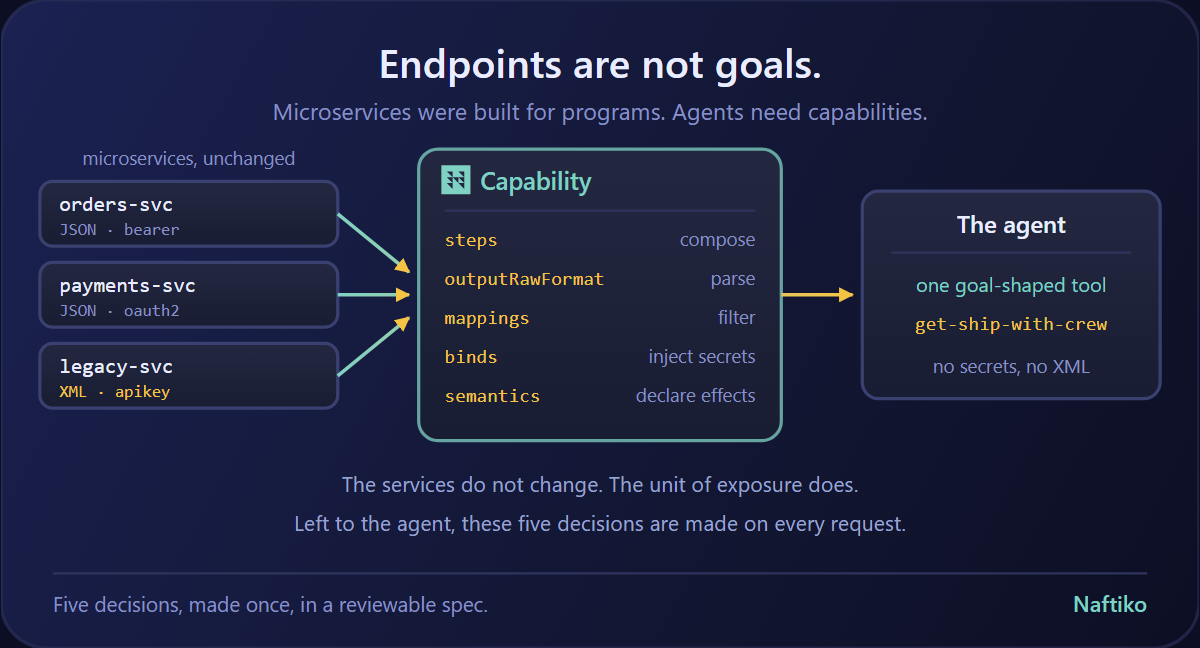
For enterprise integration infrastructure, that preparation has a technical name. It is governance. Specifically, it is the ability to declare what your integrations consume, what they expose, how they authenticate, and what they produce — in a form that is inspectable, versionable, and adaptable without requiring a team to reverse-engineer undocumented glue code at the moment of crisis.
Governing the Fleet Before the Storm
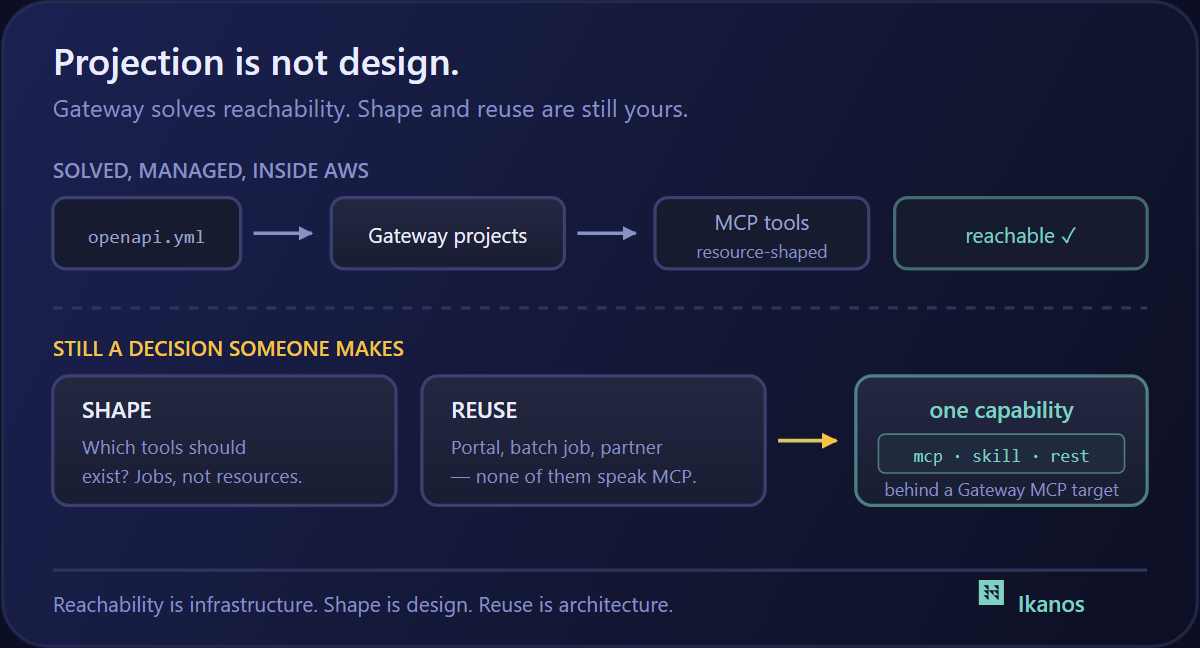
The Naftiko Fleet is an open-source framework for defining your enterprise integrations as governed capabilities — declarative YAML files that specify what each integration consumes and exposes, served over REST, MCP, or Agent Skills without application code. The specification is the integration. That means every dependency your enterprise has on an external API or internal service can be inventoried, reviewed, versioned, and adapted without touching application code.
When Shell manages sixty-seven million tonnes of LNG across a global portfolio, the operational question underneath is: how many integrations does that portfolio depend on, and how many of them could you swap, reroute, or adapt within hours if a critical dependency failed? When Saudi Aramco coordinates production across nine million barrels per day of output, the question is: how many of those coordination systems are a single integration away from manual fallback? When BP’s trading desk processes millions of barrels of transactions daily, the question is: how many of those data feeds are chokepoints with no contingency?
The Naftiko Fleet does not solve geopolitical risk. Nothing does. What it does is give you the visibility and control to respond when the chokepoints you depend on — in energy markets, in logistics infrastructure, in the operational systems your enterprise runs on — experience the kind of disruption that every oil and gas major is now modeling as a primary scenario.
The Strait of Hormuz is twenty-one miles wide. The integrations your enterprise depends on are narrower than that, and most of them have no contingency plan.