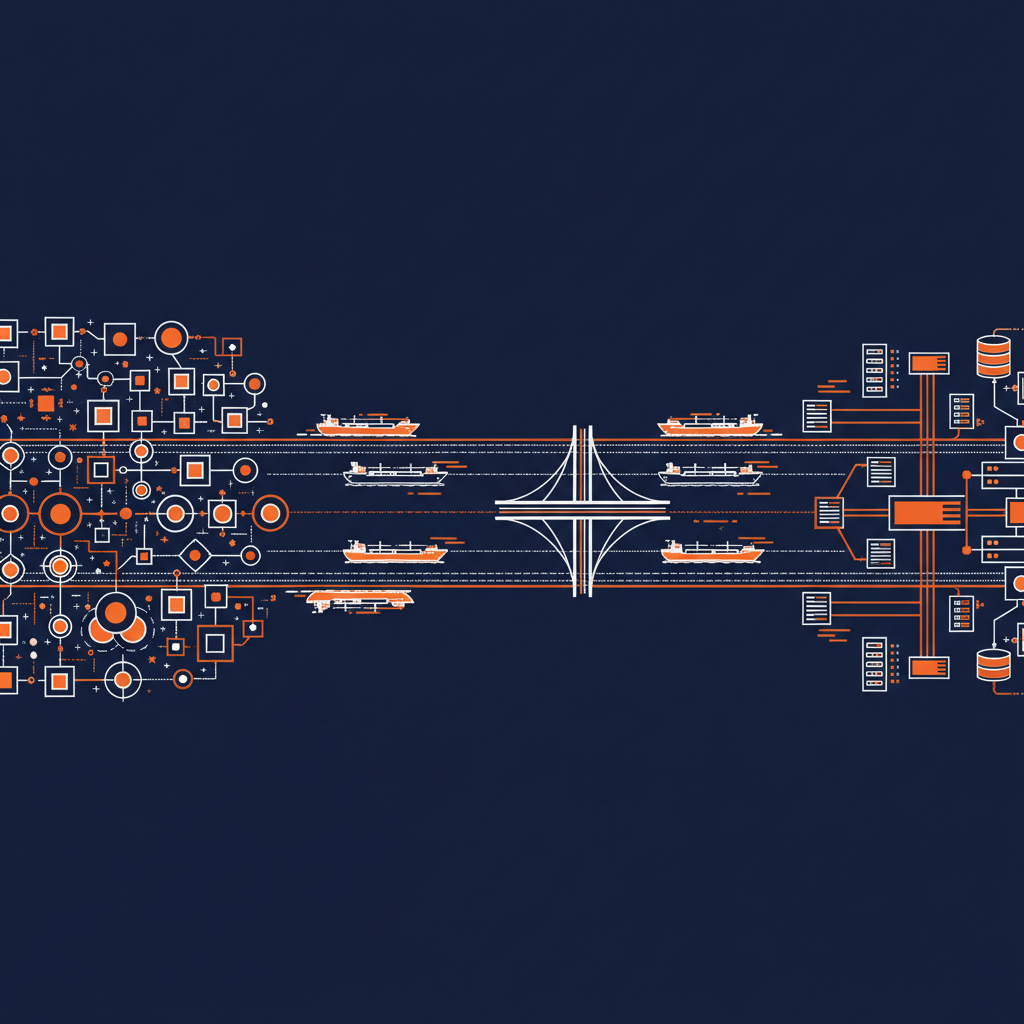
Twenty percent of the world’s oil and nineteen percent of its liquefied natural gas move through a waterway twenty-one miles wide at its narrowest point. When geopolitical pressure in the Middle East reaches a certain threshold, every major financial institution on earth starts doing the same math. This week, they published their answers.
JPMorgan, Goldman Sachs, Morgan Stanley, Citigroup, Deutsche Bank, BNP Paribas, and UBS have each released analysis on what a sustained Strait of Hormuz disruption means for global markets. The details differ. The underlying message does not: when a critical chokepoint closes, the enterprises that survive are the ones that can see their dependencies clearly, adapt quickly, and maintain control over the systems they rely on. That is a statement about oil tankers. It is also a statement about enterprise integration infrastructure.
What the Banks Are Actually Saying
JPMorgan has been the most direct about scale. Their analysis characterizes the current situation as “the largest supply disruption in the history of the global oil market” — seven million barrels per day of regional production shutdowns, with the Strait accounting for roughly twenty percent of global oil flows. The Private Bank arm notes that the Middle East conflict is becoming an energy problem with differential exposure: Asia and Europe carry the most import risk, while the US is cushioned but not immune. Their Asset Management team has published detailed scenario guidance for institutional investors navigating the uncertainty.
Goldman Sachs has gone furthest on quantification. Their analysis of the Iran conflict’s oil price impact estimates 17.6 million barrels per day affected — a disruption eighteen times larger than the peak Russian oil shock of April 2022. Oil price increases of $1–$15 per barrel depending on duration and extent. Recession probability rising to thirty percent. Goldman also flags the LNG dimension that most observers miss: nineteen percent of global LNG supply — approximately eighty million tons per year — flows through the same chokepoint, meaning the energy exposure is not limited to crude markets.
Morgan Stanley has taken the scenario-planning approach. Across multiple published analyses and a dedicated podcast on Strait of Hormuz energy markets, their team has revised 2026 oil expectations from roughly sixty dollars to eighty to ninety dollars per barrel — with prices already exceeding one hundred. The complication they keep returning to is the stagflation dynamic: the energy shock drives simultaneous downward revisions to growth and upward revisions to inflation, putting central banks in a position where the standard toolkit does not apply cleanly.
Citigroup offers the most measured view. In Turmoil in the Middle East: Could Resilience Again Prevail?, they argue that the global economy has sufficient buffers — strategic petroleum reserves, demand adaptation, stronger household balance sheets, resilient labor markets — to absorb the shock without tipping into recession. The key word in their framing is resilience. Citi’s thesis is that resilience is not accidental; it is the product of having built redundancy, visibility, and adaptability into the system before the disruption arrives.
Deutsche Bank takes the most unconventional angle. Their analysis — covered by Middle East Eye — warns that a prolonged disruption could accelerate the erosion of petrodollar dominance, with China potentially securing passage through yuan-denominated payments. The geopolitical calculus here is long-cycle: the disruption does not just affect this quarter’s oil prices, it potentially reshapes the currency infrastructure that global trade has operated on for fifty years. Deutsche Bank is watching the Strait not as an energy story but as a monetary system story.
BNP Paribas has focused on differential exposure within the Gulf region itself. Their Gulf resilience and investment outlook analysis highlights that smaller Gulf states — Bahrain, Kuwait, Qatar — face the hardest constraints because they have no alternative export routes. Saudi Arabia and the UAE can partially offset through overland bypass capacity, but at limited volume. BNP Paribas concludes that Gulf macro fundamentals are strong enough to absorb the shock, but regional GDP contraction in 2026 is likely regardless.
UBS has been most granular on GDP impact. Their commodity analysts estimate the supply shock at ten million barrels per day removed from supply, with refined products impacted in addition to crude. Their scenario analysis projects global real GDP growth falling 0.2 percentage points for a one-quarter disruption, 0.3 for two quarters, and 1.3 percentage points if the disruption extends three quarters. UBS also extends the analysis beyond hydrocarbons to industrial commodities — methanol, aluminum, sulfur, graphite — that are critical to manufacturing and the green energy transition. The exposure is broader than most headline analyses capture.
The Pattern Underneath the Oil Price
Set aside the specific oil price forecasts for a moment and look at what every one of these analyses is actually describing. A chokepoint closes. Everything that depended on flow through that chokepoint — cargo, fuel, feedstock, production inputs — becomes uncertain. Enterprises that knew exactly what they depended on, had redundancy built in, and could adapt their operations quickly fared better than those that discovered their exposure only after the closure.
This is not a story about tankers. It is a story about visibility and control over dependencies.
Every enterprise operates with its own version of the Strait of Hormuz. The SaaS platform that processes your payments. The logistics API your fulfillment system calls sixty thousand times a day. The data feed your risk models ingest every hour. The authentication service three teams depend on. These integrations are the invisible infrastructure that enterprise operations flow through. Most of them are managed the way shipping lanes were managed before geopolitical stress tests arrived: with the assumption that they will keep working, not with the readiness to respond when they do not.
The banks are telling a story about oil. The lesson applies to every critical dependency your enterprise has built on top of infrastructure you do not control.
What Resilience Actually Requires
Citi’s framing — could resilience again prevail? — is worth dwelling on. The word again implies that resilience is something that has been demonstrated before under stress, not something that simply exists by default. It is earned through preparation: redundancy in supply, visibility into exposure, the ability to substitute and adapt when a specific flow is interrupted.
For enterprise integration infrastructure, that preparation has a technical name. It is governance. Specifically, it is the ability to declare what your integrations consume, what they expose, how they authenticate, and what they produce — in a form that is inspectable, versionable, and adaptable without requiring a team to reverse-engineer undocumented glue code at the moment of crisis.
The enterprises that will navigate the coming months of supply uncertainty — energy price volatility, logistics disruption, stagflationary pressure on operating costs — are the ones that already know what their systems depend on and can change those dependencies faster than their competitors. That advantage is not built during a crisis. It is built before one arrives.
Governing the Fleet Before the Storm
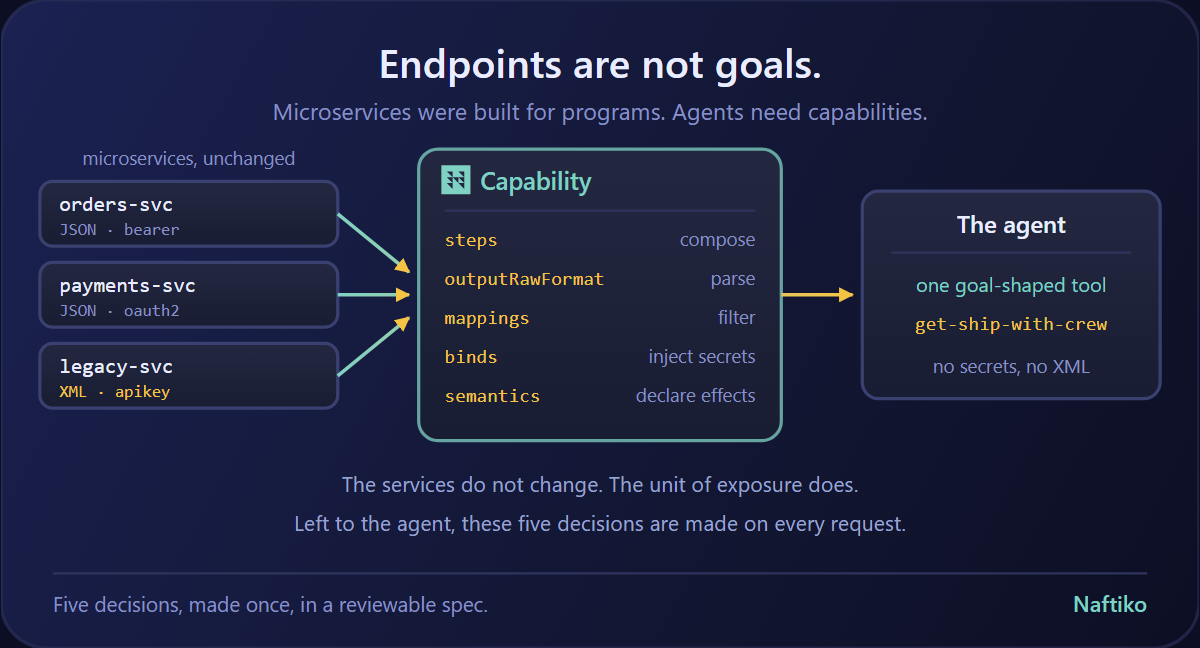
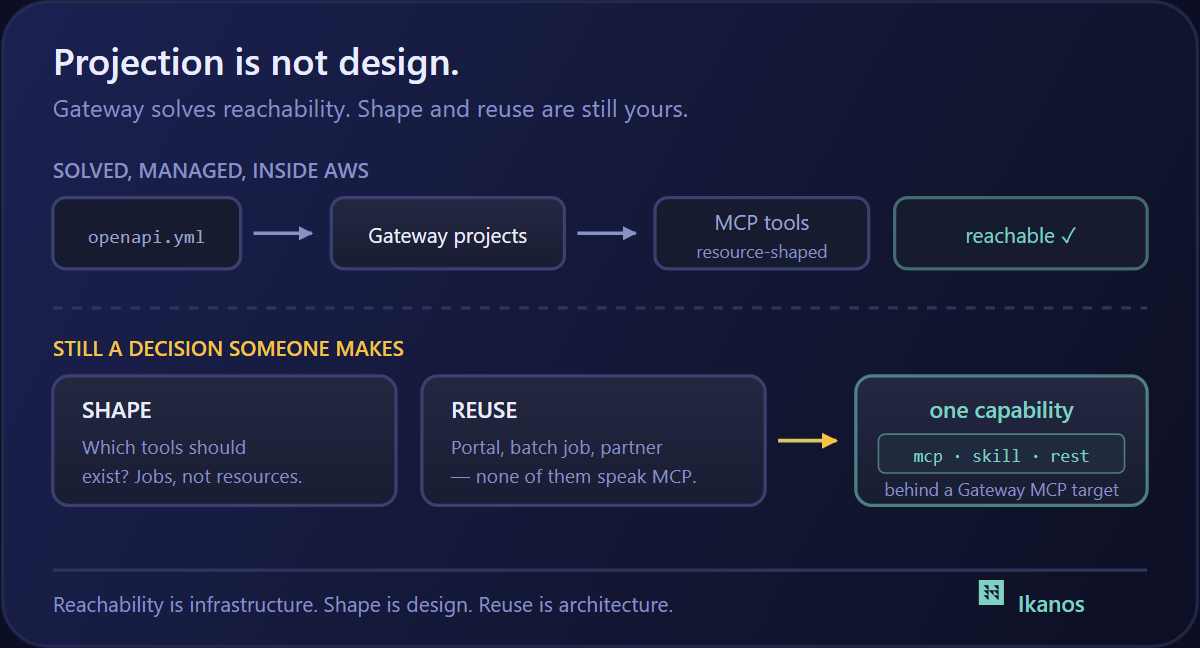
The Naftiko Fleet is an open-source framework for defining your enterprise integrations as governed capabilities — declarative YAML files that specify what each integration consumes and exposes, served over REST, MCP, or Agent Skills without application code. The specification is the integration. That means every dependency your enterprise has on an external API or internal service can be inventoried, reviewed, versioned, and adapted without touching application code.
When Deutsche Bank warns about petrodollar erosion and currency infrastructure shifts, the underlying question is: how many of your integrations assume payment infrastructure that may need to change? When UBS extends the analysis to industrial commodities and manufacturing inputs, the underlying question is: how many of your supply chain integrations are a single dependency away from failure? When Morgan Stanley describes stagflation dynamics that complicate standard policy responses, the underlying question is: how quickly can your operations adapt to new constraints when the environment shifts faster than your planning cycles?
The Naftiko Fleet does not solve geopolitical risk. Nothing does. What it does is give you the visibility and control to respond when the chokepoints you depend on — in energy markets, in payment infrastructure, in logistics APIs, in the SaaS stack your teams run on — experience the kind of disruption that every major bank is now modeling as a primary scenario.
The Strait of Hormuz is twenty-one miles wide. The integrations your enterprise depends on are narrower than that, and most of them have no contingency plan.