
We track technology investment signals across 292 companies with Naftiko Signals. APIs, AI, cloud, data, security, governance, automation, integrations — scored and ranked by observable investment across public job postings, technical content, open-source activity, and public ecosystem signals.
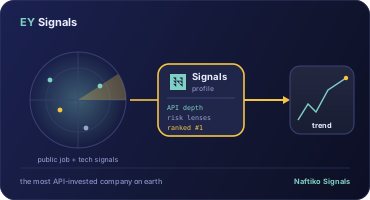
EY ranks number one. Not just number one among professional services firms. Number one across all 292 companies. Ahead of Citi. Ahead of Scotiabank. Ahead of UnitedHealth Group. Ahead of Morgan Stanley, Cisco, Visa, Nvidia, and Alphabet.
A Big Four accounting and advisory firm is the most API-invested company on Earth. It is an interesting signal.
The Numbers
EY scores 2,603 points across all investment categories. Here is how that breaks down against the other major professional services firms:
| Company | Total Score | Share of Sector |
|---|---|---|
| EY | 2,603 | 22.8% |
| Accenture | 2,022 | 17.7% |
| Booz Allen | 1,447 | 12.7% |
| McKinsey | 1,435 | 12.6% |
| KPMG | 1,200 | 10.5% |
| PwC | 1,155 | 10.1% |
| Bain & Company | 991 | 8.7% |
| Deloitte | 572 | 5.0% |
EY leads every single category — APIs (40), AI (118), cloud (219), data (222), security (139), governance (92), services (400), integrations (61), containers (44), observability (66). This is not a narrow lead in one area. It is broad, deep, and consistent.
Why Professional Services Is Ahead
Professional services as a sector totals 11,425 points across these eight companies. That places it twelfth by industry total — behind technology, financial services, healthcare, and fintech. But the raw total understates what is happening.
Technology’s 44,840 points are spread across 49 companies, averaging 915 points each. Professional services’ 11,425 points are concentrated in 8 companies, averaging 1,428 points each. Per-company investment density in professional services is 56% higher than technology.
The reason is structural. Professional services firms do not build one product. They build integration and transformation capabilities for every client, across every industry. A single firm like EY needs to be competent in financial services data platforms, healthcare interoperability, manufacturing automation, retail personalization, and energy grid management—simultaneously. That breadth of investment shows up in the signals.
These firms also sit at the intersection of business strategy and technical implementation. They are the ones wiring SAP to Salesforce, connecting Workday to Azure AD, building data pipelines from Oracle to Snowflake, and now — increasingly — governing AI agent access to all of it. Their investment in APIs, integrations, governance, and security is not aspirational. It is operational.
What EY Is Doing Differently
EY’s lead over Accenture (2,603 vs. 2,022) and the rest of the field is not random. A few patterns stand out in the data:
Services investment is massive. EY scores 400 in services — the highest single-category score of any company in the dataset. This reflects EY’s breadth across advisory, assurance, tax, and strategy consulting, each requiring deep integration with client technology stacks.
Cloud and data are the foundation. Cloud (219) and data (222) are EY’s two highest infrastructure scores. These are the categories where enterprises are building the platforms that AI agents will eventually consume. EY is investing in the substrate.
Governance is a differentiator. EY scores 92 in governance — significantly ahead of Accenture (64), PwC (50), KPMG (48), and Booz Allen (35). For a firm whose core business includes audit and compliance, governance investment makes strategic sense. But it also positions them ahead of the curve for AI agent governance, where controlling what agents can access and do is becoming an enterprise-critical requirement.
Security investment is the highest in the sector. EY’s 139 in security leads Accenture (97), Booz Allen (88), KPMG (68), and PwC (53). In a world where AI agents are about to be given API access to enterprise systems, security investment is not defensive — it is the prerequisite for adoption.
Why This Matters for Naftiko
The professional services sector’s investment pattern maps directly to what Naftiko builds. These firms need to:
- Discover and inventory APIs across client environments that span dozens of platforms and hundreds of services
- Govern API access so that AI agents operate within trust boundaries — with identity propagation, policy enforcement, and audit trails
- Compose capabilities from existing APIs, data sources, and services into reusable units of work that can be deployed across clients and industries
- Observe and measure what agents are doing, what APIs they are consuming, and whether the integrations are working as expected
This is exactly what Naftiko Fleet does. Each capability is a portable YAML that consumes APIs and exposes governed MCP tools, REST resources, and agent skills. The framework handles discovery, composition, governance, and observability.
Professional services firms are the most integration-intensive organizations on the planet. They have the most APIs to govern, the most client environments to integrate, and the most urgent need for AI agent infrastructure that actually works. The investment signals confirm it. EY is not ahead by accident — they are ahead because their business demands it.
The question is whether the rest of the enterprise world catches up before the agents arrive, or after.
You can explore the full signals data by becoming a Naftiko design partner and run capabilities yourself using the open-source Naftiko Fleet.