Enterprises that invested in Apigee made a specific bet: that governed API infrastructure would become load-bearing for the business. That bet is paying off. But the terrain has shifted in a way that Apigee was not designed to address on its own. The primary consumer of your APIs is no longer a developer writing a mobile app. It is an AI agent that needs to reason about what your APIs can do, call them deterministically, and return results that map to a business outcome — not just a JSON payload.
Apigee governs your gateway. Naftiko governs what happens between your gateway and the AI systems your enterprise is now building on top of it.
What Apigee Does Well
Apigee is excellent at what it was designed for. It manages API proxies, enforces authentication and rate limiting, routes traffic across environments, packages capabilities as API products for developer consumption, and provides analytics on how those products are being used. It gives enterprises the gateway controls that make large-scale API programs possible.
The Apigee API Hub adds a catalog layer — a place to register, version, and search the APIs your organization produces. The APIM observation layer detects shadow APIs surfacing in traffic that were never formally registered. Together these tools give platform engineering teams a comprehensive view of API supply: what proxies exist, what products wrap them, who is consuming them, and what is happening in the traffic stream.
This is the right foundation. It is not, by itself, an AI strategy.
The Problem That Apigee Alone Does Not Solve
When an AI agent needs to use an API, it does not browse the Apigee developer portal. It does not read a human-authored product description and infer what to call. It needs a structured, machine-readable definition of what the API can do, what inputs it requires, what outputs it produces, and how to authenticate — expressed in a format the agent can reason about and act on.
Most enterprise AI integration work today is being done the hard way: developers write bespoke integration layers that sit between AI tools and Apigee-managed APIs. Each team builds its own version. Each version has its own authentication assumptions, its own output shaping, its own error handling. The result is an AI integration layer that is fragmented, ungoverned, and invisible to the platform engineering team that is supposed to own it. Apigee can see the traffic. It cannot see the intent behind the integration, the business outcome it is supposed to produce, or whether five different teams have built five different versions of the same thing.
This is the gap Naftiko is built to close.
Capabilities as the Bridge Between Apigee and AI Outcomes
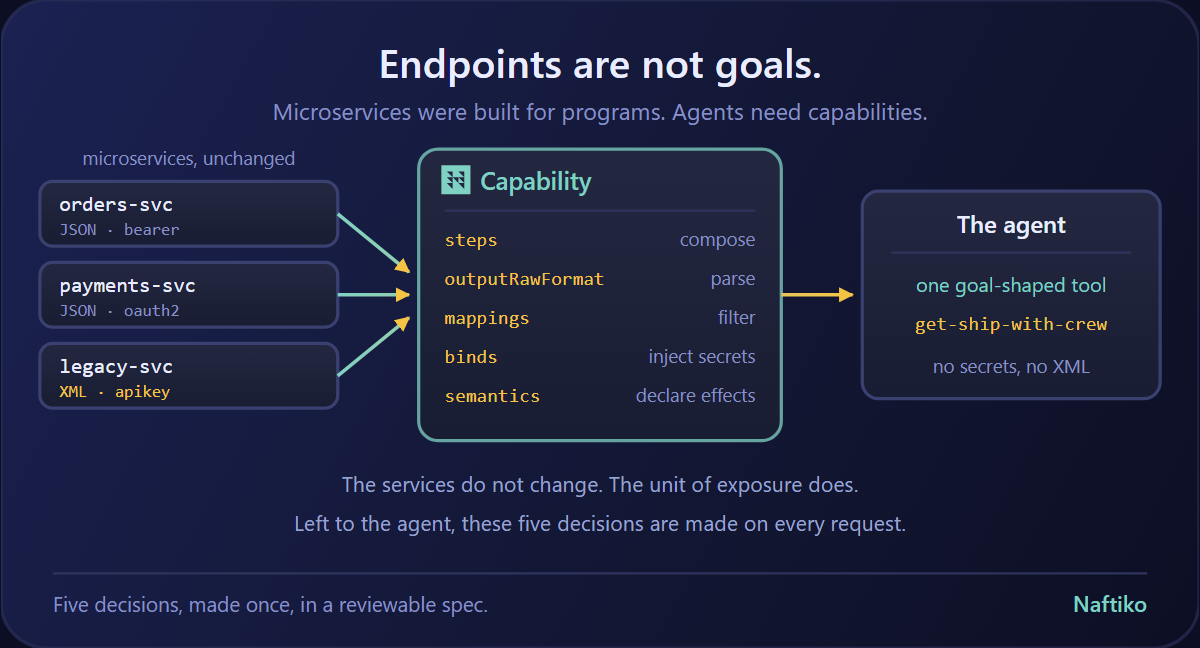
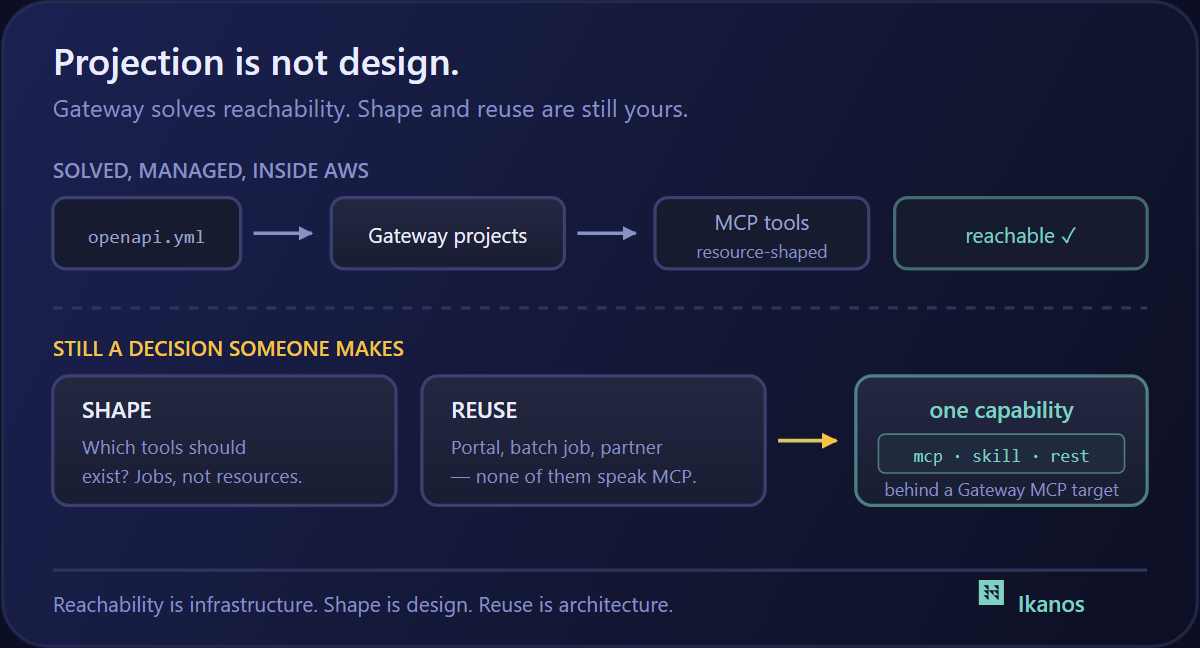
A Naftiko capability is a declarative YAML file that specifies exactly what an integration consumes from an upstream API and exactly what it exposes to downstream consumers. For an Apigee customer, that means declaring the Apigee-managed endpoints your teams depend on, shaping the outputs to match what AI systems actually need, and exposing the result as MCP tools, REST endpoints, or Agent Skills — all from the same governed specification.
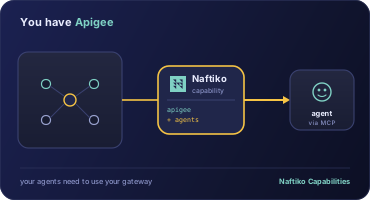
The capability sits between Apigee and the AI layer. It does not replace Apigee’s proxy management, rate limiting, or authentication enforcement. It extends that governance upward, into the AI consumption surface, where the business outcomes actually live.
Consider what this looks like in practice for a platform engineering team running Apigee:
API proxy inventory becomes an MCP tool. Instead of a developer asking “what APIs do we have,” an AI agent calls list-api-proxies and gets a structured response that can be reasoned about, filtered, and acted on. The governance is in the spec. The answer is always current because it comes from Apigee directly.
API product subscriptions become governed context. Instead of manually tracking which developers have access to which products, a capability exposes list-developer-apps and get-api-product as tools that an AI assistant can use to answer access questions in real time — without requiring a human to navigate the Apigee console.
Shadow API discovery becomes an AI workflow. The Apigee APIM observation layer finds undocumented APIs in your traffic. A Naftiko capability exposes discover-shadow-apis and list-observed-api-operations as MCP tools. An AI agent can now run a governance workflow: find the shadow APIs, identify which teams own the traffic, compare against the catalog, and flag gaps — without a human coordinating each step.
Analytics become business signal, not just traffic data. Apigee’s analytics report on request counts, latency, and error rates. A capability can shape those analytics responses into the context an AI business intelligence layer needs: which API products are driving revenue, which developer apps are generating the most value, where traffic patterns suggest an untapped market opportunity.
Aligning API Operations With AI Business Outcomes
The framing that matters here is not technical — it is organizational. Apigee gives you control over your API operations. Naftiko gives you a way to connect those operations to the AI workloads that are now expected to produce business outcomes.
Every enterprise using Apigee has invested in a catalog, a proxy layer, a set of API products, and a developer ecosystem. That investment was made because APIs were the integration primitive that mattered. They still are. But the expectation has changed: APIs are no longer just integration infrastructure. They are the connective tissue between enterprise data and the AI systems your business is being asked to build, govern, and scale.
The teams building AI agents and AI-assisted workflows inside your enterprise need the same thing your API program was built to provide: governed access to the right data, at the right level of abstraction, with the right authentication, in a format the consumer can actually use. The difference is that the consumer is now an AI system, and the format it needs is a structured capability spec, not a developer portal.
Naftiko makes your Apigee investment AI-ready without changing what Apigee does. You keep the gateway, the proxy management, the product packaging, the analytics. You add a governed capability layer that exposes Apigee operations as the structured, declarative surfaces AI agents can reason about and act on.
Getting Started
The five Naftiko capabilities built for Apigee cover the most common AI integration patterns a platform engineering team will encounter:
- API Lifecycle Management — proxies, products, developers, environments, and deployments as MCP tools
- API Governance and Observability — catalog search, shadow API discovery, and spec tracking unified in a single governed surface
- API Specification Management — spec inventory, contents retrieval, and compliance linting for AI-assisted governance workflows
- Developer Portal and App Management — developer and app context for AI assistants that need to answer access and subscription questions
- Analytics and Traffic Observability — traffic analytics and shadow API correlation for AI-powered platform intelligence
Each capability imports the relevant shared Apigee API definitions and exposes them over REST and MCP from the same YAML specification. No application code. No bespoke integration layers built team by team. One governed spec, every surface.
Your Apigee investment built the gateway. Naftiko connects it to the outcomes your AI strategy requires.