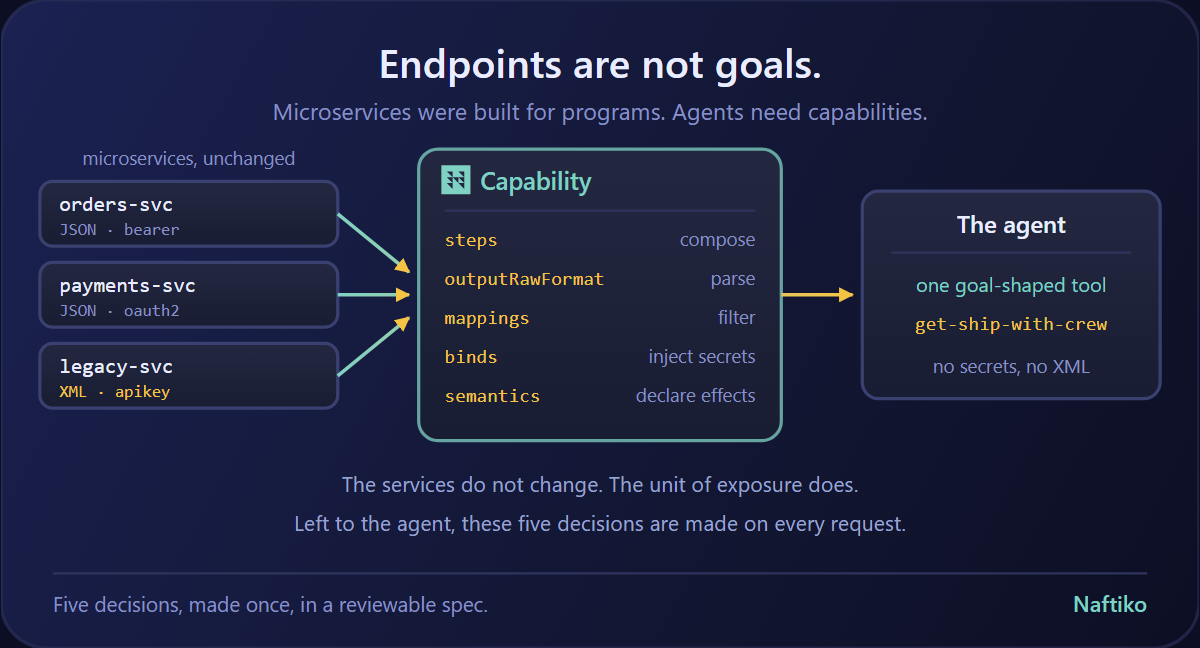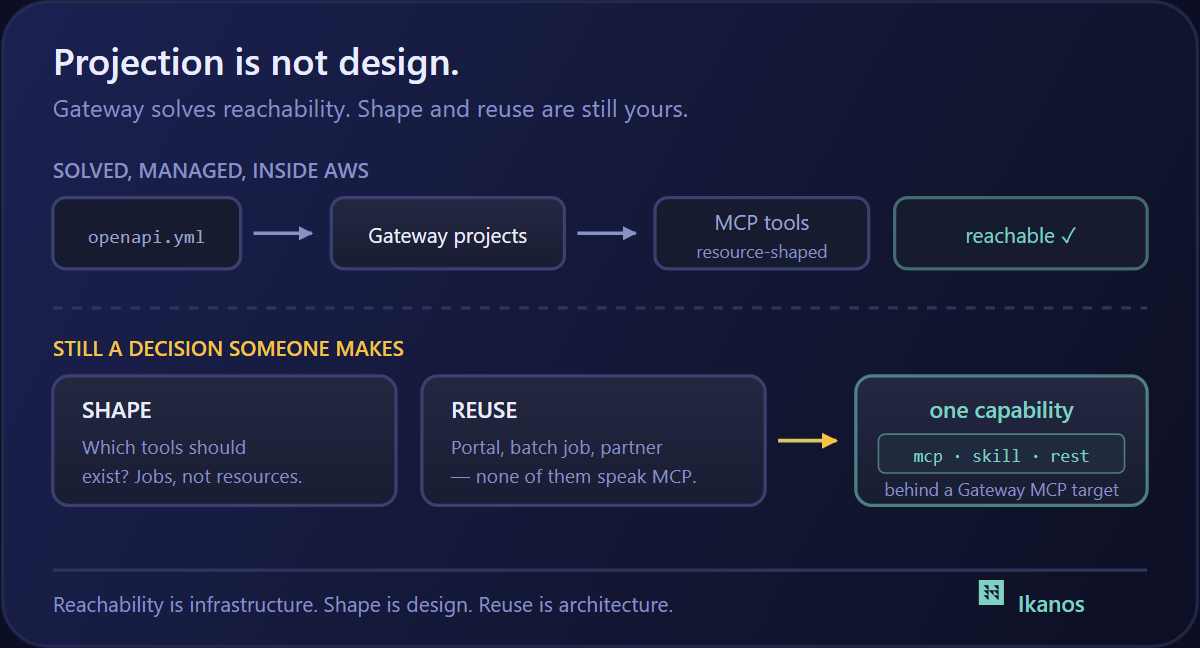

I had a working session with an advisor last week where we both ended up at the same phrase at the same time. We had been circling for half an hour trying to describe what Naftiko is to a CIO who is not yet sold on us. Not the demo. Not the tactical pitch. The positioning. The one-line answer to what does this company actually do.
We landed on it together.
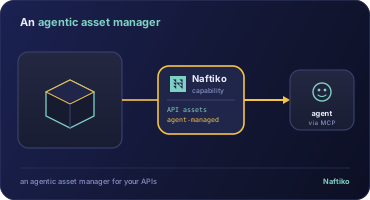
Naftiko is an agentic asset manager.
I wrote it down. Then I sat with it for a few days. Then I tested it on three more conversations. Then I came back to write this post.
The phrase fits. It fits in a way the previous attempts — “AI integration platform,” “capability fleet,” “MCP governance layer” — never quite did. It explains who the buyer is, what the job is, why the job is new, and why the existing categories do not cover it. The rest of this post is the unpack.
Every enterprise already has an asset manager. They just call it IT.
Walk into any enterprise of meaningful size and ask who knows what software we are running, what it costs, who has access, and what we are not using. Somebody knows. Probably a small group of people inside IT, or finance, or a procurement office that sits between the two. They are running an asset manager — whether or not the budget line says “asset manager” — because the alternative is shadow IT, license waste, and audits that go badly.
Software asset management is a boring discipline. Nobody writes founder Twitter threads about it. But it is also one of the most consequential things an enterprise does, because the assets it covers — SaaS licenses, server capacity, database instances, integration platforms, internal services — are what the business actually runs on. Get the asset management wrong and you discover you have been paying $4M a year for Salesforce seats nobody uses, or that the customer support team is using six different competing tools because nobody knew the existing one was already licensed.
The discipline has a stable shape. There are roughly five things a real asset manager does:
- Visibility. You know what you have. Every asset is in a registry. You can ask “what do we run” and get an answer.
- Access management. You know who is allowed to use what. Permissions are explicit, scoped, and auditable.
- Utilization. You know what is actually being used. The “we paid for it and nobody touches it” line item is visible.
- Maximization. You actively push toward higher utilization of paid assets before you buy new ones. Use what you have before you buy another.
- Decommission. You know when an asset’s life is over, and you retire it cleanly without leaving access lying around.
Those five jobs have existed for decades. The IT organization has owned them, the finance organization has paid for them, and the procurement organization has enforced them.
Agents just became a new class of asset. The same five jobs apply.
Why agents specifically need asset management
The job is not interesting for SaaS licenses anymore — most enterprises have working tooling for that. The job is very interesting for agents, because every property that made traditional asset management hard is amplified for agent workloads.
Agents proliferate fast. A typical enterprise added new SaaS licenses at the rate of a dozen per quarter. The same enterprise is adding agents at the rate of dozens per week — once you count team-level pilots, embedded copilots inside tools they already license, and the side projects nobody told IT about.
Agents have non-obvious access. A SaaS license grants access to the SaaS itself. An agent grants access to whatever services the agent calls on the user’s behalf. The set of services an agent reaches is dynamic, runtime-resolved, and frequently invisible to the user, let alone to IT.
Agents have non-obvious cost. A SaaS seat costs a predictable monthly number. An agent’s cost is the model bill plus the token spend plus the upstream API spend plus the retry overhead plus the human cleanup time. Most enterprises do not have a single line of accounting that captures any of those, let alone all of them.
Agents have non-obvious risk. A SaaS seat has a known compliance posture — the vendor publishes a SOC 2 report, the legal team reviews it, the access is logged. An agent’s compliance posture is per-invocation. The same agent doing the same operation on the same data can be safe on Monday and out of scope on Tuesday depending on which upstream services it composed.
Each of these makes the traditional asset management discipline more important, not less. The set of jobs is the same. The amplification is what is new.
What an agentic asset manager looks like in practice
This is what Naftiko does, mapped to the five jobs.
Visibility. Every capability you run on Naftiko is declared — what it does, what it consumes upstream, what it exposes downstream, what cost it carries, what risk surface it lives in. The declaration is the registry. Ask “what agent-reachable surfaces do we have” and there is an answer. For the services you have not declared yet, Naftiko Signals reads the external footprint and gives you the inventory you have not built one for internally yet. Visibility from both directions — what you have declared and what we can see from outside.
Access management. Capabilities ship with allow-lists. Per-environment, per-agent, per-team. The same operation can be allowed for the marketing-team agent and disallowed for the customer-support-team agent, expressed declaratively, audited centrally.
Utilization. Every capability invocation is observable — cost, latency, success rate, retry rate. The capabilities nobody uses become visible the same way the SaaS seats nobody uses do. The capabilities that are being hammered become visible too, which tells you where the next investment should go.
Maximization. The whole capability framing is built around reusability. The job is to take the API the enterprise already paid for and make it agent-reachable once, then let every agent in the org reuse the same capability. No new vendor purchase needed for most of the agent’s job. That is maximization. Use what you have before you buy another.
Decommission. Capabilities have a lifecycle. The retired ones are recorded as retired. The agents that used them know they are gone. The credentials they held are revoked. The audit log carries the history. Nothing leaks because nobody remembered to clean up.
Five jobs. Same shape as the discipline that has worked for SaaS asset management for two decades. Different artifact — the capability instead of the license — but the operating bar is the same.
Why the existing categories do not cover this
The reason this matters is not that “agentic asset manager” sounds cool. It is that the existing categories do not actually do the job.
MCP gateway. Routes agent traffic. Does not give you a registry, an access policy, a utilization view, or a cost view of the assets being routed. Necessary, not sufficient.
API management. Already exists. Already runs in most enterprises. Does not extend to the agent class of consumer, because the consumer model was designed for human-driven SDKs in 2014, not for autonomous agents in 2026. Necessary at the gateway layer, not sufficient at the asset-management layer.
LLM observability tools. Watch the model layer. Tell you what the prompt was and what the response was. Cannot see what the agent did between those two events when it called four upstream services and burned a lot of money doing it.
Software asset management tools. Manage licenses. Do not have a vocabulary for agents, capabilities, or the per-invocation cost shape an agent has.
Each of these is doing real work. None of them, alone or together, gives you the full asset-management discipline applied to the agent layer. That is the seat Naftiko is taking.
Who the buyer is
The buyer is the person in the enterprise who is already responsible for asset management at the SaaS or infrastructure layer, who is being asked to extend that responsibility to the agent layer and does not have a tool to do it.
In practice that is the CIO, the CTO, the Chief AI Officer, the head of platform engineering, or the head of integration depending on the org chart. The exact title matters less than the question they keep getting asked by the CEO and the board: what are our agents doing, what are they costing us, and are we safe?
If you cannot answer that question today, that is the gap. Naftiko fills it. That is the agentic asset manager.
Five jobs, same discipline, new class of asset. We have been running asset management on the rest of the stack for thirty years. Now we run it on the agents too.