A pattern in enterprise IT keeps repeating, and we are watching it repeat right now in real time.
A category opens up. A startup makes the entry point easy and free, gets people hooked at the team and individual level, and then funnels everyone toward the SaaS-cloud version where the actual revenue lives. The cloud version is the lock-in. By the time the enterprise notices, half of their teams are using it, and now the migration cost of leaving is bigger than the renewal price.
I have watched that play happen for two decades. I have been on the side that benefited from it. I have been on the side that had to clean it up. The clean-up side is where I keep landing, because every large enterprise I have worked with has spent the last few years fighting the same fight — get rid of the leeches, build out our own platform, stop renting from companies whose business model is hooking us deeper.
That is the context I keep in mind when I describe what we are doing differently.
Two business models look identical from the outside
From the outside, a SaaS company and an open-source company can look almost the same in the early stages. Both have a website, both have docs, both have a quickstart, both have a free tier, both have customers. The difference is what happens after the first month.
In the SaaS-cloud model, the easy entry point is the funnel. You get hooked on the local version, you graduate to the team version, you graduate to the cloud version, and now your data, your configs, your workflows, your audit trail — all of it — lives on someone else’s infrastructure under someone else’s control. When the contract changes, when the company gets acquired, when the pricing model shifts, you have very little leverage. The exit cost is the moat.
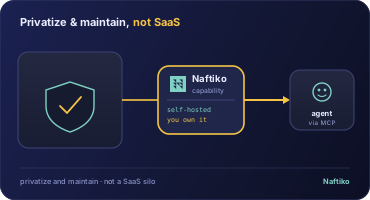
In the privatize-and-maintain model the easy entry point is the whole product. The full code is open source. The full spec is open. The artifacts you produce — the capability files, the integrations, the governance configs — are yours, on your infrastructure, in your namespace, in standards that do not require permission to read. There is no cloud version above you that owns the lock-in.
What you pay for, when you decide to be an enterprise customer, is help running it at the scale you actually need. Support. SLA. Availability. The dashboards and tooling that make running the open-source substrate at production scale practical for a real team. Mapping work — sitting alongside your team and helping you turn what you already have into governed capabilities. The labor and the assurances. Not the substrate.
If you stop being a customer, you keep the substrate. That is the whole point.
Why this matters more right now than it did a decade ago
The SaaS-cloud era created a specific kind of mess that enterprises are still untangling. Hundreds of overlapping contracts. Hundreds of overlapping integrations. Hundreds of overlapping risk surfaces. Each one was sold as velocity. Each one bought velocity in the moment. And now the bill for that velocity has come due in the form of a multi-year migration project to consolidate, centralize, and own the platform.
You do not want to build your AI platform on the same model that produced that mess. AI workloads are not lighter than SaaS — they are heavier, more cross-cutting, more sensitive to data movement, and more expensive to migrate once they are wired in. If you let your agent layer become someone else’s lock-in surface, you will be doing this exact same migration in 2032, just with bigger numbers and uglier dependencies.
Enterprises figured this out the hard way for the SaaS layer. The smart ones are not going to make the same bet again at the agent layer.
What you actually pay for
Open source is not free. The substrate is free; the operating discipline is not. There is real, ongoing work to run any open-source platform at enterprise scale. Standing it up. Connecting it to the systems that matter. Mapping the API surface into governed capabilities. Tagging by domain. Wiring observability. Maintaining auth across all the places it has to live. Keeping up with the spec as it evolves.
That work is what an enterprise license buys. The dashboards. The SLA on availability. The support contract that means your team is not the only one on the hook when something breaks at three in the morning. The mapping engagement that compresses the time-to-first-governed-capability from months to weeks. The continued contribution back into the open-source artifact so that the substrate keeps improving without anyone holding the artifact hostage.
That is the design partner relationship. We sit alongside your team. We help you map. We deliver the supporting machinery that makes running this at production weight practical. And the result of that work is yours. Open standards, open source, on your infrastructure.
The line that does the work
I have been compressing this argument into a single line, because the longer version is hard to repeat in a hallway conversation.
Naftiko is not the next SaaS you are going to have to migrate off of.
That sentence does a lot. It tells a buyer that we have noticed what just happened to them. It tells a builder that the artifact they produce is theirs to keep. It tells a CFO that the lock-in they paid through the nose for last decade is not part of this deal.
It is also a line we have to keep earning. Open source is a posture, not a press release. Every architectural decision either deepens that line or undermines it. Every business model decision either reinforces privatize and maintain or quietly turns it into use ours and pay forever.
We are deciding for the first one. On purpose. With the previous decade’s mistakes still close enough that we can see them clearly.
That is the deal.