Roadmaps are buyer documents.
The platform team reads them to know whether to pilot now or wait. The security team reads them to know whether the right governance hooks are coming. The CFO reads them to know whether the cost picture stabilizes before the next budget cycle. The Head of AI reads them to know whether the AI integration story holds together at production scale.
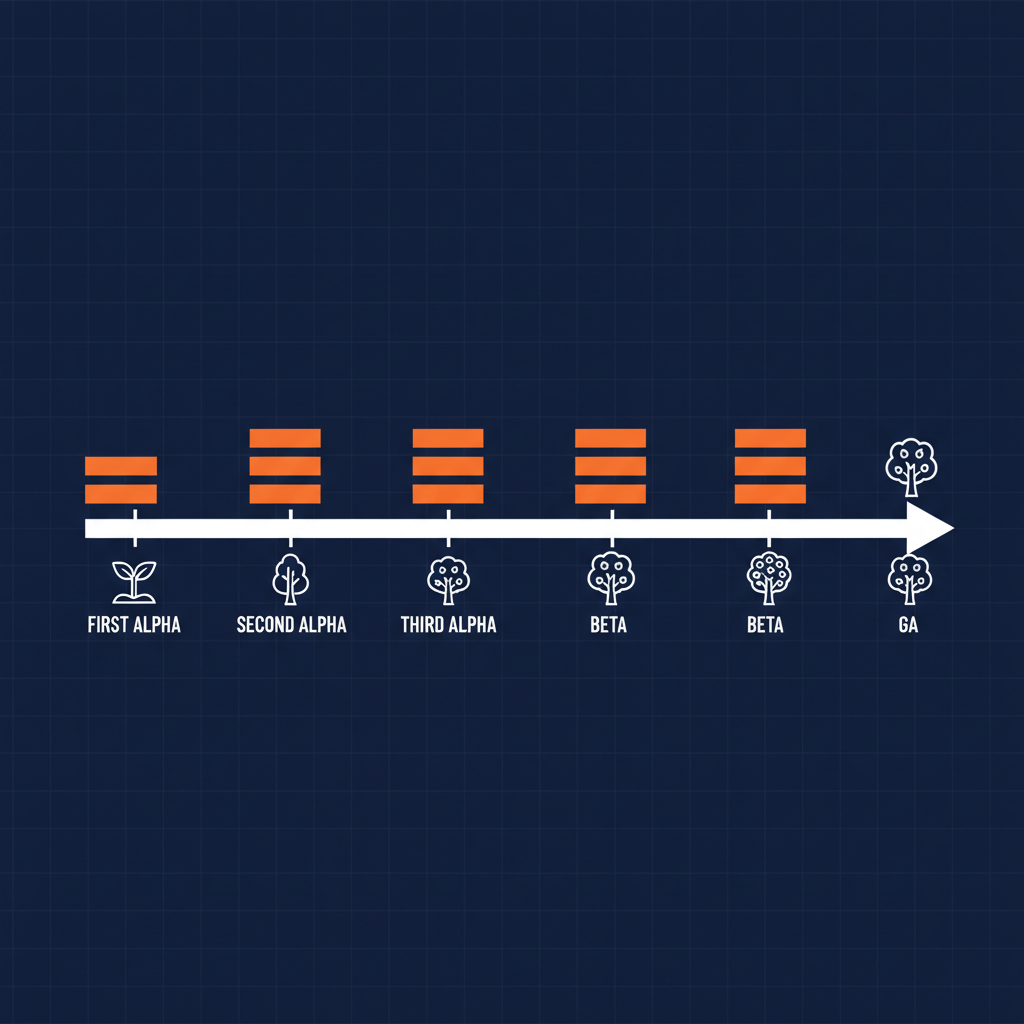
The Naftiko roadmap covers four products — Naftiko Framework, Naftiko Framework Wiki, Naftiko Fleet, Naftiko Fleet Wiki — across five milestones from First Alpha to General Availability. Here is what is in your hands today, what lands next, and what arrives by September.
Organized by buyer concern.
What shipped — First Alpha (March 30, 2026)
The Naftiko First Alpha is in production-pilot use today. What you can install and run right now:
Cost (reuse becomes measurable)
- Capability YAML as a single source of truth — the artifact that runs is the artifact that ships
- REST + MCP + Agent Skills exposed from one capability spec — three surfaces, one source
- Reusable source HTTP adapter declarations across capabilities — duplication elimination at the spec level
- Per-capability
/metricsand structured JSON logs — the FinOps primitives are in place
Risk (governed by default)
- Naftiko Ruleset based on Spectral — out-of-the-box governance for capability specs
- JSON Schema validation — every capability is structurally complete before deploy
- Tags on consumes (data sensitivity, billing) and tags on exposes (network topology, deprecation) — governance metadata travels with the artifact
GET /healthliveness/readiness probes — Kubernetes-native from day one- Resilience-pattern metrics surface — circuit breaker, bulkhead, rate limiter state
Velocity (delivery compounds)
- Naftiko Skill based on the Naftiko CLI — IDE-native capability creation
- Published Maven artifacts on Maven Central, Javadocs on Javadoc.io, Docker image on Docker Hub — every distribution channel a JVM team expects
- GitHub Action template based on Super Linter — CI integration from the first commit
- Naftiko JSON Structure published — the schema is canonical
Discoverability (catalog from creation)
NaftikoCapabilityEntityProvider— auto-catalog from CRDs or Git reposNaftikoCapabilityCard— Backstage capability page renders topology, lifecycle, stakeholders- Catalog enrichment of API entries — capabilities and APIs stay linked
- Backstage MCP server integration — agents can query the catalog
Wikis published
- Naftiko Framework Wiki — Spec-Driven Integration, Rightsize AI Context, Tutorial parts, FAQ
- Naftiko Fleet Wiki — Naftiko Templates for Backstage, Naftiko Extension for VS Code, Roadmap
What is landing now — Second Alpha (End of April 2026)
The Second Alpha is the first version that pushes the Naftiko story into agent-orchestration use cases. What is shipping right now:
Cost & Velocity
- Webhook server adapter for workflow automation — capability consumes webhooks the same way it consumes REST
- A2A server adapter with tool discovery and execution — agent-to-agent capability calls
- Factorize capability core with “aggregates” of functions — reuse at the fine-grained operation level
- Conditional steps, for-each steps, parallel-join — capabilities can express real workflows
- Control port via REST API, usable via Naftiko CLI, packaged as a capability — meta-control from inside Naftiko itself
- OpenAPI-to-Naftiko import (Second Alpha) — lift existing OAS catalogs into capability YAMLs without re-authoring
Risk
- Authentication in the MCP server adapter — closes the auth gap that has gated production rollout
- Integration with Keycloak and OpenFGA — enterprise identity stacks plug in directly
- Facilitate integration with various API / MCP / AI gateways — capability layer sits cleanly behind existing gateway investments
Discoverability
- VS Code Extension publishes to the Marketplace — installation friction drops to zero
- Backstage scaffold of a capability from existing APIs with proper lineage — capability creation from existing OAS in three clicks
- Backstage Templates for Cursor, Windsurf, Antigravity, Kiro compatibility verified
Fleet roadmap (Kubernetes integration)
- OpenTelemetry → Prometheus or Datadog — telemetry pipeline standardization
- Argo CD continuous deployment from Git — GitOps native
- Demo environment based on Kind — Kubernetes-in-Docker for local trials
Distribution
- Docker Desktop Extension on Docker Hub — single-click local install
What’s coming next — Third Alpha (End of May 2026)
The Third Alpha closes the developer-experience gaps. What lands:
Velocity & Discoverability
- Naftiko Shipyard MVP — the assistant that helps developers and agents learn to create capabilities, hosted as a capability itself
- VS Code Agent Plugin install alongside the extension with the Naftiko Skills preset — Copilot picks up Naftiko on first install
- Onboarding embedded videos and improved guidance content
Backstage integration
- TechDocs enabled for every capability created via the template — capability docs live next to the capability
- Kubernetes plugin with developer-centric monitoring —
/metricsfeeds the Backstage capability page - Tech Radar plugin focused on capabilities registered in the catalog — adopt / trial / assess / hold for capabilities, not technologies
Fleet & infrastructure
- CNOE for IDP builder + enterprise-grade CNCF stacks
- Naftiko Operator and Capability CRD via Kustomize — Kubernetes-native fleet management
What arrives in First Beta — June 2026
The First Beta is when the spec stabilizes and the production-readiness story closes. Highlights:
Cost & Velocity
- Server-side code mode in the MCP server adapter (à la CloudFlare) — execute MCP-callable code without round-tripping
- gRPC and tRPC server adapters — capabilities exposed in formats beyond REST + MCP
Risk
- Full resiliency patterns: retry, circuit breaker, rate limiter, time limiter, bulkhead, cache, fallback — patterns themselves implemented (the metrics surface for them is already shipping)
- Solidified alpha-version scope and increased test coverage
Discoverability
- Specification stable — the capability YAML schema becomes the contract you can build other tooling against
General Availability — September 2026
GA is the production-ready release. By September:
- Specification is final
- JSON Schema published to the JSON Schema Store — ecosystem-wide schema discoverability
- Beta-version scope solidified
- Test coverage and quality at the level required for first-tier enterprise production
How to read this
If you are evaluating Naftiko today: First Alpha is in your hands and meets the threshold for any AI-integration pilot. Second Alpha lands the agent-orchestration use cases. Third Alpha closes the developer-experience gap. By June, the spec stabilizes. By September, the GA story is intact.
Pilots that start now ride the Alpha → Beta → GA curve without rebuilding. The capability YAML you write today is the capability YAML that runs in GA — the spec is not changing shape under you, and the runtime is becoming more capable, not less.
Roadmaps are buyer documents. This one is the answer to “is Naftiko production-ready?” — yes for the use cases the First Alpha covers, with a clear arc to GA for the use cases the Beta and GA milestones add.
The Naftiko Framework, the Framework Wiki, the Fleet, and the Fleet Wiki together cover the full picture. Each one is shipped. Each one is on a public roadmap. Each one will be there in September with the version you piloted in April still working.