
The Naftiko Fleet
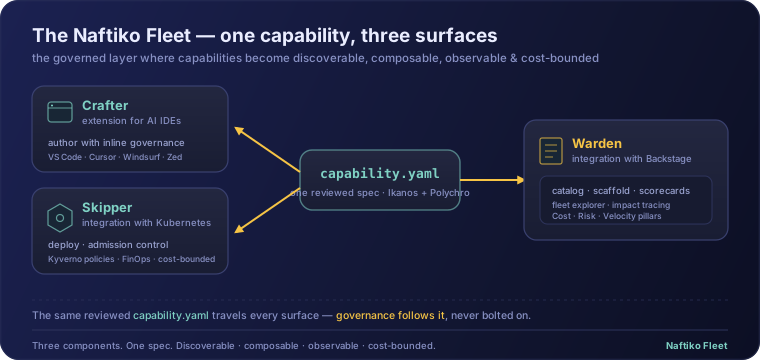
The governed enterprise layer of the Agentic Capabilities Platform. Three components carry one reviewed capability.yaml onto the surfaces your teams already use — turning API sprawl into a strategic, discoverable, and cost-bounded inventory.
Four properties of a capability fleet

Discoverable
Humans and agents can find what exists before rebuilding. Intent and semantic discovery, not just filters and keywords. Reduce human-router dependency for ownership, changes, and onboarding.

Policy-driven
Security, compliance, and ownership are enforceable. Blocking and advisory rules at validation, CI gates, and Kubernetes admission. Governance as enablement, not a gate.

Composable
Capabilities assemble into MCP servers, copilots, and agent workflows. Right-sized units with clearer contracts. Domain-driven abstraction layers through capability composition.

Observable + cost-bounded
Telemetry, attribution, and guardrails are built-in. Cost-center labeling, FinOps tagging, Kubecost integration. Budget-aware execution with thresholds and alerts.
Three components, three surfaces
The Fleet is not a new place to work. Each component meets a team where it already lives — the AI IDE, the Backstage portal, and the Kubernetes cluster — and carries the same reviewed capability spec with its governance intact.

Crafter — the extension for AI IDEs
Author and govern capabilities inside the editor developers (and their AI copilots) already live in — VS Code, Cursor, Windsurf, Zed, and the rest of the AI-IDE family.
Structure validation via JSON Schema and rules validation via Polychro/Spectral, surfaced as live diagnostics with Quick Fix — right where the capability is written.
Copilot-ready authoring
The capability spec is the contract the copilot is asked to fill in. IntelliSense, JSONPath and Mustache linting, and a live topology panel make that contract legible to the agent.
One-click run/stop
Launch and stop a capability from the editor to test the tool locally before it ever reaches staging.
Ships for VS Code and is compatible with Cursor, Windsurf, Zed, and Kiro — no new tool to adopt.

Warden — the integration with Backstage
Turn the Backstage portal your platform team already runs into the discovery, scaffolding, and governance surface for the whole fleet.
Roadmap
Catalog capabilities from CRDs or Git. The NaftikoCapabilityCard shows topology, lifecycle, and stakeholders at a glance.
Scaffolding & scorecards
Roadmap
Bootstrap new capabilities from templates, and score every one against the Cost, Risk, and Velocity pillars.
Fleet explorer
Roadmap
A full-page dependency graph across the entire fleet, with impact tracing and duplicate detection for consolidation and reuse.
Roadmap
Connect via Backstage's extensible MCP server so AI agents can discover and interact with the capability catalog.

Skipper — the integration with Kubernetes
Carry the same capability spec that ran locally into a production posture across one or many Kubernetes clusters — with governance enforced at admission.
Roadmap
Mirror Polychro governance rules as Kubernetes ClusterPolicies for admission-time enforcement — the same rules that ran in the IDE and CI.
Roadmap
Centralized lifecycle operations across the fleet — start, stop, restart, status — with a dependency graph to assess blast radius.
Cost-bounded runtime
Roadmap
Cost-center labeling, FinOps tagging, and Kubecost integration for budget-aware execution with thresholds and alerts.
Domains & federation
Roadmap
Aggregate metrics and compliance at the domain level, and federate multiple fleets with cross-fleet discovery and unified governance.
Become a Design Partner
Help us define what your fleet will need to go where you need to go tomorrow.