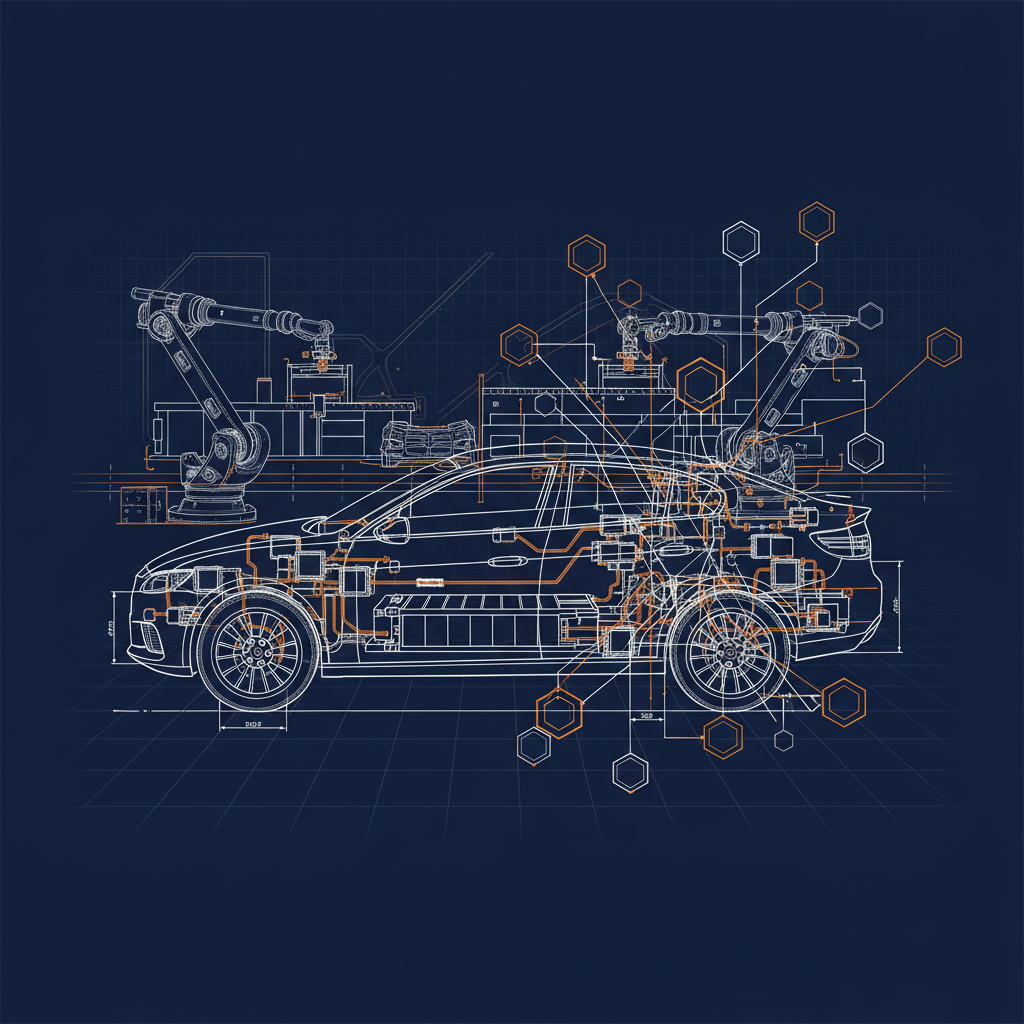
Of all the industries I run through Naftiko Signals, automotive is the one I find myself returning to most often. It is the most readable industry on the board right now, and the reason is simple — every legacy OEM is restructuring its software stack in public. They are not whispering about it in analyst briefings. They are posting it in job descriptions for principal engineers, naming the cloud providers in supplier press releases, and standing up developer portals with their own logos at the top. The rewiring of a hundred-year-old industry is happening one commit, one hiring requisition, and one OTA release note at a time, and Signals catches all of it.
The aggregate picture
The aggregate picture across the 43 automotive companies we pulled is a Total Signal Score of 8,464 across 41 scoring areas. The top categories tell you exactly where the industry has spent its money — Services (1,288), Data (641), Cloud (598), Operations (442), Security (365), Automation (349), and AI (323). That stack is the receipt for fifteen years of digital transformation. The enterprise software estate is mature, the cloud substrate is deep, and the data plumbing is real. What sits much further down the list — Specifications (29), Data Pipelines (41), Privacy & Data Rights (36), Domain Specialization (9) — is the rewiring that is still in progress, and it is the most strategically important gap in the dataset.
Three OEMs, three different bets
Inside that aggregate, no single company leads on every layer. Ford (1,671) leads the infrastructure profile — Operations (89), Code (56), Containers (32), Integrations (47), Observability (59), Data (136). It is the platform-first profile of a company that decided BlueOval Intelligence was going to be a real software platform, not a marketing deck. Toyota (1,462) leads the safety-and-compliance posture — Security (84), Governance (46), Regulatory Posture (17) — which is exactly the moat you want if you are planning to deploy AI into UNECE WP.29-regulated vehicle functions. BMW (1,377) leads the MLOps stack — Multimodal Infrastructure (18), Model Registry (17), AI Review & Approval (22), AI FinOps (9), CNCF (29). Three companies, three completely different bets on the future, all visible in the public signal.
The patterns are what make the read interesting. Software-defined vehicle architecture shows up as Code, Containers, and Platform scores clustered tightly across the top four — these companies have standardized container deployment for in-vehicle services. EV platforms show up as Apache and event-driven scores at Ford and Volkswagen — Kafka, Spark, and stream processing for telemetry coming off connected fleets. ADAS and multimodal AI show up in BMW’s Multimodal Infrastructure lead — camera, radar, LiDAR, GPS, and CAN bus all feeding the same model registry. OTA infrastructure surfaces inside the Observability and Operations layers, which is where the runway for safe over-the-air updates actually lives. And the dealer-to-vehicle data fabric sits underneath all of it — Salesforce, Oracle, ServiceNow, and ClickHouse showing up at near-universal adoption across the peer group.
What a Gartner report would miss
Here is what the public footprint shows that a Gartner report would miss. Tesla — total signal score 620 — is the lowest-scoring of the seven measurable automakers on nearly every dimension. Code (13), Containers (8), Security (20), Observability (20), Governance (15). The company whose vehicles ship more software than any competitor has the smallest public software signal in the peer group. That is not noise. It is the signature of a deeply proprietary, vertically integrated practice that doesn’t surface in shared developer tooling, open-source contributions, or job descriptions written in industry-standard language. The same data shows that Volkswagen leads Cloud and Services breadth but trails Ford and Toyota in API (8 vs 23 and 21) — a company with the largest enterprise software estate in the peer group that hasn’t yet translated it into a formal API platform. You don’t get those readings from a market report.
What’s next
What’s next for the industry is not another cloud migration. The top four already have the substrate. The two highest-leverage capability investments I would put in front of any automotive CTO today are streaming data pipelines that turn vehicle telemetry into AI-consumable surfaces in real time, and a specifications-and-governance discipline — OpenAPI, AsyncAPI, JSON Schema, model registries with lineage — that lets connected vehicles interoperate safely with insurance, navigation, smart cities, and third-party agents. That is the capability layer Naftiko was built to wrap around an existing API estate, and automotive is the industry where the substrate is most ready for it.
Full industry view: industries.naftiko.io/signals/automotive/QksQH2oVMj/