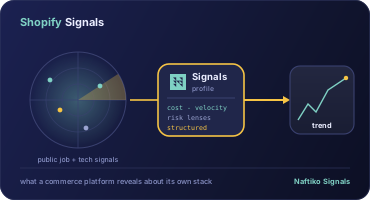
I find Shopify a strange and useful company to read through Naftiko Signals. Most of the companies I run through the Signals pipeline are pure consumers — they sit downstream of someone else’s API, and the public footprint tells me what they bought, what they built around, and what they’re hiring against. Shopify sits on both sides of the line. It is one of the most consumed commerce APIs on the planet, and it is simultaneously a buyer of hundreds of other people’s services to keep the platform running. That two-sided posture changes what the signals mean, and I think it’s worth walking through.
The headline number
The aggregate number is a total signal score of 1388 across 41 dimensions, with the heaviest weight sitting in Services (221), Data (98), Cloud (94), Operations (62), AI (60), and Security (53). That ordering tells you almost everything you need to know about how Shopify operates before you read a single press release. This is a company whose center of gravity is service consumption and data — not, interestingly, API production, even though API production is the actual product.
Three detections that stood out
Three detections stood out to me as I worked through the layers.
First, the data footprint is enormous and broad — Splunk, Tableau, Informatica, Apache Kafka, Apache Spark, Elasticsearch, MongoDB, ClickHouse, MySQL — but the corresponding Data Pipelines score is only 8, and the Specifications score is a 7. That gap is the story. Shopify has data at rest in every shape imaginable, and the pipes to move it around are still maturing. For a platform that wants to ship real-time merchant intelligence and agent-grade retrieval, the work isn’t to add another warehouse; it’s to formalize the streams and the schemas that flow into them.
Second, the AI posture is real but not yet productized internally. AI score of 60 across Azure ML, ChatGPT, Claude, Gemini, GitHub Copilot, Hugging Face, plus Kubeflow, PyTorch, and Semantic Kernel on the tools side. That’s a serious consumption pattern. But the AI Review & Approval score is 15 and Domain Specialization is a 2. Shopify is using everyone else’s models. The question the signals raise — and don’t yet answer — is whether commerce-specific fine-tuned models become a Shopify product, or stay an internal lever.
The platform inside the platform
Third, the developer surface tells on itself. Standards detected include GraphQL, REST, OpenAPI, HTTP/2, Protocol Buffers, JSON, and the API score is 19 against 221 services consumed. Shopify is famous for its GraphQL Admin API, and you can see it in the standards list — but the internal API footprint reads like a company that has not yet pushed the same connective discipline inward that it ships outward to merchants. That’s a familiar pattern in platform companies. The shipping product gets the love; the integration tissue behind the curtain gets bolted together as needed.
What’s next
What’s next, if I’m reading the navigation correctly, isn’t more tools. It’s two specific moves. Stand up an API-first internal integration layer so the 221 services Shopify consumes can be exposed to agents and partners through one consistent surface rather than 221 of them. And formalize an AI governance and review council that pairs the AI consumption (60) with the AI review discipline (currently 15) before regulators or merchants ask for it. Both are unglamorous. Both are the difference between an AI-capable commerce platform and a commerce platform that just happens to use AI.
The full read is at companies.naftiko.io/signals/shopify/nA22mYbWK3 — score breakdown, the 905 areas, the 144 tools, and the full 50-item navigation behind those recommendations.