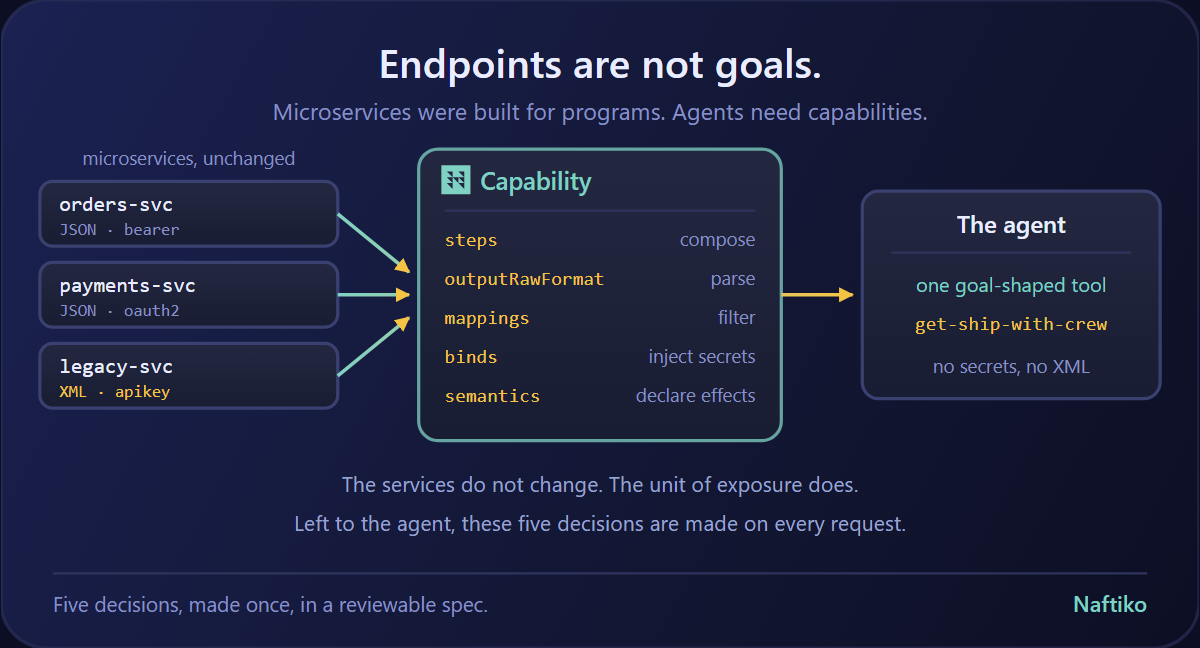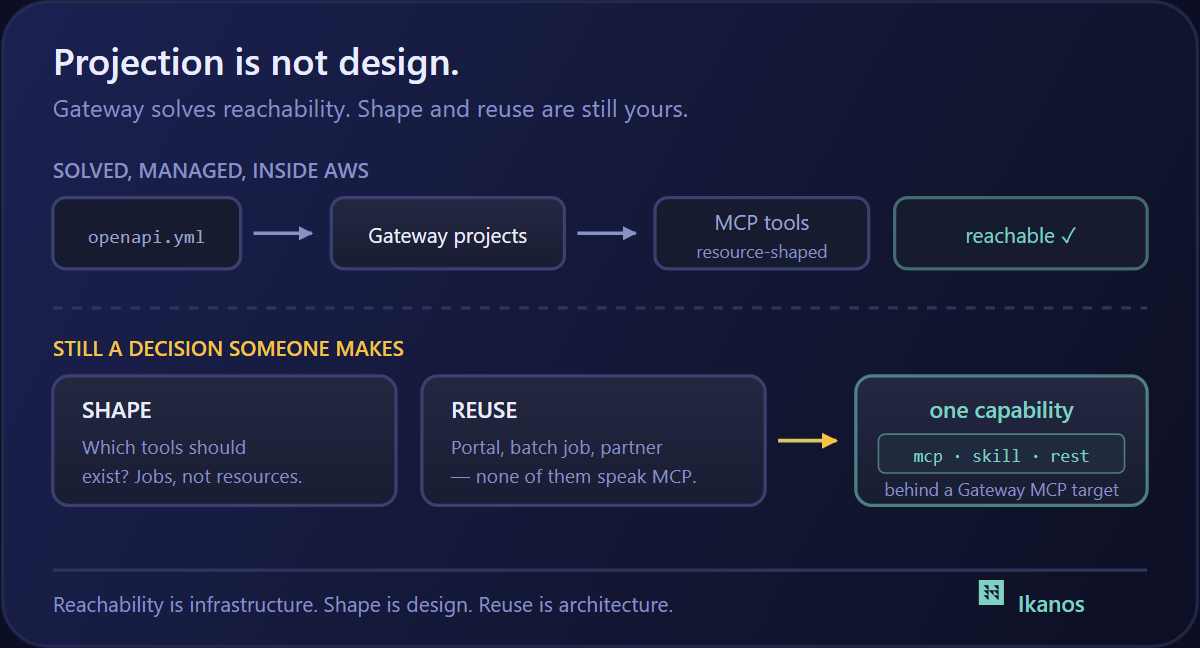
For most of the last two quarters, the Naftiko platform has been a set of working titles connected by a shared specification. Internally we knew what each piece did. Externally, the names changed depending on who I was talking to. That ends this week.
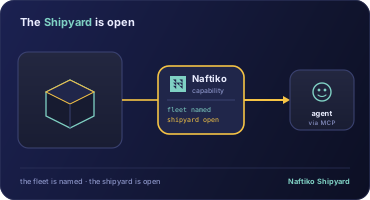
The Fleet has six components. Each one has a canonical name. All six are at v1.0.0-alpha3. And the front door for the whole thing — the documentation hub, the tutorial track router, the “what does this actually do” landing page — is Naftiko Shipyard, now open at shipyard.naftiko.io.
The Six Components
| Component | Purpose |
|---|---|
| Shipyard | Documentation hub — and soon a hosted Playground and AI-assisted Ask Navi search |
| Ikanos | The OSS capability engine — runs a Naftiko spec as a multi-protocol server |
| Polychro | The OSS deterministic AI-era linter for YAML, JSON, and Markdown specs |
| Crafter | The capability builder for VS Code and most AI IDEs — visual + spec-driven authoring |
| Warden | Capability governance and policy enforcement for Backstage |
| Skipper | Fleet-wide orchestration for Kubernetes, across teams, regions, and compliance domains |
The renames are not cosmetic. Each one sharpens the question the product answers. When someone asks “what runs the spec?” the answer is Ikanos. When someone asks “what catches the spec before it ships?” the answer is Polychro. When someone asks “where do I author it?” the answer is Crafter. When someone asks “what governs it inside Backstage?” the answer is Warden. When someone asks “what orchestrates the Fleet across teams and regions?” the answer is Skipper. And when someone asks “where do I land first?” the answer is Shipyard.
The names finally do the work the working titles couldn’t.
Spec-Driven Integration Is the Thread
The methodology that ties all six together is Spec-Driven Integration (SDI). SDI treats every integration as a declarative specification first: authored once, validated by a deterministic linter, executed by a deterministic engine, governed by deterministic policy, and orchestrated across the Fleet. Shipyard teaches SDI as the very first concept a new reader encounters, and the entire docs tree is organized around it.
The reason SDI matters is the reason every other approach has run out of road. Code-first integration produces drift the moment two teams ship in parallel. API-first integration loses the agent layer. MCP-first integration loses the API layer. SDI is the only posture where one specification — authored once in YAML — survives validation, execution, governance, and orchestration without losing fidelity at any handoff.
Ikanos and Polychro Stay Apache 2.0
The Fleet ships in three layered editions: Community (free forever, every component, Ikanos and Polychro under Apache 2.0), Standard (planned, team-grade features under the Naftiko Commercial License), and Enterprise (planned, governance and scale for regulated environments). The editions are layered, not exclusive — anything authored in Community runs unchanged in Standard or Enterprise. Capability YAML, rulesets, and policies are forward-compatible across editions.
The open-source commitment underneath all of this is straightforward: Ikanos and Polychro are committed to staying 100% Apache 2.0 in every edition of the Fleet, forever. That commitment is what funded this week. It is also what makes Shipyard a real front door rather than a marketing surface — the thing visitors are landing on is documentation for software they can run today, without paying anyone, under a permissive license.
What Comes Next
- Alpha 4 (mid-June 2026) — MCP trust propagation, API-gateway integration (CORS for developer portals, OpenTelemetry context propagation, mTLS client certificates, HTTP cache-control directives), and the first A2A server adapter with native Langchain4j integration.
- Beta 1 (end of June 2026) — Stable MVP target: interactive MCP Apps, server-side code-mode for MCP, client-SDK generation across TypeScript / Python / Java / Go, authorization via Open Policy Agent. The Shipyard Playground and Ask Navi search ride that same train.
- General Availability (September 2026) — Production-ready v1.0 across the Fleet.
The full plan is public: the Ikanos / Framework Roadmap and Fleet Roadmap are both updated weekly and cross-linked from Shipyard.
Land in the Shipyard
If you have been following Naftiko on Substack or LinkedIn but have not yet seen the open-source surface up close, this is the week to do that. Twenty minutes in Shipyard — read the SDI overview, scan the six-component table, pick one tutorial track that matches the pain you came in with — and the next conversation we have will be on common ground.
The working titles are gone. The Fleet is named. The front door is open.