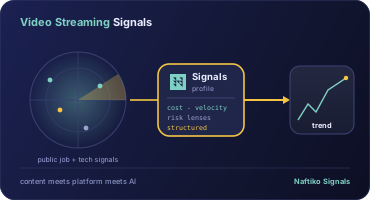
I have been reading streaming company tech blogs for almost as long as I have been writing about APIs. For a long stretch, the Netflix tech blog was the industry’s textbook — chaos engineering, Hystrix, Zuul, Conductor, the entire microservices vocabulary that the rest of us are still cleaning up after. So when I turn Naftiko Signals on the Video Streaming industry, I am not coming at it cold. I want to see whether the public footprint of these companies — their job postings, press releases, repos, and standards work — still matches the story they tell about themselves on stage, and where content, platform, recommendation, and ad tech are actually colliding right now.
The aggregate picture
The aggregate picture across 22 companies is a 16,633 total signal score, which makes Video Streaming one of the most technology-intensive verticals in the dataset. The categories that float to the top are not surprising in order, but they are revealing in magnitude — Services at 2,566, Data at 1,306, Cloud at 1,151, Operations at 858, and Automation at 686. AI lands at 630, sitting right alongside Security at 648. That ordering is the story. This is an industry where SaaS-saturated workflows, data infrastructure, and 24/7 operations are the load-bearing investments, and AI is being layered on top of them rather than swapped in.
Who leads which layer
Warner Brothers, Netflix, and Hearst keep showing up at the top of the layers. Warner Brothers leads cloud (133), data (130), and services (266). Netflix leads open-source (44), platform (41), APIs (27), and CNCF (28). Hearst — the one a lot of people would not guess — ties or leads on automation (56), containers (31), operations (67), and AI review and approval (17). Comcast quietly dominates security (68) and observability (45), which makes sense the moment you remember Comcast is also an ISP carrying the bits.
What the detections actually say
The specific detections are where it gets interesting. Video transcoding and media encoding both show up as named areas across the cohort, which is the public surface of an enormous compute-and-CDN problem hiding behind every Play button. Content Delivery Networks register at 238 companies sector-wide — that is not a Netflix anomaly, it is table stakes. ClickHouse appears at universal 16-company adoption, which is what happens when high-cardinality viewer telemetry and ad performance data become the daily workload. Kotlin is universal too — a clean tell that mobile and JVM platform work is non-negotiable for anyone shipping to phones, smart TVs, and game consoles. And the Semantic Kernel signal showing up across all 16 streamers tells me Microsoft’s AI orchestration framework is being quietly evaluated as the glue for the next round of copilot and agent experiences inside content tools.
The privacy debt the trade press misses
What the footprint reveals that the trade press misses is the privacy gap. The trade narrative right now is all about AI-driven recommendation, generative production tools, and the streaming wars. The signals tell a different story underneath. Data scores are massive — Warner Brothers at 130, Netflix at 122, NBC at 113 — and Privacy and Data Rights aggregates to only 66 across the entire industry. Hearst, Warner Brothers, and NBC tie for the top privacy score at 5 each. For an industry sitting on the richest behavioral dataset in the consumer economy, that is not a rounding error, that is a governance debt that is going to show up as either regulation or a breach before it shows up as a strategy. The other quiet finding is the flat 2-point Domain Specialization score across the leaders — meaning purpose-built vertical AI models for streaming (content-aware encoding, genre-specific recommendation, character recognition for IP protection) are still mostly slideware.
If I were writing the industry-level capability recommendations, I would start with two. First, a privacy-and-data-rights capability that sits between the streaming analytics stack and the recommendation/ad-targeting layer — purpose-built for the data this industry actually collects, not a generic enterprise privacy console retrofitted to it. Second, an AI FinOps capability scoped specifically to video workloads, where encoding compute, inference at viewer scale, and recommendation serving collide on the same bill. Both are categories the generic vendors have not closed.
You can see the full industry view here: https://industries.naftiko.io/signals/video-streaming/04XrffHTeP/.