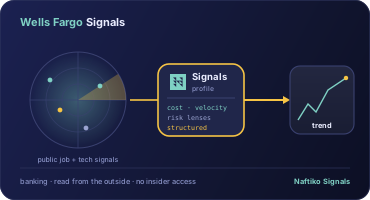
I spend a lot of time staring at companies I will probably never have a meeting with — and Wells Fargo is the kind of institution that makes that exercise interesting. A national bank that touches one in three American households and over ten percent of small businesses in the country is not just a company, it is a piece of infrastructure. The technology, business, and political posture of a bank like that ripples outward into how the economy actually moves. So when I look at Wells Fargo through Naftiko Signals, I am not trying to score them like a stock — I am trying to read what their public footprint says about how an enterprise of that scale is actually wiring itself for the next decade.
The headline number
The headline number from the read is a total signal score of 1656 across forty-one dimensions. That alone tells you something — this is a deep, broad enterprise surface. The signal does not concentrate in one place, it spreads. The top categories — Services at 212, Data at 129, Cloud at 126, Automation at 86, Operations at 86, and Security at 82 — are the shape of a classic large-bank stack. Lots of SaaS, lots of analytics, real cloud commitment, hardened operations, and a deep security posture. None of that surprises anyone who has walked the halls of a Tier-1 bank. What is more interesting is what sits inside those buckets.
Inside the stack
On the cloud line, the detections name Amazon API Gateway, Amazon ECS, Amazon Kinesis, Amazon S3, Azure Active Directory, and Azure Data Factory — a real multi-cloud stance, not a slide-deck one. On the data line, the same pattern repeats — Databricks, Snowflake, Power BI, QlikSense, plus the full Apache analytics catalog from Hadoop and Hive through Iceberg, Kafka, NiFi, and Spark. That is not a shop that picked a lane. That is a shop that bought everything that worked and is now living with the integration tax. The AI footprint, scoring 67, leans on Azure Machine Learning, Databricks, GitHub Copilot, Hugging Face, Microsoft Copilot, and OpenAI, with PyTorch, TensorFlow, Semantic Kernel, and Kubeflow underneath — broad consumption, no obvious house bet. And on the standards side, the governance signal pulls in ISO, ITIL, ITSM, NIST, Lean Six Sigma, and RACI — the unmistakable vocabulary of a regulated institution that knows how to write a control framework.
What the analyst desk would miss
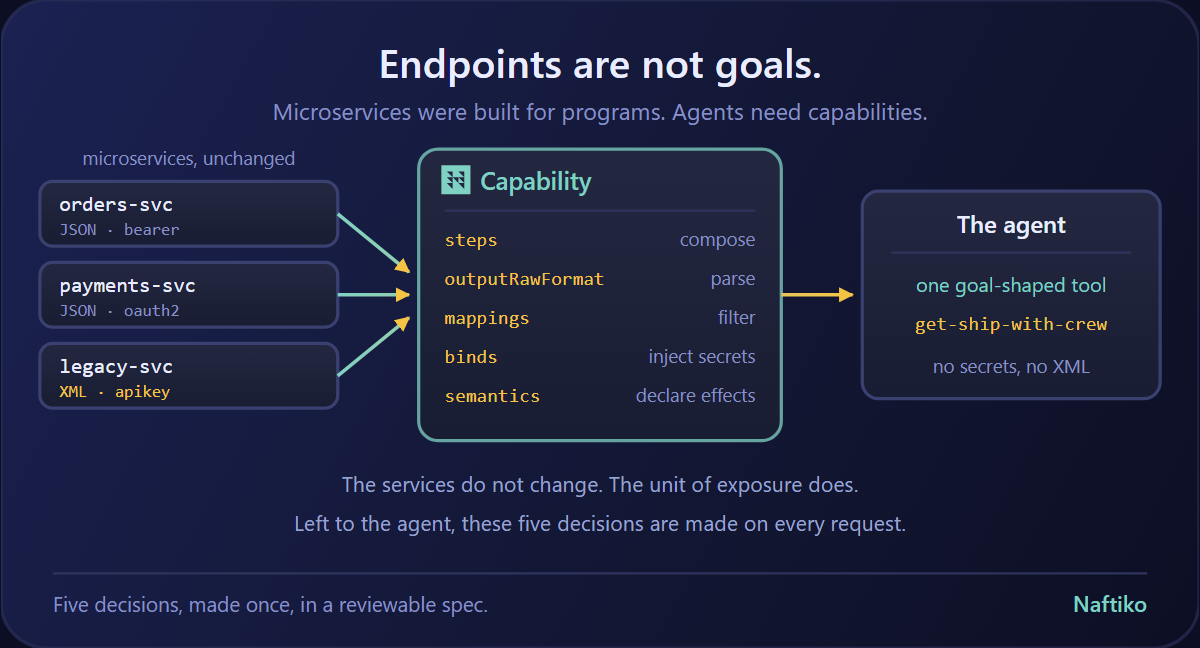
Here is what an analyst desk would miss. The story is not in the cloud spend or the AI tools — those are table stakes. The story is in the gap between the bank’s data muscle and its connective tissue. Data scores 129 and Services scores 212 — meaning the bank is consuming an enormous amount of information and running an enormous amount of software — but the API score is 20, Integrations is 36, Specifications is 10, and Event-Driven is 23. That is the shape of an organization with extraordinary raw material and not enough pipes to move it. It is the kind of imbalance that does not show up in an earnings call, but it is exactly what determines whether the AI investments of the next three years actually compound or just sit there.
What’s next
Naftiko’s read closes with three specific moves — establish an API-first integration layer to give those 212 services reusable connective tissue, stand up a formal AI governance and review council to match the AI Review score of 19 against the AI adoption score of 67, and invest in real-time data pipelines and event streams to close the gap between data maturity and real-time AI. None of those are exotic. All of them are the unsexy plumbing work that determines whether a bank of this size compounds its existing investment or quietly loses ground to institutions that did the boring integration work first.
You can read the full Wells Fargo signal landing page — every layer, every score, every detection — at companies.naftiko.io/signals/wells-fargo/abiVHRWEMQ/. The point of this exercise is not to grade Wells Fargo. The point is to show that you can read an enterprise of that scale from the outside, in public, using nothing but the signal it already leaks — and that the picture you get is often more honest than the one inside the building.