

How organizations can move from API chaos to strategic clarity—and why the old playbooks no longer apply.
Every platform leader eventually faces the same uncomfortable question from the executive floor: "Are we actually getting value from our API investments?"
It sounds simple. It isn't.
Riley, a head of APIs at a mid-sized enterprise, recently found herself in exactly this position. Leadership wanted to know how well the organization was reusing APIs and what incentives existed to improve. Meanwhile, down the hall, Laura—the head of AI—was wrestling with a parallel challenge: teams across product, support, sales, and engineering were independently adopting third-party MCP servers, and no one had a clear picture of the security, cost, or compliance implications.
These aren't isolated problems. They're symptoms of the same underlying gap: organizations have invested heavily in building APIs and enabling AI integrations, but haven't yet built the governance muscles to ensure those investments compound rather than fragment.
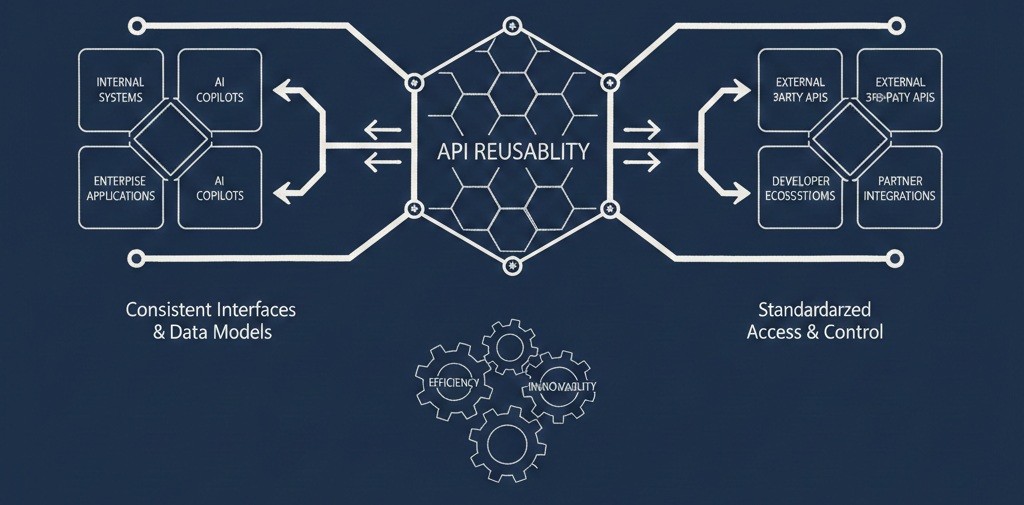
The API Reuse Problem No One Knows How to Measure
Here's the uncomfortable truth about API reuse: most organizations can't even agree on what it means.
Riley's team has a catalog of APIs defined as OpenAPI specs for specific domains. That's more than many organizations have. But when asked to report on reuse, the conversation stalls. Does reuse mean the same endpoint is called by multiple consumers? Does it mean developers are extending existing APIs rather than building new ones? Does it mean properties and schemas are shared across domain boundaries?
The answer, of course, is "it depends." And that ambiguity creates real consequences.
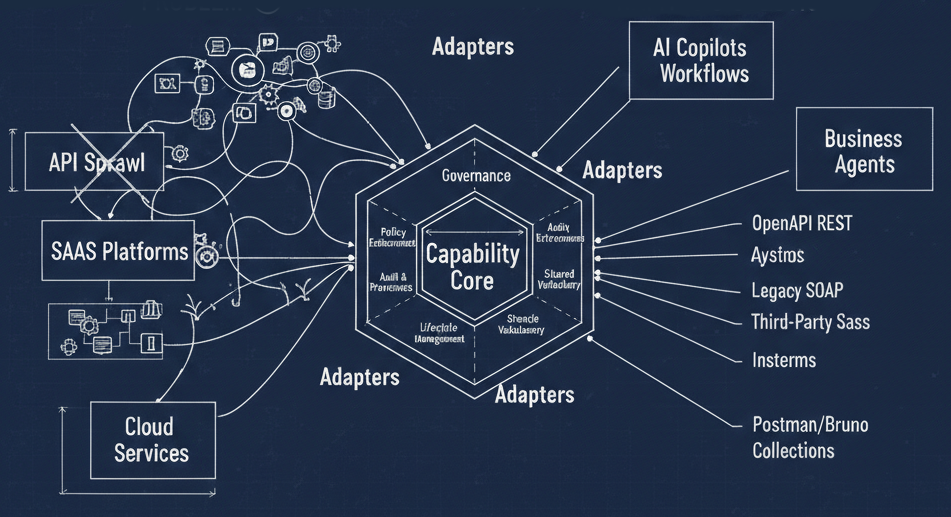
The visible costs are obvious: redundant APIs proliferate. Properties that should be standardized exist in five slightly different variations. Infrastructure sprawls as each team maintains their own version of what is essentially the same capability.
The invisible costs are worse. Developers can't discover internal or third-party APIs from their IDE or copilot. They build what already exists because finding it would take longer than rebuilding it. Every new project inherits the technical debt of the last one.
The instinct here is to reach for metrics—to define KPIs, build dashboards, and track reuse percentages. But API reusability isn't fundamentally a metrics problem. It's a discovery, incentive, and design problem that metrics can help illuminate but never solve on their own.
What actually moves the needle:
- Discovery at the point of need. If developers can't find existing APIs from within their workflow—their IDE, their copilot, their design tools—they won't reuse them. Catalogs that require context-switching get ignored.
- Incentives aligned with behavior. Telling developers to "reuse more" while rewarding them for shipping features fast creates predictable outcomes. Organizations that succeed at reuse make it the path of least resistance, not an additional burden.
- Governance that enables rather than restricts. The goal isn't to prevent teams from building new APIs. It's to ensure they have the information and tooling to make intentional choices about when to extend, when to reuse, and when to build net-new.
The MCP Server Governance Gap
Meanwhile, Laura is watching a different kind of fragmentation unfold in real time.
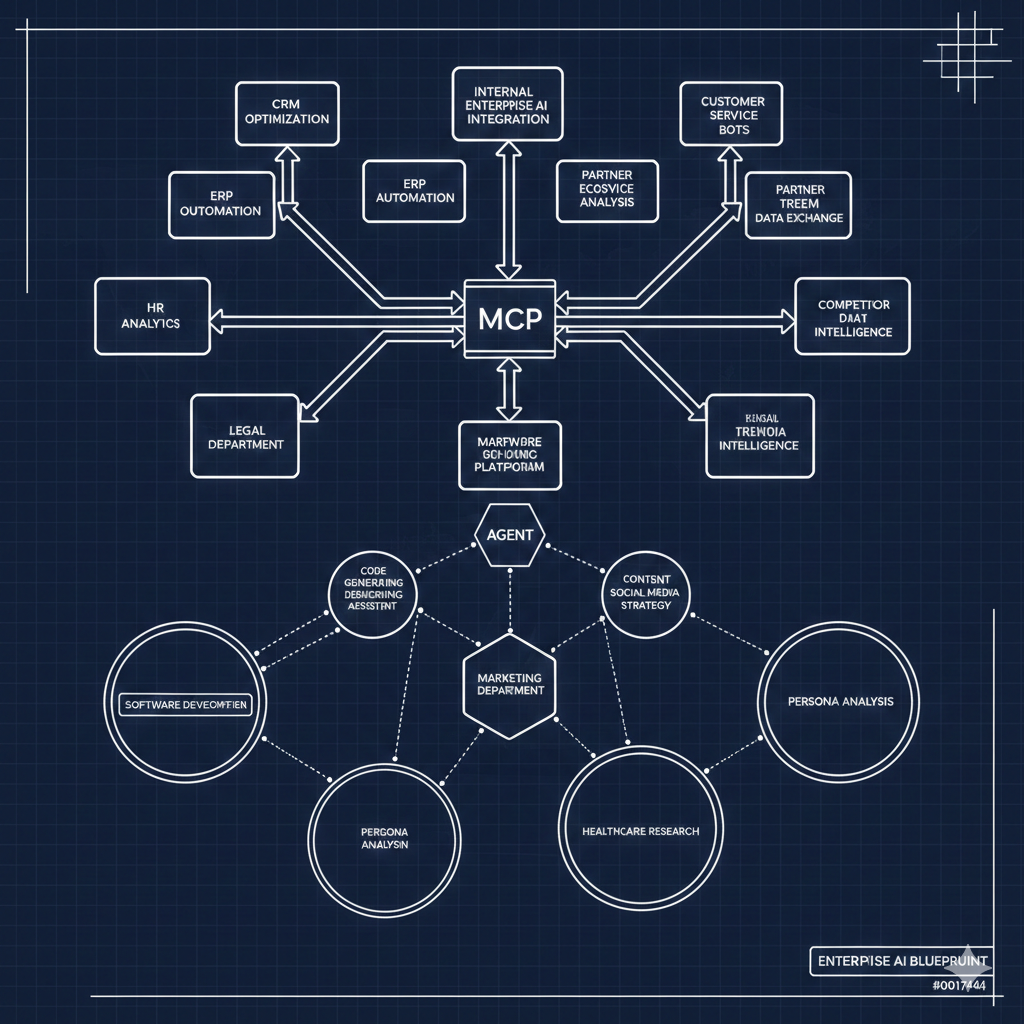
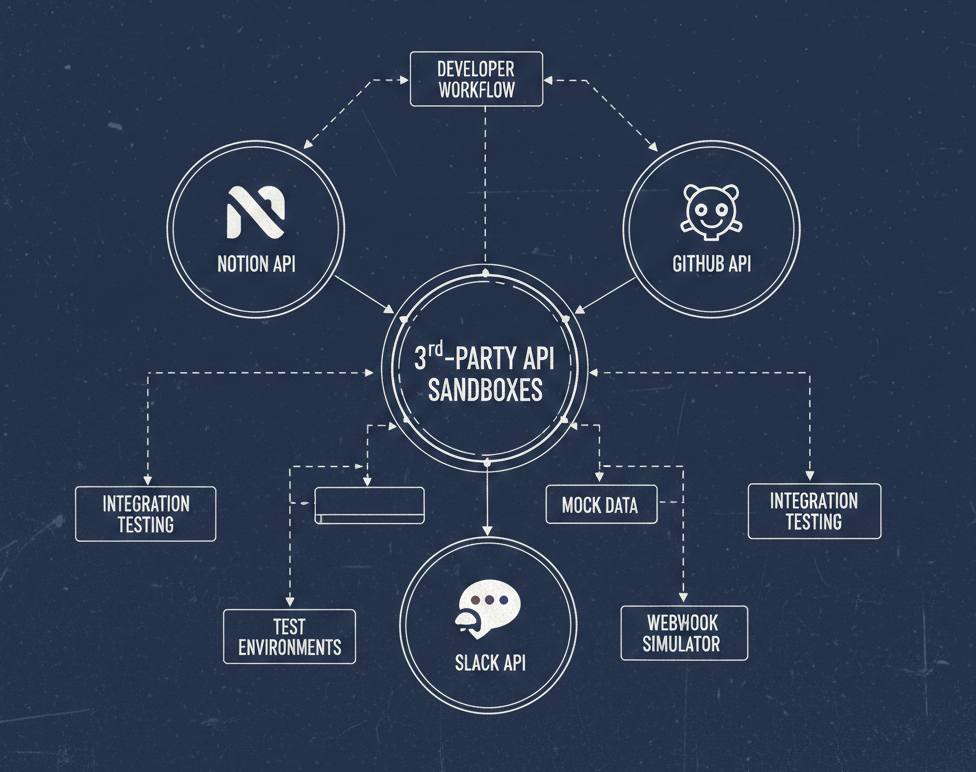
Model Context Protocol (MCP) servers have become the connective tissue between AI assistants and external services. They're powerful. They're flexible. And in most organizations, they're being adopted with almost no central visibility.
Product teams connect their copilots to one set of third-party services. Support teams use another. Sales has their own integrations. Engineering discovers useful MCP servers on GitHub and starts using them in development workflows.
None of this is malicious. It's what happens when useful technology meets distributed decision-making. But the cumulative effect is significant:
Security and privacy risks multiply. Each ungoverned MCP server connection is a potential vector for data exposure. Without centralized authentication and access controls, sensitive information flows through channels no one is monitoring.
Cost visibility disappears. Third-party services accessed via MCP servers often have usage-based pricing. When every team manages their own integrations, finance loses the ability to forecast, optimize, or even understand AI-related spend.
Compliance becomes guesswork. Regulatory requirements don't care about organizational silos. If customer data passes through an MCP server that hasn't been vetted for compliance, the organization—not the individual team—bears the liability.
The solution isn't to ban MCP servers. That would be like banning APIs a decade ago—theoretically possible, practically counterproductive. The solution is to build governed pathways that make compliant usage easier than ungoverned usage.
This means:
- Centralized discovery. Teams need a single place to find approved MCP servers, understand their capabilities, and see what authentication is required.
- Standardized onboarding. Connection to third-party services should flow through established security and compliance checkpoints—not as a blocker, but as a streamlined process that reduces friction rather than adding it.
- Visibility without micromanagement. Leaders like Laura don't need to approve every MCP server connection. They need dashboards that show what's being used, by whom, at what cost, and with what risk profile.
Two Problems, One Governance Philosophy
On the surface, API reuse metrics and MCP server governance look like separate challenges. One is about internal efficiency; the other is about external risk management.
But they share a common root: organizations need mechanisms to turn distributed technical decisions into coherent organizational outcomes.
The platforms that will succeed over the next decade aren't the ones with the most APIs or the most AI integrations. They're the ones that can answer basic questions about their technical landscape: What do we have? Who's using it? What's it costing us? Where are the risks?
These questions require governance. Not governance as bureaucracy, but governance as clarity—the ability to see the system as a whole and make informed decisions about how it should evolve.
For Riley, that means moving beyond the question of "how do we measure reuse?" to the question of "how do we make reuse the natural choice?" For Laura, it means moving beyond "how do we control MCP server access?" to "how do we enable safe, productive AI integration at scale?"
Both paths lead to the same destination: organizations that can move fast precisely because they understand what they're building on.
Where to Start
If you're facing similar challenges, resist the urge to solve everything at once. Start with visibility.
For API reuse:
- Audit your current catalog. What's documented? What's discoverable? What's actually being used?
- Talk to developers about their discovery experience. Where do they look for existing APIs? What would make reuse easier?
- Define reusability in terms that make sense for your organization—then measure those specific dimensions rather than chasing abstract metrics.
For MCP server governance:
- Inventory current third-party integrations. Which teams are using which services? Through what mechanisms?
- Assess risk by service. Not all MCP servers carry the same compliance or security implications. Prioritize governance efforts accordingly.
- Design an onboarding process that developers will actually use. If the governed path is slower than the ungoverned path, governance will fail.
The goal in both cases is the same: create the conditions where good decisions become easy decisions. Everything else follows from there.