
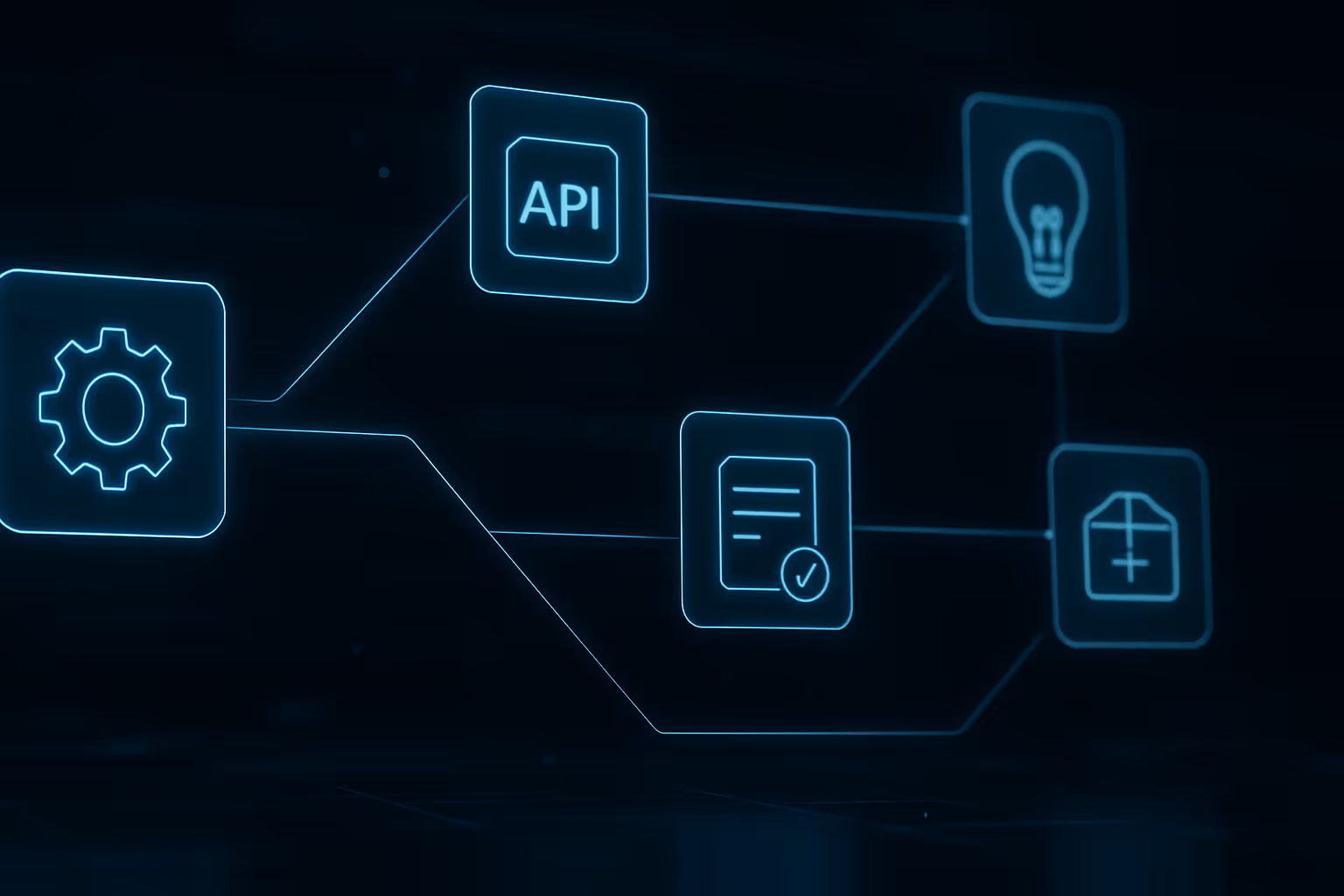
Modern software delivery is buckling under the scale, complexity, and sprawl of the systems we’ve stitched together. We have more APIs, services, data pipelines, and integrations than ever before—but building and connecting systems feels harder, not easier. As organizations push to adopt AI, automate with agents, and leverage years of API investments, our traditional interface designs are hitting their limits. The result is a growing sense of strain and fragmentation.
This is where capabilities enter the conversation. Capabilities are open-source, declarative, standards-based integrations aligned with business outcomes within specific domains. They provide the building blocks needed to deliver and automate integrations across countless internal, partner, and third-party systems. Capabilities help rebalance how we think about and execute integrations across the sprawling ecosystems we depend on.
Beginning with capability thinking
Capabilities start with a mindset shift. Capability thinking moves our focus from APIs, endpoints, and resources to the higher-level business functions that actually matter. Instead of designing around tables or CRUD operations, we design around outcomes.
Capabilities become the primary building blocks of a platform—not low-level resources, but clear expressions of what the business can do.
“Capability Thinking reframes the unit of design. Instead of exposing granular resources, platforms describe discrete business functions such as Ship Order, Process Payment, or Approve Loan.” — Daniel Kocot Daniel names the obvious truth: we don’t integrate just because APIs exist—we integrate to achieve business outcomes. This shift in focus is essential for defining, delivering, and sustaining integrations across diverse services, establishing a shared way of thinking about what our systems are capable of.
What is a capability?
To ground our approach to system and data integrations, it helps to return to the simplest definition of the word:
- “The power or ability to do something.”- “The extent of someone’s or something’s ability.”Across modern platforms, however, a capability has become something richer:
“Think of a capability as a self-describing, semantically rich declaration of what a system can do—not just how to invoke it.” — Christian Posta A capability is both human-readable and machine-executable. It explains itself. It carries semantic meaning. It can be composed, automated, reused, governed, and observed. In a world of AI agents, event-driven systems, and interconnected ecosystems, capabilities become the logical unit of work and interaction.
What makes a good capability?
A capability is not just a label. It is a strongly typed, governed, standardized set of artifacts. Mature capabilities have qualities that make them predictable, reusable, and understandable across teams, tools, and domains.
Good capabilities are:
- Business-aligned, with intuitive metadata, clear boundaries, and domain language- Human- and machine-readable, discoverable, and semantically meaningful- Composable and reusable, interoperable with other capabilities- Declarative, event-driven, automated, and predictable- Governed, policy-driven, secure, role-aware, and monitored- Executable, shareable, versioned, and lifecycle-aware- Integrated across APIs, data connections, file systems, and protocols- Collaborative, bringing product, engineering, and domain experts together- Insightful, observable, and traceable everywhere they runWhen fully realized, capabilities become the connective tissue of digital ecosystems—something both engineers and business stakeholders can define, own, and use to automate tasks within their domains. This makes it significantly easier to integrate AI into real operational workflows.
Why capabilities matter today
Simply having APIs is no longer enough. AI agents must navigate systems based on what they can do, not which endpoints they expose. Event-driven architectures require predictable, well-defined reactions to signals. Business teams need abstractions aligned with how they actually think. Automation demands repeatable, composable units of work—with or without AI.
Capabilities deliver all of this.
“When the client is autonomous, your API has to be more than a list of endpoints. It needs to be a menu of possibilities.” — Mike Amundsen Capabilities express intent. Intent fuels automation. Automation fuels scale. Paired with a federated platform like the Naftiko Engine, capabilities become the path to new functionality, new automation, and new AI-driven behaviors. As Mike Amundsen suggests, when AI consumes your APIs, capabilities transform your API catalog into a menu of what your enterprise is actually able to do.
A capabilities-driven future
As ecosystems expand and AI adoption intensifies, capabilities are emerging as the natural evolution beyond APIs and microservices. They provide a common language that aligns engineering, product, and business around what truly matters: the outcomes an enterprise platform delivers.
Capabilities build on familiar standards like OpenAPI, AsyncAPI, and JSON Schema, while speaking modern client formats like Postman and Bruno. At the same time, they embrace emerging standards such as MCP and Agent-to-Agent, extending your existing integration practices into the future.
Capabilities help you extend your legacy, engage with today’s ecosystem, and prepare for the standards and automation patterns just around the corner. They offer a way to unify how organizations describe, govern, and execute what they are able to do—today and in the years ahead.