
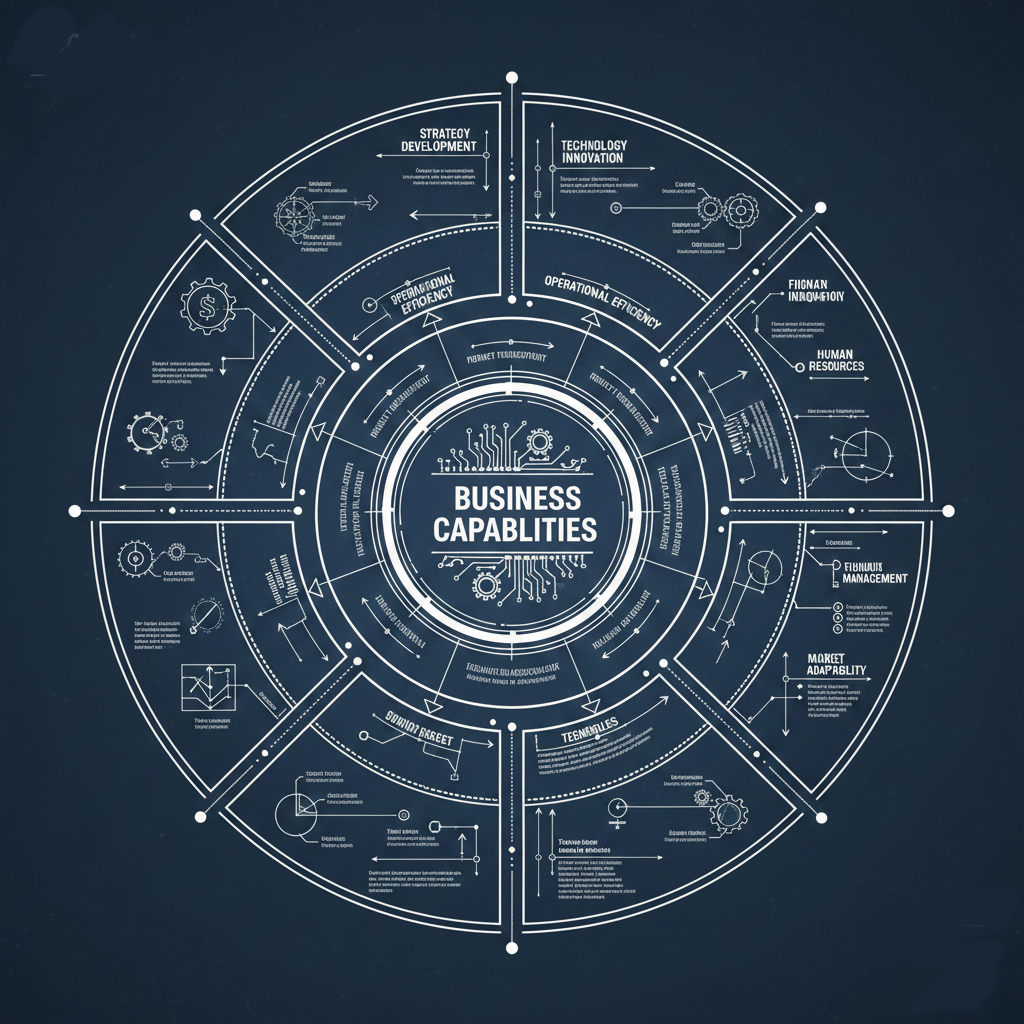
This is a summary of a conversation between Kin Lane and Claire Barrett, where Kin asked Claire, what is a capability, to better understand the definition from an economic and strategy perspective.
Core Definition
When we talk about a business capability, syntax is important. It’s a thing that gets done—a function that’s abstract in nature. For the grammatically curious, a capability is usually expressed as a compound noun (mix of one or more nouns and/or a verb in noun form i.e. a gerund).
Examples:
- Customer order management- Payroll processing- Identity access management
Business Architecture Perspective
Business capabilities make sense to people who think logically and like to categorise and subdivide things in structured ways.
Most organizations, when distilled down to the essence of what they do, have business capability models at the higher levels that look remarkably similar to those in similar lines of business. It’s equivalent to P&Ls and balance sheets having similar categories and layouts to peer businesses. Heavy industries might have much more detail around asset management or capital investment. Financial services more on income margins and loan quality. Digital businesses on customer processes etc.
But their detail all falls into categories familiar to anyone with financial accounting training and experience.
The same goes for business capabilities. Organisations essentially all have the same core business capabilities—albeit labelled differently and/or showing up at wildly different levels of granularity. They typically include:
- Customer management- Supplier management- Product management- People / employee management- Financial / legal / investment management.
Where Differentiation Occurs
Business capabilities start varying when you get more specific. For example:
- Financial services capabilities look different between investment and retail banking; between insurance and credit services; or between leasing and wealth management.- Manufacturing/distribution/retail businesses will vary between, say, process manufacturing, luxury goods, or mining. Each variation will have more or less detail in particular areas.
Primary Purpose
It’s important to note that there’s no single “right or wrong” business capability model. It is a way of representing the business in a way that makes sense for managing technology and the business processes and data around those technologies.
It is ultimately about helping decision-making. Otherwise it risks being just a tagging mechanism for, say, tech assets in a particular area.
A business capability has a one-to-many relationship with the technologies that underpin it.
In theory, business capabilities should be of roughly the same “size” (level of organisational complexity, tech footprint, funding / product investment etc). However, this rarely exists in reality across all parts of a business. High numbers of tech teams, vendors, and other factors mean that many organisations have less than “pure” business capability models to accommodate different SaaS solutions, outsourced capabilities, or partnering models that may not neatly fit an idealised or theoretical business capability hierarchy.
But at the end of the day, the business capability model is a way of partitioning the organization into a set of things that allow you to plan, prioritize, and manage your IT-related investments, landscape, etc.
How To Use Them
Business capabilities are essentially a tagging system for all of your tech.
In a mature business, it can inform choices around your technology organization structure, for example deciding what technologies get looked after by whom and for what reason.
There are always gray areas. For example:
- “Where do we put ServiceNow?” It depends on which bits of ServiceNow you’ve implemented and what they do.- “How do we tag the Salesforce chatbot?” It depends on what business capability it’s enabling.- “Should we include the technology only used by our third party service provider?” It depends on who’s accountable for it when it breaks.
The Conversation Framework
Importantly, the business capability model is a place where you can have constructive and evidence-based conversations between:
- People seeking to improve, simplify, and mature the technology landscape- People trying to manage it- People trying to deliver new features and functions
Culture Matters
Depending on the strength with which your business capability model is used to inform, provide feedback, or serve as a sounding board for how your business operates, what you do with it very much depends on the culture of your organization.