As we map out the next phase of the Naftiko roadmap, one question keeps surfacing in our planning sessions: how do we protect the sustainability of our business while staying true to the open-source is so important to us and our customers?
If you’re running a commercial open-source startup, you’ve probably wrestled with this same tension. You want the community engagement, the transparency, and the collaborative energy that open source brings. But you’ve also watched companies pour years of work into projects only to see cloud giants spin up competing services overnight, contributing little back while capturing enormous value.
After months of research, we recently got introduced to Fair Source, and here’s what we’ve learned and why it might be right for us.
What Fair Source Actually Is
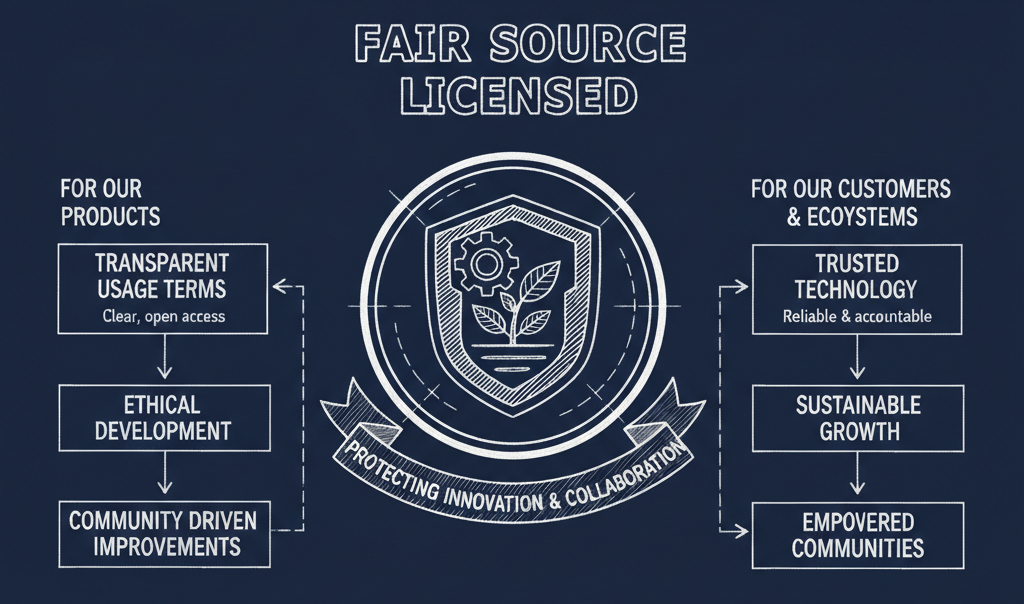
Fair Source isn’t trying to replace open source—it’s offering a middle path. The core idea is elegantly simple: you get most of the benefits of open source (view the code, modify it, distribute it), but with one key restriction: no one can build a competing commercial service using your software for the first two years.
After those two years? The code automatically converts to MIT or Apache 2.0. Full open source, no strings attached.
Think of it as a “timed core” rather than the traditional “scoped core” of Open Core models. Instead of keeping specific features proprietary forever, you’re keeping recent developments proprietary temporarily.
Why This Matters for Our Roadmap
We’ve are following CNCF’s lead and adopting the Apache 2.0 license as the default, which we believe will serve us well when it comes to building our open-source core. But as we plan for growth, three realities are becoming impossible to ignore.
The sustainability equation doesn’t balance. We’re a small team competing for talent with companies that could take our code tomorrow and outspend us on marketing, infrastructure, and sales. Our runway isn’t infinite, and our investors aren’t patient forever. We need a model that lets us capture enough value to keep building.
Open Core feels like the wrong tradeoff. The traditional Open Core approach—keeping premium features closed—creates friction we don’t want. It fragments our codebase, complicates our development workflow, and creates an awkward dynamic with our community. Contributors can’t see or improve the “good stuff,” and users feel like they’re getting a crippled version.
We’re not anti-competition; we’re anti-free-riding. We’d welcome competitors who build on our work and contribute back. What we can’t sustain is asymmetric competition where someone else monetizes our innovation while we bear the cost of development.
What Makes Fair Source Compelling
After digging into the details, several aspects stand out.
Single repository, single workflow. Unlike Open Core, everything lives in one place. The community can see all the code, file issues against it, and even contribute to the newest features. The only restriction is commercial competition, not visibility or collaboration.
The two-year conversion is a feature, not a bug. Some see the automatic open-source conversion as a weakness, but we see it as a trust signal. We’re committing to eventual full openness. We’re just asking for a head start.
It’s legally mature. The FSL and FCL licenses are concise, well-drafted, and designed by experienced legal minds. They’re not the experimental license experiments of five years ago. Companies like Sentry have already adopted them, which gives us confidence in their enforceability.
It handles the bankruptcy scenario. If we fail, our community isn’t left stranded. The code will become fully open source on a predictable timeline. No acquisition drama, no license hostage situations.
The Honest Tradeoffs
We’re not naive about the downsides.
We’ll need a CLA. Managing contributions under Fair Source requires a Contributor License Agreement. That’s friction, and some contributors will walk away over it. We accept that.
Some community members will be disappointed. Purists will argue this isn’t “real” open source, and they’re technically right. We’ve decided we can live with that tension if it means we’re still building in two years.
We’re betting on our own velocity. The two-year moat only matters if we keep shipping. If we stagnate, competitors could simply wait us out. That’s pressure we’re choosing to embrace.
The governance is still emerging. Fair Source as a movement is young. There’s no established foundation or trademark protection yet. We’re early adopters, with all the risk that implies.
What We’re Asking Ourselves
Before we commit, we’re working through a few key questions.
Does the two-year timeline fit our market? In fast-moving spaces, two years is an eternity. In enterprise infrastructure, it might be just right. We need to understand our specific competitive dynamics.
How will our existing community react? We’re planning to have these conversations openly before any switch. Surprising people with a licensing change is a fast way to destroy trust.
Are there hybrid approaches worth considering? Fair Source isn’t all-or-nothing. We could maintain an open-source core with a Fair Source shell for new premium capabilities. Or we could start new projects under Fair Source while keeping existing ones under their current licenses.
Where We Are Now
We haven’t made a final decision, and we won’t rush one. Licensing is one of those choices that’s easy to get into and hard to get out of.
But as we plan our roadmap—we are thinking about the features we want to build, the team we want to grow, and the company we want to become—Fair Source is very much on the table. It feels like a model designed for companies exactly like ours: committed to openness, but realistic about sustainability.
If you’re in a similar position, we’d encourage you to dig in. Read Dieter Platnik’s post. Look at who’s adopting them and why. Think about what your community actually needs versus what licensing ideology demands.
The goal isn’t purity. The goal is building something that lasts.
We’ll share our final decision and reasoning when we’ve reached it. In the meantime, if you have experience with Fair Source or similar licensing models, we’d love to hear from you.